
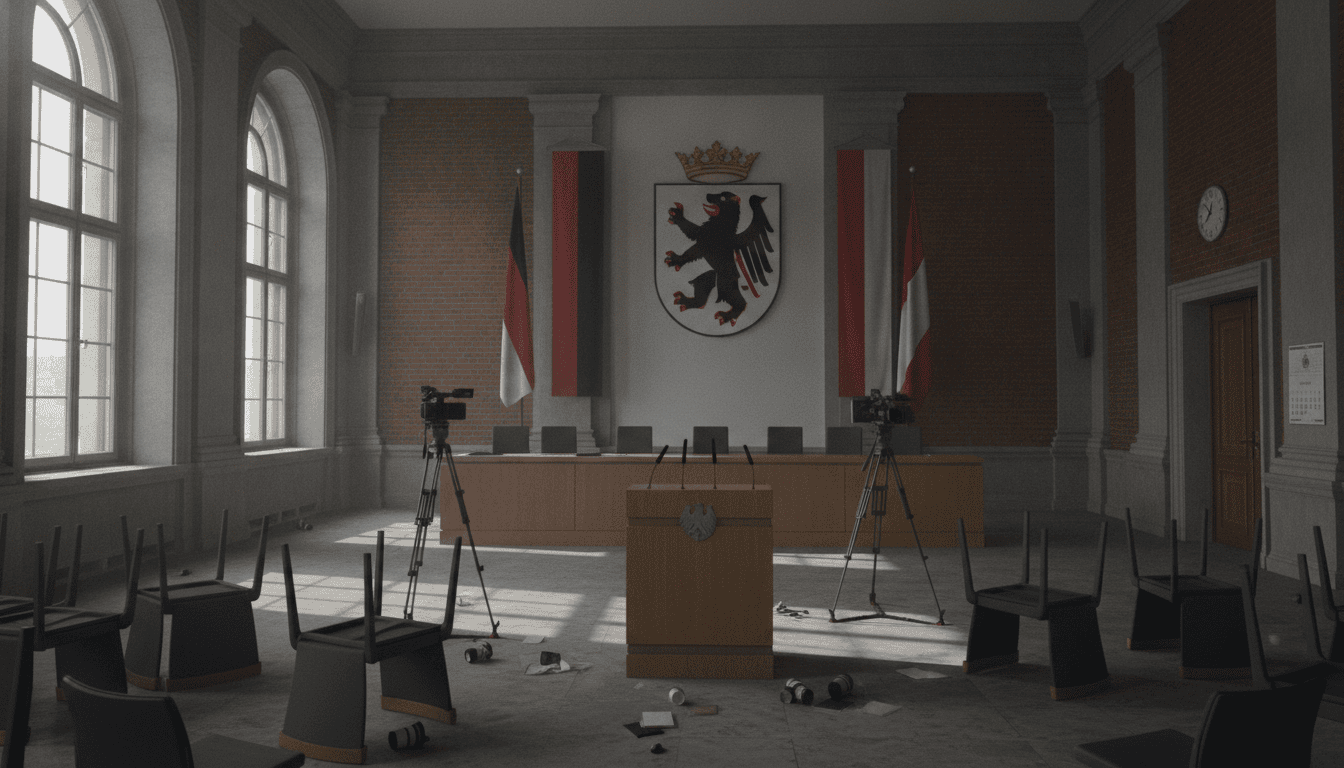
Kai Wegner resignation leaves Berlin politics at a crossroads
Berlin faces an uncertain run-up to the September election after Kai Wegner resignation sparks debate over leadership, coalition math, and policy priorities.
Kai Wegner resignation has thrown the city’s political landscape into renewed uncertainty, with Berliners and party strategists alike assessing whether the change at the top will alter the trajectory of a capital long beset by chronic problems. Wegner’s departure was framed by his own assertion that he acted under a “pressure situation,” a line that failed to convince critics who say the explanation lacked genuine contrition. While the resignation removes one immediate controversy, it does little to resolve the deeper structural and political challenges shaping the campaign ahead.
Immediate political fallout in the Senate
Wegner’s exit triggered an immediate scramble inside party ranks and the city administration to stabilize governance and restore public confidence. Senior officials emphasized continuity in day-to-day operations even as party organizations began contingency planning for candidate line-ups and messaging. Opposition leaders framed the resignation as symptomatic of broader leadership weaknesses, arguing Berlin must move quickly to refocus on municipal performance.
Public reaction has been mixed, with some voters welcoming the change and others warning that personality shifts will not address systemic issues. Municipal departments are under pressure to demonstrate steady service delivery during the campaign period, and party strategists know that visible administrative failures could shape voter choices in September.
Unresolved urban problems persist
Despite selective improvements in recent years, many of Berlin’s most persistent problems remain unresolved and risk dominating the election debate. Administration reforms have eased some jurisdictional frictions between the state and its boroughs, and services such as Bürgerämter and local police units report better conditions to carry out core tasks. Those gains, however, have not translated into broad public satisfaction.
The city continues to grapple with visible street cleanliness challenges, a housing market constrained by regulatory complexities, and traffic disruptions driven by ongoing construction projects. Competitors point to other German cities that have made more tangible progress on these fronts, arguing Berlin needs clearer policy solutions rather than symbolic leadership changes.
Opinion polls show a fragmented contest
Recent polling trends indicate a fragmented electorate with no single party commanding a dominant lead, a dynamic that increases the likelihood of complex coalition building after the election. Five parties have hovered around similar support levels for months, and a failure to produce a decisive swing for any camp would make a three-party coalition a probable outcome. Political analysts warn such broad alliances may struggle to forge a coherent reform agenda.
A multiparty Senate risks producing a lowest-common-denominator government, where compromise limits the scope of bold initiatives. Analysts say this could leave major policy areas—housing, mobility, and municipal services—subject to incremental change rather than the decisive measures many voters demand.
Front-runners face visibility and credibility tests
The leading candidates from the center parties are wrestling with low public profiles and internal obstacles that hamper their ability to act as clear campaign drivers. Stefan Evers (CDU), Steffen Krach (SPD), and Werner Graf (Greens) are identified by party insiders as having work to do to become widely recognized and politically potent in Berlin’s electorate. Each candidate brings distinct baggage that complicates efforts to consolidate support.
Evers must contend with his close association with the outgoing mayor, which opponents use to question his capacity for fresh leadership. Krach faces challenges securing firm backing within his own party, while Graf operates within a shared leadership structure that forces him to compete for attention with a co-leader. Observers say all three must sharpen distinctions and connect policy proposals to tangible city problems if they hope to mobilize voters beyond their base.
Centre parties urged to rethink strategy on the extremes
Parties in the center are being advised to alter long-standing approaches toward both the far right and the far left in order to recover lost votes. The ritualized exclusion of the AfD in the state parliament has not prevented the party from gaining traction, and some center-right strategists argue for greater engagement with conservative voters to reclaim their support. Internal networks within the CDU’s parliamentary group may play a role in that outreach if party leadership chooses to prioritize it.
At the same time, SPD and Greens are under pressure to confront illiberal tendencies within the Left Party with the same candor they apply to the AfD. Concerns have been raised about antisemitic and extremist currents within parts of the Left’s local apparatus, including instances that have drawn public condemnation. Party officials say clearer public articulation of red lines could persuade disaffected left-leaning voters to remain within mainstream coalition options.
What the campaign must deliver to change course
As the campaign period intensifies, Berlin’s political actors will need to transform resignation-driven headlines into substantive policy debates to regain voter trust. That means presenting concrete packages to unclog the housing market, accelerate waste-management reforms, and reduce disruptive traffic bottlenecks. Voters, according to strategists, are seeking credible plans and demonstrable management capacity rather than purely symbolic leadership changes.
For the centrist parties, the imperative is twofold: increase their electoral appeal to make a two-party coalition feasible, and offer clear programmatic contrasts to prevent the political margins from benefiting. In the absence of that, the city’s next Senate risks being a coalition of convenience rather than a vehicle for decisive reform.
The coming weeks will test whether the Kai Wegner resignation becomes a turning point for Berlin politics or merely a temporary shake-up that leaves long-standing municipal problems untouched.
