
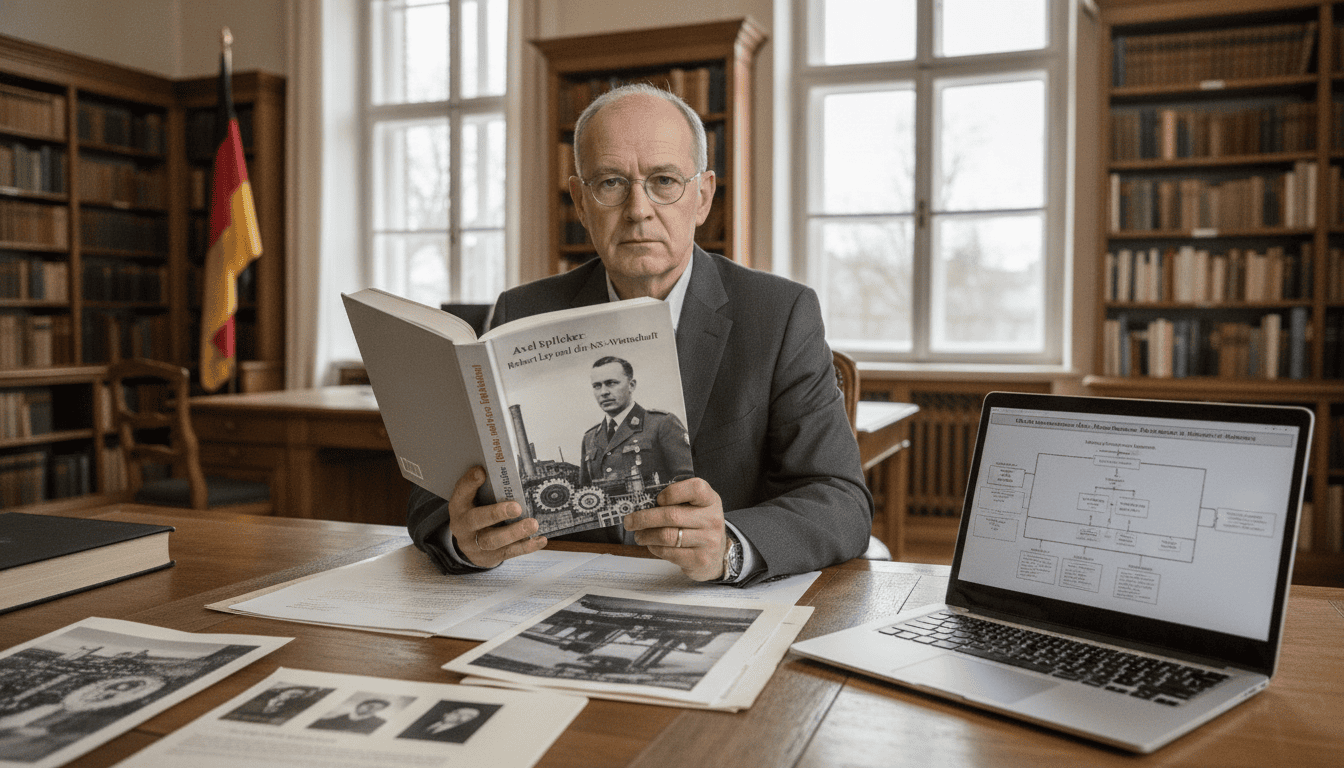
Journalist Axel Spilcker Confronts Grandfather Robert Ley in New Book as Archives Drive Family Histories
As the U.S. National Archives released millions of Nazi Party membership records online, journalist Axel Spilcker has published a probing family history centered on his grandfather, Robert Ley, a leading Nazi official.
In recent weeks a surge of interest in ancestral records has followed the National Archives posting of Nazi Party membership cards, prompting renewed public scrutiny of family histories tied to the Third Reich. Axel Spilcker’s new book, which focuses on his grandfather Robert Ley, arrives amid that broader wave of genealogical inquiry and public debate.
Archives Release Triggers Wider Interest in Nazi-Era Ancestry
The recent online publication of Nazi Party membership files by the U.S. National Archives has led many families to re-examine wartime records and personal archives. The release made searchable millions of entries that document party affiliation across Germany, reigniting questions about who joined the party and why.
Genealogists, historians and ordinary citizens have used the digitized files to trace family connections, while journalists and researchers note the ethical and emotional complexity of confronting relatives’ ties to the Nazi state. The archival material is renewing public discussion about complicity, resistance and everyday life under dictatorship.
Axel Spilcker’s Personal Investigation into Robert Ley
Axel Spilcker approached the subject from a position of personal knowledge: he already knew his grandfather, Robert Ley, had been a Nazi Party member and a prominent official in the regime. Rather than relying solely on the newly released membership cards, Spilcker traces Ley’s life through family memories, public records and contemporary accounts.
Spilcker’s book combines private recollection and public documentation to explore how a man who sat at the center of economic policy and Nazi propaganda shaped both national policy and his own family’s fortunes. The work reads as both a biographical probe and a family reckoning, offering readers an intimate vantage point on an infamous historical figure.
Robert Ley’s Role in the Nazi Leadership
Robert Ley rose to prominence in the 1930s as a key organiser of the Nazi labor and economic apparatus, wielding significant influence over industrial relations and workforce mobilisation. He was a central figure in the regime’s efforts to reshape labor policy, and his public rhetoric often aligned with virulent anti-Semitic propaganda.
Ley’s authority in economic and labor matters, combined with his proximity to Adolf Hitler, made him both powerful and wealthy within the Nazi hierarchy. Historians have long cited Ley as an example of how administrative and economic power supported the regime’s broader political and racial agenda.
Family Memory, Wealth and Moral Reckoning
Spilcker’s narrative examines not only Ley’s public acts but their repercussions for his family, including questions of inherited wealth and inherited responsibility. The book interrogates how descendants process privilege derived from a violent political order, and what silence or disclosure within families reveals about postwar memory.
The book also delves into the dissonance between private family life and public atrocity, documenting how relatives navigated social standing and moral questioning in the decades after 1945. Spilcker interrogates whether ordinary familial narratives can coexist with an unvarnished account of a relative’s role in state-sponsored persecution.
Public Reaction and the Limits of Documentary Evidence
Public response to renewed archival access has been mixed: for some, the records provide clarity and closure; for others, they reopen wounds and raise anxieties about public exposure. Scholars caution that membership cards and bureaucratic documents, while valuable, do not always capture the full scope of individual agency or intent.
Spilcker’s approach underscores the limits of documentary evidence alone, showing how personal testimony and archival material must be combined to reconstruct a fuller picture. His book encourages readers to treat records as starting points for inquiry rather than definitive moral summaries.
Implications for Historical Responsibility and Memory
The convergence of digitized archives and personal memoirs like Spilcker’s highlights ongoing debates over how societies remember and teach about the Nazi past. Enhanced access to primary sources makes it harder for families and institutions to maintain ambiguous narratives about complicity.
At the same time, public engagement with these materials raises new questions about privacy, collective memory and the responsibilities of descendants and historians alike. Spilcker’s book becomes part of a larger cultural moment in which archival transparency and personal accountability intersect.
Axel Spilcker’s study of his grandfather Robert Ley is a reminder that historical investigation is often both scholarly and personal, and that new archival releases can prompt difficult but necessary conversations about the past and its legacy.
