
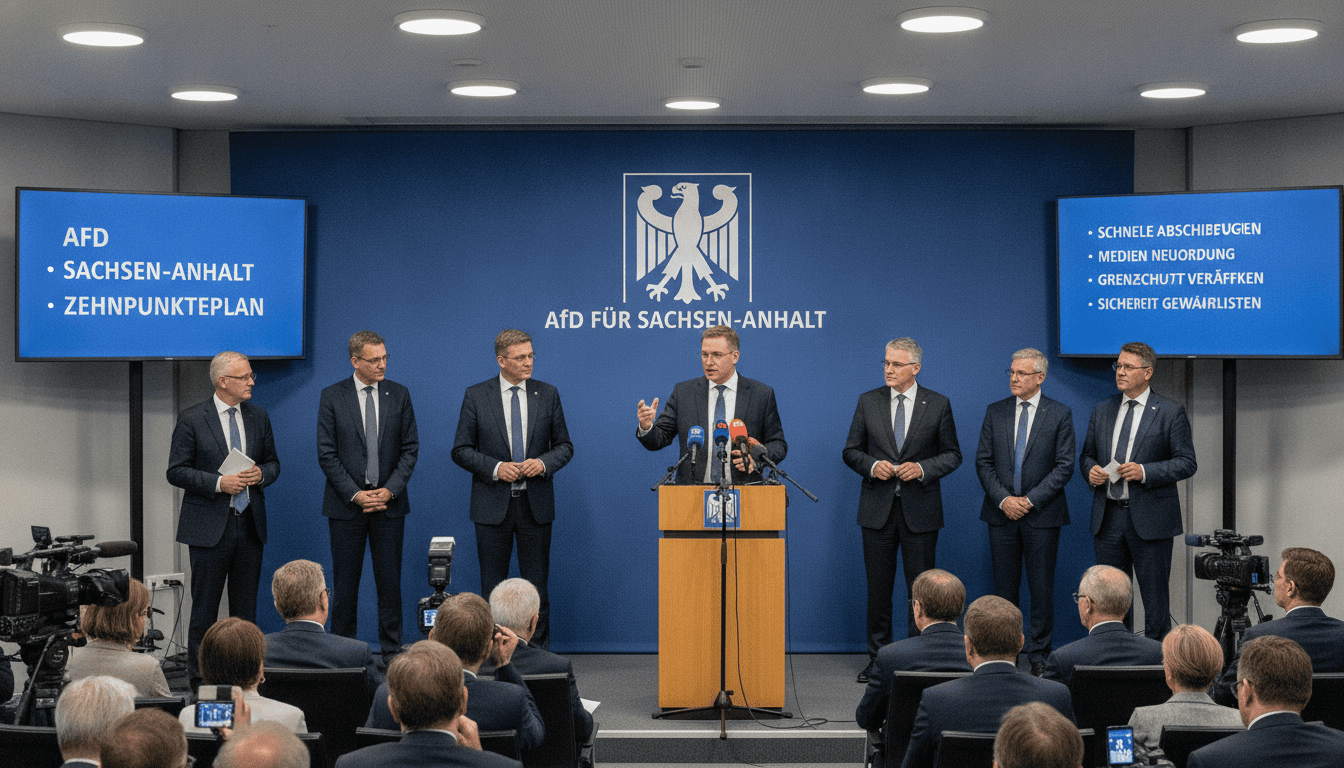
AfD Saxony-Anhalt unveils hardline ‘Sofortprogramm’ at Magdeburg conference
AfD Saxony-Anhalt unveils a ten-point ‘Sofortprogramm’ in Magdeburg, promising deportations, school changes and funding cuts ahead of the Sept 6 state election.
The AfD Saxony-Anhalt presented a compact ten-point “Sofortprogramm” at a party congress in Magdeburg on Saturday, laying out immediate measures it says it would enact within the first 100 days if it forms a government. The proposals range from sweeping changes to asylum policy and education to cuts in funding for civic and climate initiatives, reflecting a campaign pitched toward rapid, visible action. Party leaders described the package as a blueprint for governance, while critics warned of constitutional limits and financial strain.
Platform launch in the Hyparschale
The party gathered in Magdeburg’s glass-fronted Hyparschale where provincial leader Martin Reichardt opened the meeting with combative language aimed at rivals, and Ulrich Siegmund, the AfD’s top candidate, formally presented the program later in the morning. Delegates applauded a document that the party framed as achievable: ten measures to be implemented “in the first 100 days.” The public unveiling was staged as both policy statement and campaign spectacle ahead of the September 6, 2026 state election.
Key measures and symbolic gestures
The program foregrounds a number of headline-grabbing items: termination of the state broadcasting treaties, an immediate intensification of deportations, mandatory community work for asylum seekers and centralized accommodation. Education proposals include special classes for children of parents with temporary residency and the introduction of security personnel at schools, paired with a daily display of the national flag. The party also proposed renaming a state image campaign and redirecting resources toward an explicitly national-political curriculum.
Funding cuts and redirected spending
AfD officials promised to cancel public subsidies for party foundations and to withdraw funding from initiatives described in their program as “gender projects,” climate-related efforts and some democracy-promotion schemes. At the same time, the party pledged new outlays such as a driver’s license grant for apprentices. Party strategists say the program will be financed by ending what they call wasteful projects, but they offered few concrete budgetary calculations at the event.
Financial and constitutional hurdles
Analysts and opponents highlighted immediate obstacles to carrying out the program. Saxony-Anhalt’s public finances are already constrained, and many of the proposed changes—such as abolishing the basic right to asylum—fall outside the authority of a state government and would require federal action. AfD leaders signalled they would pursue federal avenues, including a Bundesrat initiative, if necessary, but they acknowledged that implementing national changes would depend on broader political developments in Berlin.
Leadership votes and internal controversies
The congress also served as a personnel reaffirmation for the state leadership, with Reichardt re-elected by a substantial margin and other figures receiving strong delegate support. That internal consolidation came despite controversies involving party personnel and past reports of clientelism. Delegates confirmed prominent appointments to senior party positions even as critics and media reports have raised questions about connections between local officials and former AfD figures with contentious records.
Electoral outlook and political implications
Polls cited by party speakers place the AfD well ahead of the CDU in the state, suggesting a realistic path to lead a government if the party maintains momentum on election night. Still, the outcome on September 6, 2026 will depend not only on the AfD’s vote share but on which other parties cross the electoral threshold and how coalition bargaining shapes afterward. Opponents warn that a government led by the AfD would face legal challenges and federal resistance on many of its core promises.
The Magdeburg event crystallised the AfD’s strategy in Saxony-Anhalt: present a short, forceful list of measures that appeal to voters seeking rapid change, while laying the groundwork for attempts to push boundaries of state competence. Whether the party can translate its program into law will hinge on electoral math, budgetary realities and constitutional constraints in the months ahead.
