
Global Compact for Migration at IMRF: States Urged to Expand Safe Pathways as Mediterranean Routes Grow Deadlier
World leaders at IMRF assess the Global Compact for Migration as Mediterranean and Atlantic routes remain deadly, with displacement and risks escalating.
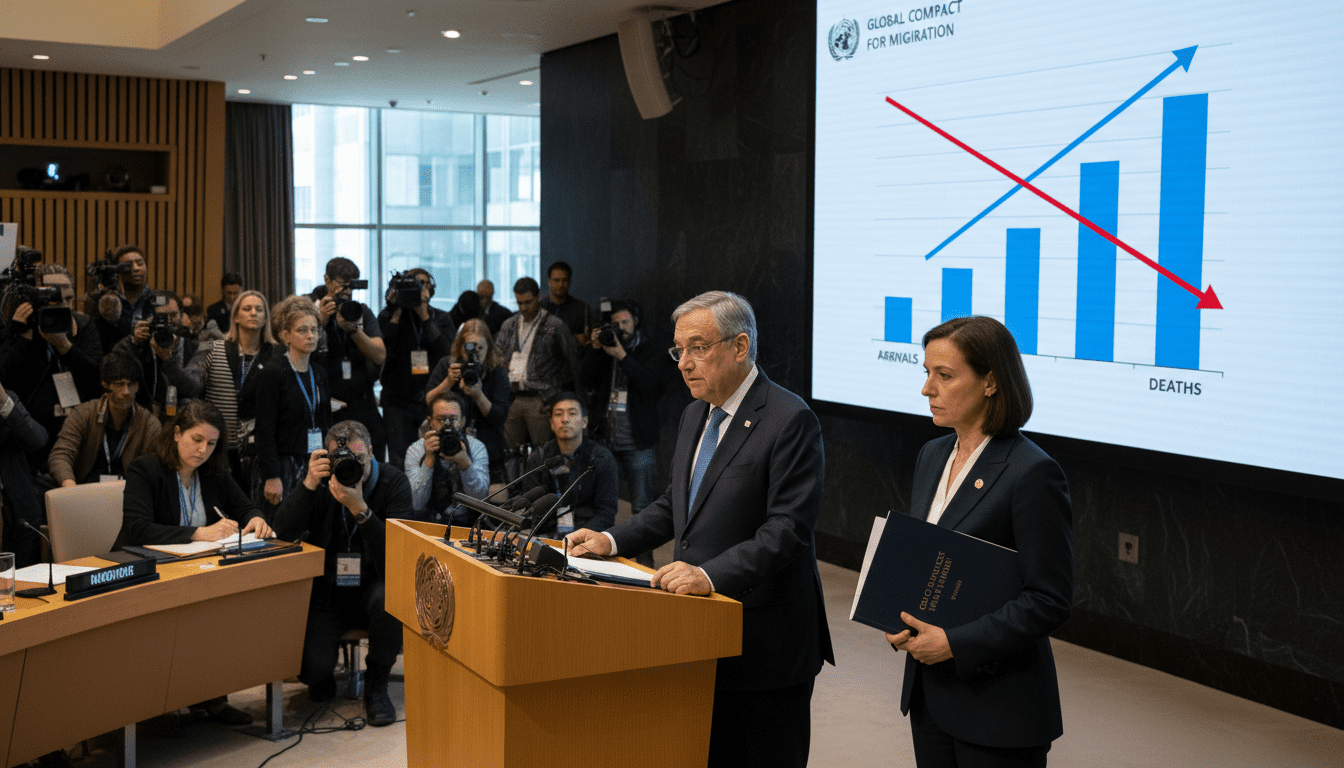
The Second International Migration Review Forum in New York has put the Global Compact for Migration at the centre of discussions as 130 states evaluate progress on commitments to safer, more orderly movement. Delegates and agencies cited new data showing shifting routes across the Middle East and North Africa while warning that lower arrival totals do not equate to reduced danger for people on the move. The International Organization for Migration’s 2025 Global Overview of Migration Routes provided the latest empirical backdrop to the talks and framed policy debates at the Forum.
Shifts in Mediterranean and Atlantic crossings
Data presented at the Forum show mixed trends across major corridors linking North Africa and Europe, underscoring the complexity of regional migration dynamics. In 2025, roughly 66,500 people reached Italy and Malta via the Central Mediterranean, a figure almost unchanged from the year before, while arrivals to Greece, Cyprus and Bulgaria along the Eastern Mediterranean fell by about 30 percent. Routes into Spain via the Western Mediterranean ticked up modestly, and the Atlantic path to the Canary Islands saw arrivals drop by 62 percent, yet these shifts mask worsening dangers on several passages.
Rising mortality despite fewer arrivals
Officials emphasised that falling arrival numbers can hide deteriorating conditions, with mortality and disappearance metrics revealing sharper risks. On the Eastern Mediterranean route, deaths and disappearances nearly doubled in a single year, and the Central Mediterranean remained among the deadliest corridors with more than 1,300 known deaths in 2025. The Western African Atlantic route recorded only a marginal decline in fatalities despite steeply reduced arrivals, implying an increased probability of dying at sea for those who attempt the journey.
Sudan conflict reshapes regional flows
The conflict that began in April 2023 in Sudan has produced one of the world’s largest displacement crises and is increasingly shaping migration patterns across the MENA region. At the crisis peak, internal displacement more than tripled, exceeding 11.5 million people, and nearly 4 million had attempted returns to damaged or partially destroyed housing, while roughly 9 million people remain displaced. Humanitarian and migration officials reported a noticeable rise in Sudanese nationals appearing on both Eastern and Central Mediterranean routes, driven by constrained options within Sudan and in neighbouring countries.
Drivers behind continued mobility
Demographic and environmental pressures continue to push people toward cross‑border movement across and beyond MENA, complicating policy responses. The region’s young population and persistently high youth unemployment combine with climate shocks — droughts, floods and heatwaves — to increase vulnerability and displacement risk. These push factors frequently interact with conflict and economic stress, so that single events or policy changes in one country can reverberate along corridors that span thousands of kilometres.
Policy priorities emerging from IMRF discussions
Delegations at the Forum emphasised a set of practical policy priorities aimed at reducing harm and improving governance under the Global Compact for Migration. First, search and rescue capacities must be scaled and coordinated, with better data collection on deaths and disappearances and sustained support for frontline communities. Second, states were urged to expand safe and regular pathways, including labour mobility schemes, family reunification and humanitarian channels, to lower reliance on irregular and perilous routes.
Data, protection systems and cooperation
Speakers at the IMRF placed renewed emphasis on investing in national data systems and protection mechanisms to inform policy and save lives. The value of combining arrival statistics, intention surveys and mortality information was highlighted as essential for anticipating pressures and targeting responses. Delegations also called for stepped‑up cooperation to dismantle criminal smuggling networks, strengthen fair recruitment and worker protections, and harmonise approaches to protection for vulnerable migrants.
If governments use the Global Compact for Migration as a roadmap rather than a rhetorical pledge, the Forum’s participants argued, they can reduce avoidable suffering and fatalities while enhancing orderly mobility that benefits origin and destination countries. The coming months will test whether commitments made in New York translate into expanded legal pathways, strengthened rescue and protection capacities, and tighter cooperation to address the criminal actors who profit from desperate journeys.
The IMRF closed with a clear message: migration remains a shared, transnational reality that requires principled partnership and practical, data‑driven action. The opportunity now is to turn the Compact’s aims into measurable change so fewer people are forced into dangerous routes and more migrants can move safely and with dignity.
