
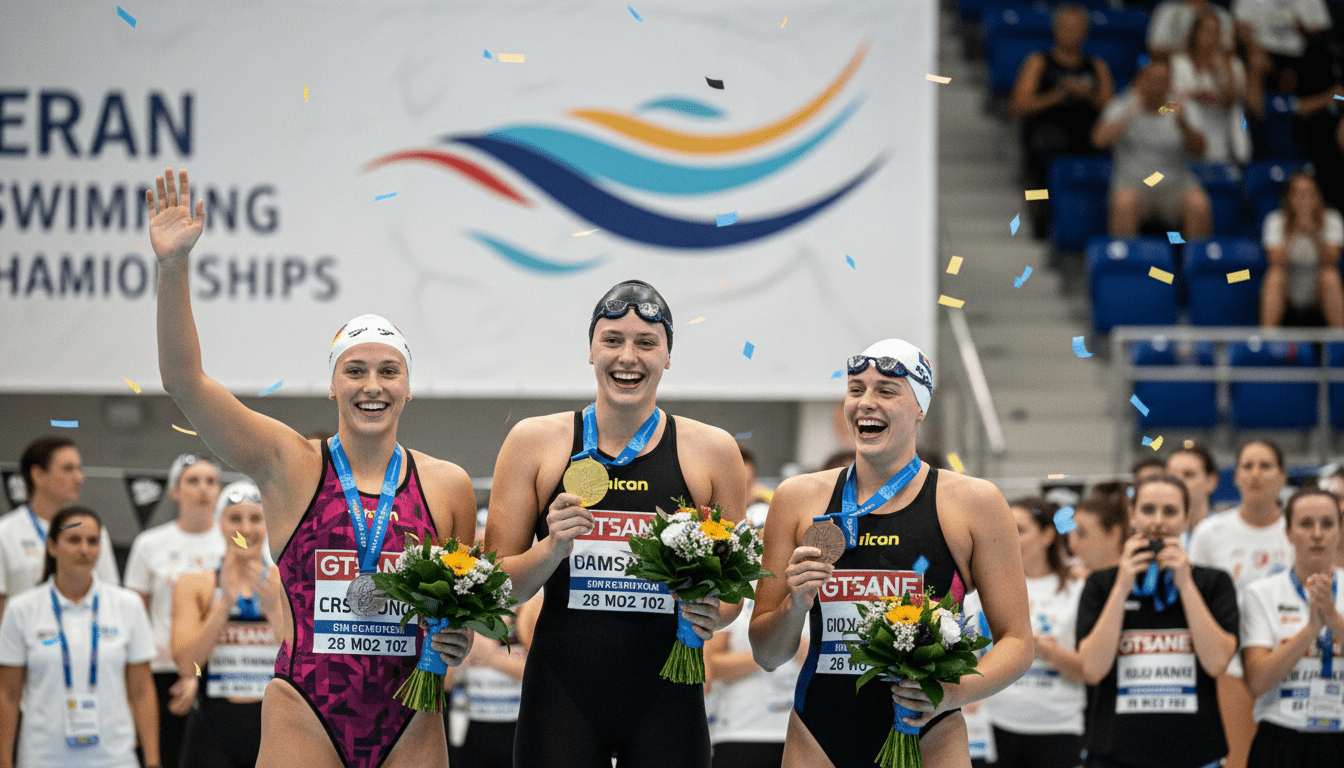
German Swimming Championships in Berlin: Elendt, Gose and Köhler Lead a Resurgent National Team
Three-time winners Anna Elendt, Isabel Gose and Angelina Köhler headlined the German Swimming Championships in Berlin, asserting control on the final day and signaling strong form ahead of the summer European Championships in Paris.
The German Swimming Championships in Berlin served as both a national title fight and an early season barometer for international ambitions. Top performers used the meet to confirm race shape, with several athletes posting times and records that suggest Germany will be competitive in the long- and short-distance events this season.
Women’s podium completes trio of veterans
Anna Elendt, Isabel Gose and Angelina Köhler closed the championships by reinforcing a pattern of dominance across the women’s program.
Each swimmer picked up another national title at the meet in Prenzlauer Berg, adding to an already extensive domestic trophy haul and underscoring their status as Germany’s leading female talents.
Elendt continued to control the breaststroke distances, while Köhler took the 100m butterfly with a time narrowly shy of her national best. Gose rounded out the trio with a decisive victory in the 800m freestyle that cemented her as the most successful competitor at this year’s championships.
Isabel Gose named top competitor after four golds
Isabel Gose emerged from Berlin as the meet’s most decorated swimmer, claiming four individual gold medals across distance events.
Trainings stints in Magdeburg alongside established stars have sharpened her endurance and race craft, and her results at the German Swimming Championships reflect progress toward continental and global targets.
Gose’s 800m triumph also reinforced her standing on the long course: she remains one of Germany’s leading distance freestylers and carried momentum from a podium finish at the Paris Olympics into this domestic season.
Angelina Köhler nearly rewrites the 100m butterfly record
Angelina Köhler delivered a commanding performance in the 100m butterfly, touching in 25.61 seconds and coming within a sliver of her own national benchmark.
Köhler, the 2024 world champion at the distance, made clear she is in elite shape even while narrowly missing the record she had aimed to break in Berlin.
Her calm assessment after the race highlighted the depth of the national sprint program, and she emphasized the value of head-to-head domestic competition in sharpening fast-twitch race abilities ahead of international assignments.
Lukas Märtens posts one of the world’s quickest 400m freestyle times
On the men’s side, Lukas Märtens seized attention with a strong swim in the 400m freestyle, recording one of the year’s fastest global times at the German Swimming Championships.
Märtens’ 3:41.76 established him as a benchmark for the middle-distance field and reiterated the quality produced by his training base in Magdeburg.
While he surrendered the 800m to Sven Schwarz in a tight duel, Märtens’ range and consistency across distances give the German team valuable options for relay and individual lineups at European and world meets.
Distance depth hints at sustainable long-course success
Berlin produced encouraging signs beyond headline names, with Sven Schwarz and rising talent Johannes Liebmann underlining Germany’s depth in distance freestyle.
Schwarz captured the 1500m and the 800m, while Liebmann — who recently lowered the European record over 1500m in Stockholm — was cited by national coaches as a key piece of the long-distance puzzle despite not racing in Berlin.
The German Swimming Championships highlighted a multi-generational pipeline in distance events, suggesting selectors will have the luxury of choices for endurance lineups at upcoming international championships.
Sprint events and para performances draw attention ahead of Los Angeles 2028
Sprinters also made headlines as Melvin Imoudu set a new German record in the 50m breaststroke, stopping the clock at 26.57 seconds to claim gold in Berlin.
The race included an inspiring performance from para-swimmer Taliso Engel, who finished seventh in the final and drew praise for competing against sighted athletes on a major domestic stage.
With 50m disciplines reinstated on the Olympic program for Los Angeles 2028, national attention is already shifting toward those sprint events, and the German Swimming Championships provided an early glimpse of who may contest Olympic berths in two years’ time.
The meet’s timing — early in the season but crucial for form-setting — allowed athletes to qualify for continental standards while offering coaches data on race execution and pacing. Several swimmers left Berlin having met European Championship marks, and team staff noted measurable improvements in starts, turns and split consistency.
Berlin’s Prenzlauer Berg facility hosted packed sessions and produced performances that suggested more than a handful of German athletes will be contenders on the European stage this summer. The results also reinforced a narrative of balance across strokes and distances, from breaststroke and butterfly specialists to middle- and long-distance freestylers.
As national preparations pivot toward the European Championships in Paris and the summer calendar beyond, the German Swimming Championships have delivered clarity on selection debates and athlete readiness. The performances in Berlin make a strong case that Germany will field a deep, competitive squad at the continental level and that several athletes are on trajectories that could translate to international medals.
Looking ahead, coaches and swimmers will use the coming weeks to refine race plans, recover from the championship exertion and target remaining qualifying windows. The German Swimming Championships did more than hand out medals — they mapped a promising path for the national team as it enters the peak phase of the season.
