
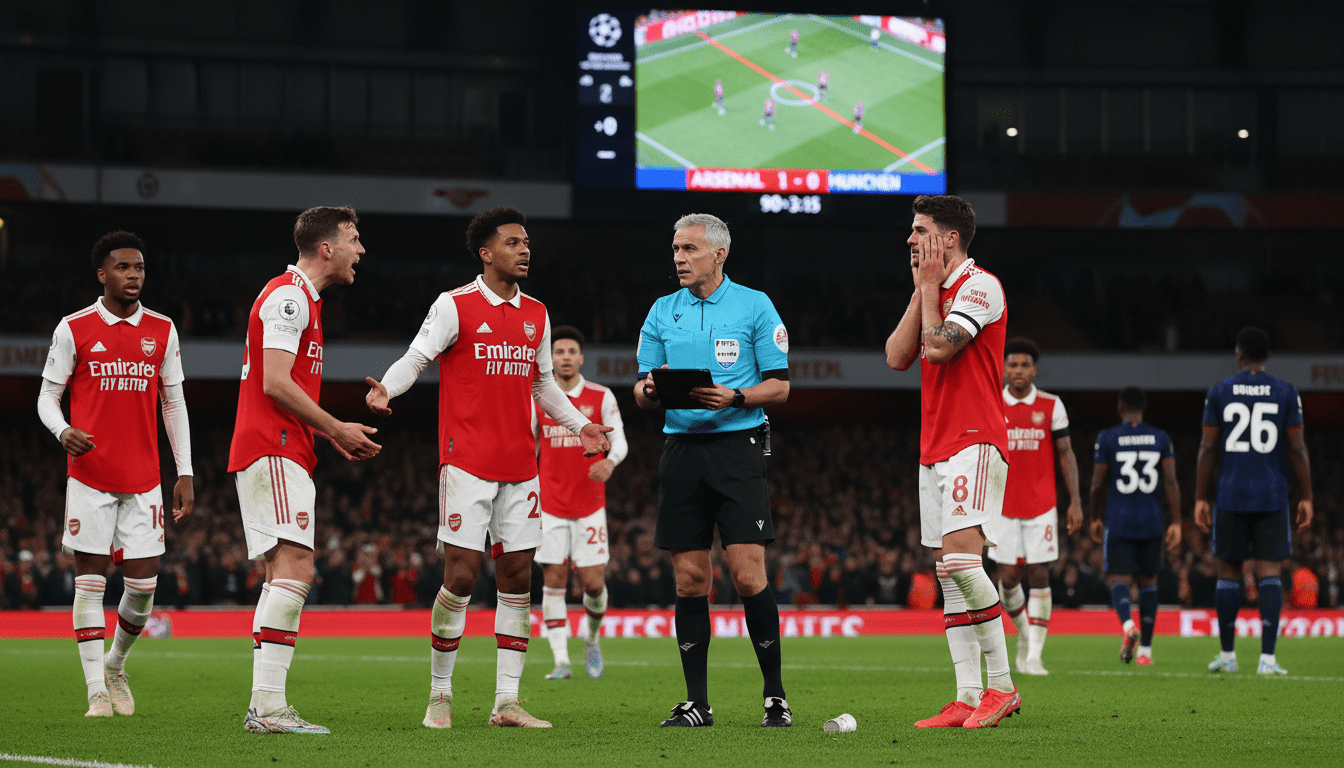
VAR controversy denies Arsenal crucial penalty in Atlético Madrid Champions League semi
Late VAR controversy on April 29, 2026 saw a potential Arsenal penalty overturned at the Metropolitano, leaving the Champions League semi between Atlético Madrid and Arsenal level at 1-1. The VAR review, prompting referee Danny Makkelie to check a contentious incident involving Atlético defender David Hancko, prevented Arsenal from seizing a 2-1 lead late in the match.
VAR review alters decisive moment
The video assistant referee intervened late in the second half and instructed on-field referee Danny Makkelie to review a penalty incident that had threatened to give Arsenal the lead. Replays showed Atlético defender David Hancko appearing to step on an Arsenal attacker’s foot inside the box, but the VAR check ultimately led to the decision being overturned. The reversal drew immediate protests from Arsenal players and staff, who argued the contact warranted a spot-kick that could have changed the tie.
The controversy followed a match already marked by two earlier penalties and intense scrutiny, reinforcing how VAR decisions continue to shape Champions League knockout ties. UEFA protocol allows VAR to prompt reviews for clear and obvious errors, but the overturning at the Metropolitano will fuel debate about consistency in how marginal incidents are judged.
Goals and key incidents that defined the game
Arsenal took the lead just before half-time when Viktor Gyökeres converted a penalty in the 44th minute after being felled near the area. The Swedish striker stepped up calmly and put Arsenal ahead, rewarding a period in which Martin Ødegaard’s presence had begun to influence play for the visitors. Atlético responded in the second half through Julián Álvarez, who dispatched a penalty after a handball was detected following a Marcos Llorente shot, leveling the score in the 56th minute.
Those two spot-kicks encapsulated a game of fine margins, with Gyökeres’ opener followed by Atlético’s immediate pushback. Álvarez’s equaliser gave the hosts renewed momentum, but his later injury raised doubts over his availability for the return leg and reduced Atlético’s offensive options for the remainder of the match.
Tactical caution and contrasting approaches
Both managers set their teams up with an emphasis on defensive organisation rather than all-out attack, producing a contest of control rather than constant end-to-end action. Arsenal, captained by Martin Ødegaard, sought to impose a measured tempo and probe for openings, while Atlético under Diego Simeone remained compact and disciplined, prioritising structure over risks. The cautious approach meant clear chances were limited, and the game was decided by a small number of high-stakes interventions.
Substitutions played a notable part in the flow, with Simeone forced to replace the injured wide player Giuliano with centre-back Robin Le Normand, a change that temporarily altered Atlético’s shape. Arsenal created occasional moments of danger through Noni Madueke and Ademola Lookman, but both sides largely avoided reckless play, aware that a single error could prove decisive in a knockout fixture.
Player performances and turning points
Martin Ødegaard’s influence was evident as he sought to direct Arsenal’s attack and press for control in midfield, but the visitors lacked consistent penetration to force Atlético into sustained trouble. Viktor Gyökeres’ penalty finish was a highlight for Arsenal, demonstrating composure in a tense moment. On Atlético’s side, Julián Álvarez provided the spark and the equaliser that kept the hosts alive, though his subsequent injury cast a shadow over the team’s immediate plans.
Defensive contributions were significant for both teams, with David Raya producing key saves for Arsenal and Atlético’s backline frequently repelling set-piece and wide threats. The decision to award and then overturn a late Arsenal penalty will likely overshadow many of those individual performances in post-match conversation.
Atmosphere and broader Champions League context
The Estadio Metropolitano buzzed at times like a cauldron, with Atlético supporters visibly buoyed after the equaliser and visibly tense during the VAR review. The stadium reacted physically as fans jumped and chanted following crucial moments, creating a charged backdrop to a tightly contested semi. The match arrived a day after a high-scoring 5-4 thriller between Paris Saint-Germain and Bayern Munich, highlighting how contrasting knockout nights in this season of the Champions League have produced drama of very different kinds.
That preceding fixture intensified expectations for spectacle at the Metropolitano but instead delivered a tactical chess match punctuated by defining interventions from match officials. The comparison underscores how knockout football can swing between attacking fireworks and finely balanced, refereed decisions.
Implications for the second leg and next steps
With the tie poised at 1-1, both clubs head into the return leg with questions about personnel, momentum and officiating. Arsenal will feel aggrieved at the overturned penalty and may demand clarity on the VAR process, while Atlético will take encouragement from the equaliser and the fact that their home advantage delivered a crucial result. Álvarez’s injury status will be monitored closely, and both management teams will likely prepare for a tactically tight return fixture.
UEFA and refereeing bodies typically review contentious VAR interventions after such matches, so further clarification or explanation could follow in the days ahead. Until then, the tie remains open and the VAR controversy at the Metropolitano will be one of the defining talking points as both sides plan for the decisive second leg.
The second leg now looms as a high-stakes encounter where fine margins and officiating decisions may once again prove decisive in the race for a Champions League final place.
