
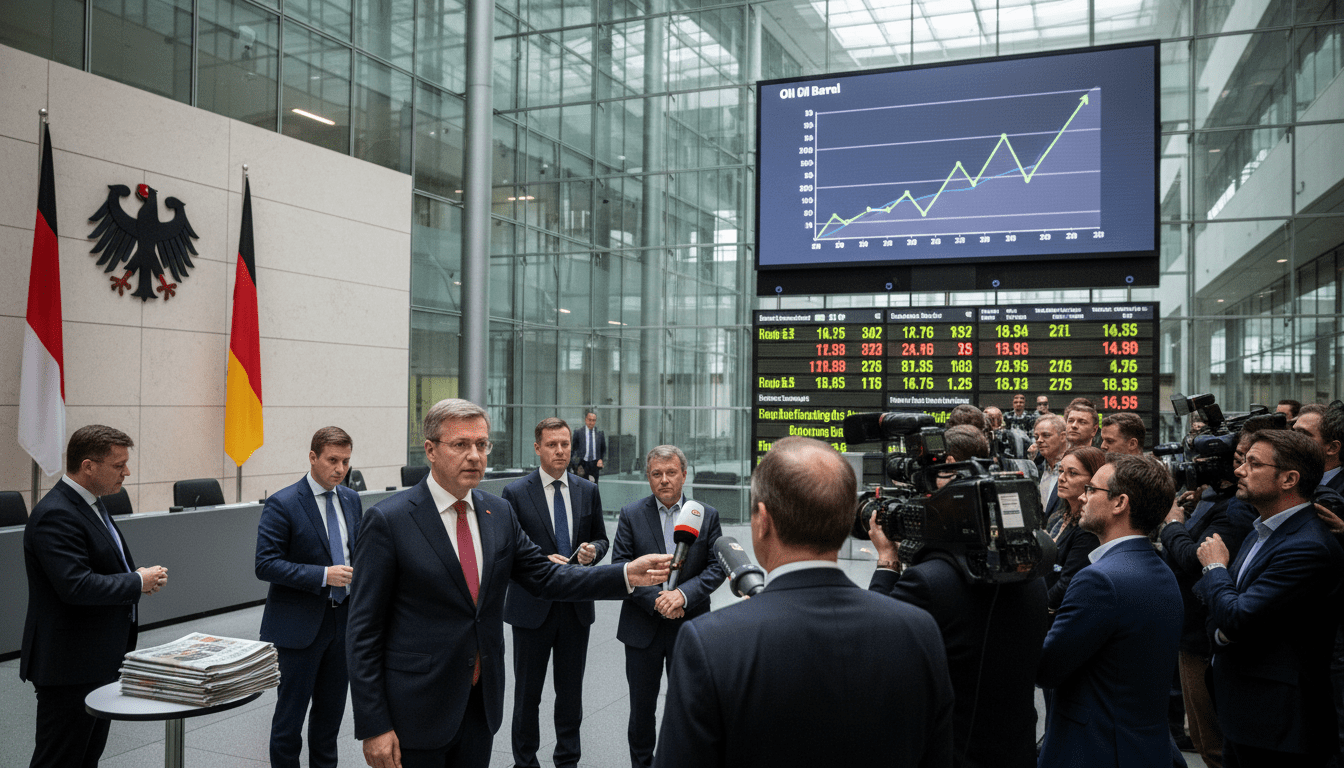
Germany’s Commitment to the Social Market Economy Tested by Strait of Hormuz Oil Shock
Germany’s government is confronting a fresh test of its commitment to the social market economy as a blockade of the Strait of Hormuz has pushed crude prices sharply higher, forcing policy trade-offs between market principles and emergency interventions. The surge in global oil prices has reignited debates in Berlin over subsidies, tax relief and targeted support for motorists and industry, placing the governing coalition’s economic rhetoric under strain. (aljazeera.com)
CDU’s Market Doctrine Under Pressure
The Christian Democratic Union has long placed the social market economy at the center of its program, presenting it as the framework for growth, competition and social stability. Senior figures in the party, including Chancellor Friedrich Merz and Economy Minister Katherina Reiche, have repeatedly defended market-oriented reforms while insisting on social safeguards. The recent energy shock is exposing tensions between doctrinal commitment and immediate political pressures as ministers weigh interventionist steps against long-term regulatory consistency. (cdu.de)
Hormuz Blockade Sends Oil Prices Higher
Commercial restrictions and military activity in the Strait of Hormuz have constricted seaborne flows of crude and ignited a pronounced rally in benchmark oil prices, amplifying costs for refiners and consumers across Europe. Markets reacted to supply uncertainty and the prospect of prolonged disruption, prompting central and national authorities to consider short-term measures to shield households and strategic industries. The energy shock has therefore become a focal point for economic and fiscal planning in Berlin. (ad-hoc-news.de)
Motorists’ Anger Shapes Policy Choices
Germany’s car-centered economy and the political importance of motorists make fuel-price politics unusually salient for any federal government, and ministers are acutely aware of that dynamic. Officials in the coalition have already signalled a willingness to adopt temporary relief—such as targeted tax measures or rebates—to blunt public anger and limit immediate social fallout. Those choices carry trade-offs: they can ease short-term pain but complicate budgets and send mixed signals about reliance on market pricing to allocate scarce resources. (bundesregierung.de)
Coalition Friction Over Economic Principles
Differences within the governing coalition have surfaced as parties balance competing priorities: preserving market signals, protecting households, and maintaining industrial competitiveness. While some ministers emphasize market-led responses and long-term structural reforms, others press for immediate fiscal relief and sector-specific aid to prevent factory slowdowns and job losses. The resulting policy tug-of-war highlights how crisis moments force abstract economic doctrines into concrete, politically charged choices.
Government Measures and Industry Impact
Berlin has begun mapping a package of responses intended to ease strain on consumers and shield critical manufacturers from abrupt cost increases. Announcements under consideration include temporary reductions in fuel levies, emergency support for high-energy industries and accelerated measures to diversify supply and boost domestic resilience. Industry groups have warned that prolonged price shocks would undermine production plans and investment, reinforcing calls for both short-term relief and a faster transition to lower-carbon energy sources. (bundesregierung.de)
Outlook for Policy and the Social Market Economy
Policymakers face a narrow corridor between preserving market discipline and preventing economic dislocation, and the choices made now will shape public confidence in the social market economy. If relief measures are perceived as ad hoc or poorly targeted, they risk eroding fiscal credibility; conversely, rigid adherence to market pricing could intensify social and political backlash. Experts and party officials alike stress the need for transparent criteria, sunset clauses on emergency measures, and a strategy that links short-term support to longer-term energy and industrial policy.
The unfolding energy shock has therefore become a practical test of how Germany reconciles market principles with social protection in times of acute external stress.
