
EU Deforestation Regulation Threatens Ethiopian Smallholder Coffee Livelihoods
EU deforestation regulation could block millions of Ethiopian coffee smallholders from EU markets if strict geolocation and historical forest‑cover rules remain, risking a return to subsistence farming.
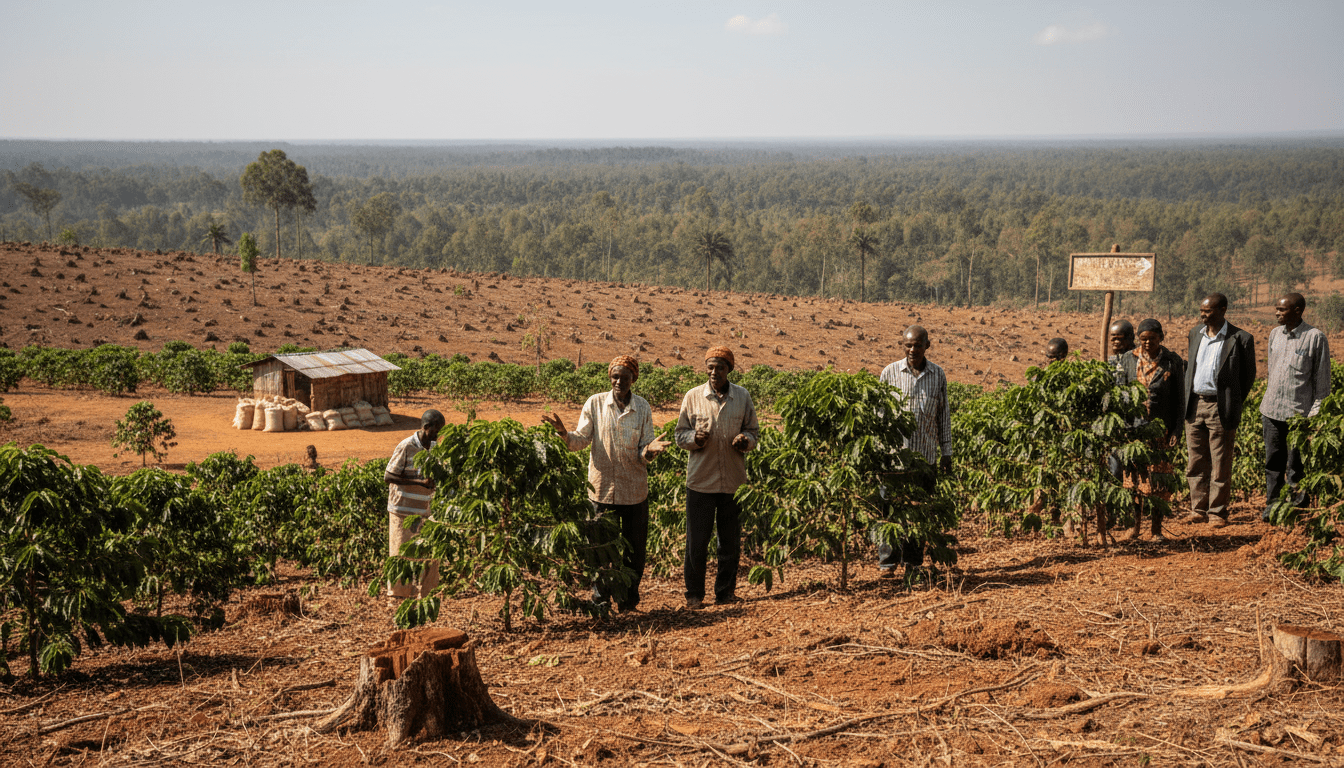
Mulugeta Kenea, a smallholder in Nono Benja, harvests ripe coffee cherries from trees he and his family planted five years ago, but the future market for his crop is uncertain as the EU deforestation regulation moves toward implementation. The regulation requires proof that exported agricultural products were not grown on land cleared of forest after a defined cut‑off date, a rule that could affect coffee producers across Ethiopia. For farmers like Kenea, who lack smartphones, land records and internet access, meeting the new documentation standards may be impossible and could close the door to European buyers.
Smallholder Coffee Farming in Nono Benja Has Transformed Local Incomes
Smallholders in Nono Benja abandoned low‑yield monocultures of maize and sorghum after development projects encouraged shade‑grown Arabica coffee and intercropping with fruit trees. Farmers report dramatic income increases: one family moved from subsistence levels to earnings that now cover food, school fees and modest savings. The new agroforestry plots have also reintroduced tree cover on many smallholdings, creating micro‑forests that benefit both coffee quality and local temperatures. Those local gains, however, may be at risk if export markets demand documentation farmers cannot provide.
Core Requirements of the EU Deforestation Regulation and the 2020 Cut‑off
The EU measure mandates that importers prove commodities were not produced on land where forest existed after 31 December 2020, using geolocation data, satellite imagery and other evidence. Coffee is among the commodities covered, alongside cocoa, soy, palm oil, rubber and cattle products. The rule shifts substantial compliance obligations onto supply chains, requiring precise field coordinates and historical land‑use verification. For widely fragmented smallholder sectors, those technical requirements translate into a heavy administrative and technological burden.
MEP Christine Schneider Advocates Shifting Compliance to EU Importers
Christine Schneider, the European Parliament rapporteur, has argued that only first movers into the EU market—importers and traders established in the EU—should be responsible for submitting deforestation‑free evidence. Her approach aims to shield producers and intermediaries in producing countries from direct reporting duties. The proposal is designed to reduce paperwork for farmers and local traders, but critics warn it may simply shift costs within supply chains rather than remove them. Political debate in Brussels has also delayed full implementation as lawmakers seek workable compromises.
Technical and Practical Barriers for Millions of Farmers
Ethiopia’s coffee sector is dominated by an estimated 4.3 million smallholders farming plots that average less than one hectare, many without formal land titles, internet access or GPS‑enabled devices. Only a minority—roughly 10 to 20 percent—are affiliated with cooperatives that could aggregate data and handle certification tasks. Governments, NGOs and cooperatives have been urged to support field mapping and record keeping, yet capacity constraints remain significant. With limited literacy among some farmers and poor rural connectivity, the practical challenge of generating the required geospatial evidence is substantial.
Mapping Progress in Ethiopia and Market Diversification Risks
Ethiopian authorities have begun national efforts to register coffee producing areas, but progress is uneven; by December 2025, officials reported mapping only 22 of 63 coffee regions. The slow pace reflects infrastructure gaps and internal political and logistical hurdles. Facing the prospect of losing EU buyers, some exporters and farmers are already exploring alternative markets in Asia and the Middle East, notably China and Saudi Arabia, where regulatory demands are perceived as lower. Such a shift could blunt the EU measure’s global impact on illegal deforestation and alter long‑standing trade relationships.
Smallholder farmers fear that if the EU market becomes inaccessible, they will be forced back to less profitable staples and may even clear trees to resume traditional monocropping. That outcome would undermine the very environmental objectives the regulation seeks to advance by encouraging reforestation and agroforestry. Policymakers in Brussels and Addis Ababa face a narrow window to design support mechanisms, clarify who bears compliance costs and ensure that smallholders are not excluded from global supply chains. Practical solutions being discussed include funding for cooperative mapping, simplified reporting routes through exporters and phased implementation to allow time for capacity building.
