
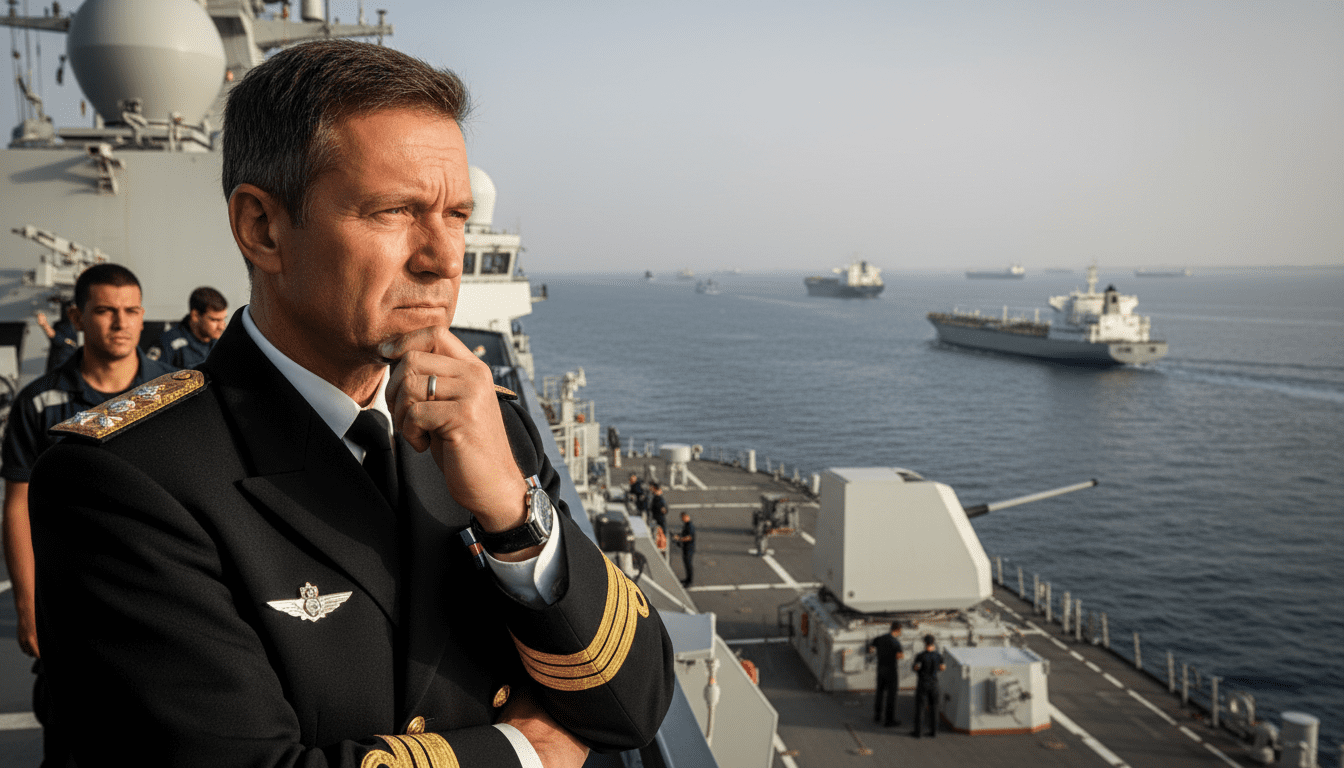
German Navy chief warns of overstretch as Germany weighs role in Strait of Hormuz mission
German Navy chief Jan Christian Kaack warns the service is overstretched as Berlin considers joining an international mission in the Strait of Hormuz to protect shipping.
The head of the German Navy has warned that Germany’s naval forces face a risk of operational overstretch as political leaders discuss a possible deployment to the Strait of Hormuz. Jan Christian Kaack told Wirtschaftswoche that the service is the smallest in the country’s history while demands on it have multiplied, and he cautioned that commitments to the Middle East must not erode deterrence on NATO’s eastern flank. Chancellor Friedrich Merz met in Paris with French President Emmanuel Macron and UK Prime Minister Keir Starmer to discuss how European partners might contribute to securing vital shipping lanes.
Kaack frames the problem as structural and immediate
Kaack characterized the current situation as one in which finite personnel and platforms are being asked to cover a growing array of tasks across distant theaters. He said Germany has “the smallest navy of all time” paired with a disproportionate volume of missions, an assessment that underscores tensions between political expectations and operational capacity. The inspector’s comments reflect concern that sending additional forces to the Middle East, even in limited roles such as mine clearance or maritime reconnaissance, would further dilute resources available for NATO obligations near Europe.
Paris talks outline possible German contributions
During the Paris discussions, leaders explored a range of tasks that Berlin might undertake within a multinational effort to secure the Strait of Hormuz. Government sources in Berlin indicated that Germany could contribute mine countermeasure forces or long-range maritime surveillance, roles that leverage specialized skills rather than high-profile combat assets. French and British officials reportedly emphasized that any comprehensive operation would be contingent on a ceasefire or end to the conflict in Iran, an explicit political precondition that frames the timing and scope of potential deployments.
Multiple maritime threats strain capacity
Kaack warned that the German Navy must contend not only with the situation in the Middle East but also with a rising tempo of activity in northern and eastern maritime zones. He pointed to increased submarine operations, violations of sovereign airspace, and sabotage attacks against pipelines and subsea cables as evolving threats that require persistent presence and specialized responses. Those developments mean that assets committed to one theater reduce the Navy’s ability to patrol and deter elsewhere, raising difficult choices about where and when to deploy ships, aircraft, and personnel.
Strategic capability and time as resources
The inspector urged political leaders to invest in strategic maritime capabilities and to treat time as an essential resource for rebuilding deterrence. Kaack argued that strengthening the navy’s long-term capacity — through additional platforms, mine warfare units, and surveillance capabilities — is necessary to ensure NATO credibility and to dissuade Russian aggression. He framed the goal in blunt terms, saying senior leadership seeks a posture that convinces adversaries that an attack on NATO would be a strategically unattractive option.
Trade-offs at the heart of the decision
The debate in Berlin reflects a broader dilemma: whether to prioritize immediate contributions to international efforts to keep key waterways open, or to reserve scarce naval assets for deterrence and defense closer to home. Mine clearance and maritime reconnaissance are valuable and lower-risk options by design, but even those activities require crews, vessels, and maintenance cycles that cannot be duplicated overnight. Political leaders will have to weigh allied expectations, the operational realities spelled out by Kaack, and the implications for readiness across both the northern and eastern flanks.
Germany faces choices about force posture and resource allocation that will shape its naval footprint for years to come. The conversation between military assessments and political aims is likely to continue as partners refine the operational concept for any Hormuz deployment, and as planners map out how to reconcile immediate contributions with long-term deterrence needs.
