
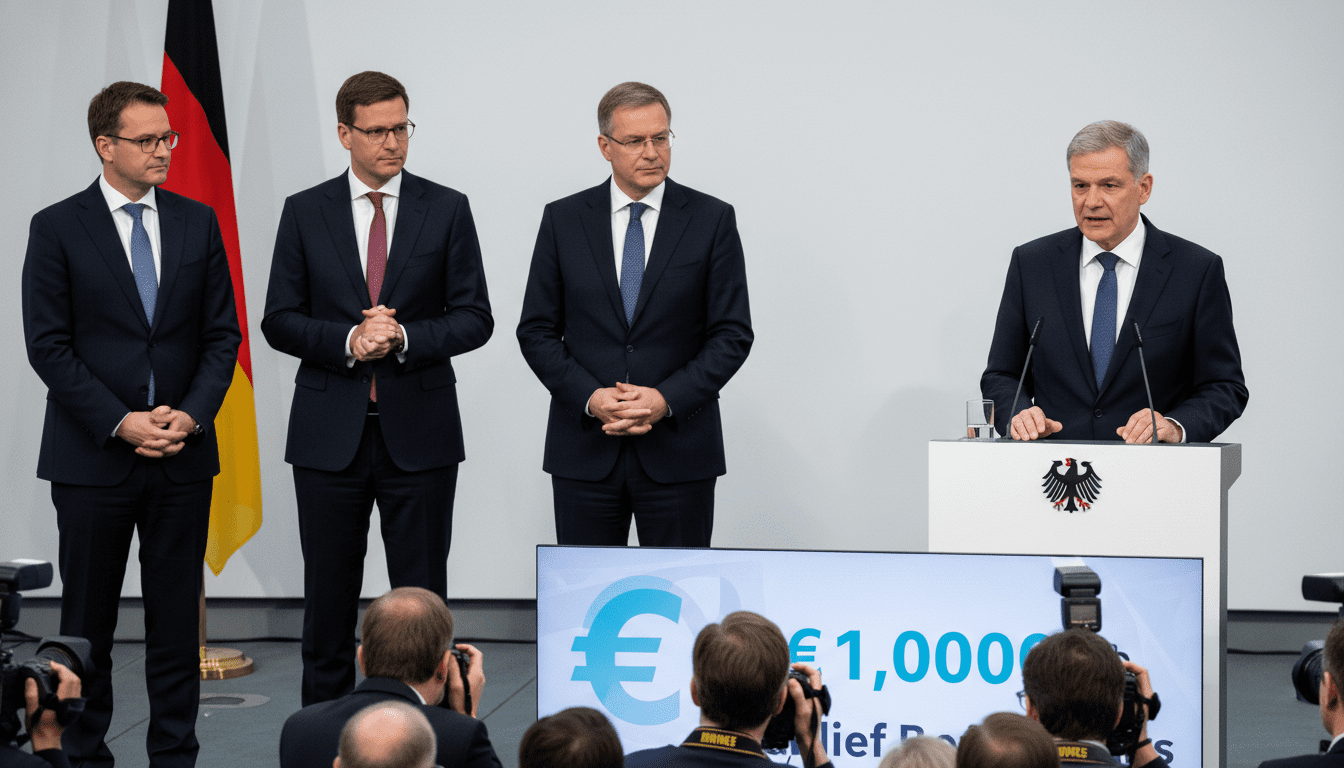
Germany’s €1,000 Entlastungsprämie Meets Corporate Hesitation as Firms Await Law
German government’s proposed Entlastungsprämie (€1,000 relief bonus) draws mixed responses from major employers, with many waiting for the final law before deciding.
The federal government’s plan for an Entlastungsprämie — a tax-free relief bonus of up to €1,000 for employees — has prompted cautious reactions across Germany’s corporate sector. Several headline companies say they will wait for the final legislative text before committing to pay, while unions and industry bodies warned the measure could shift costs onto already strained employers. The proposal, intended to address high energy costs in 2026 and 2027, remains under internal government review.
Blue-chip firms say they will wait for the legislative text
Major companies listed in the Deutsche Aktienindex, including Bosch, Volkswagen, Mercedes‑Benz, Siemens, Eon and Rheinmetall, told reporters they would first examine the draft law before making any payment commitments. A dpa survey of several large employers found none willing to pre-commit to the proposed Entlastungsprämie and many prefer to assess administrative and financial implications once the regulation is formalized.
Executives cited the need to understand eligibility rules, tax treatment and payroll mechanics before deciding. Several employers stressed that a clear legal framework is necessary to ensure consistent and lawful implementation across multi‑national payroll systems.
Retail chain Rossmann pledges conditional payments once law is final
In contrast to the broad hesitation among large industrial groups, the drugstore chain Rossmann announced it plans to pay the bonus to its workforce as soon as the entitlement becomes legally binding. Rossmann indicated typical payments would be €500, with lower amounts — €250 — for certain sales‑assist roles.
Other firms signaled they would similarly review the law and then decide, highlighting a patchwork outcome is possible if employers reach divergent choices. Industry representatives warned that voluntary payments without uniform rules could create disparities between sectors and regions.
Commerzbank declines; media reporting highlights uncertainty
A media report in Bild am Sonntag quoted a Commerzbank spokeswoman saying the bank does not plan to implement the relief bonus, citing the additional financial outlay during a period of sector‑wide cost pressure. That refusal underscores the uneven reception of the Entlastungsprämie among private employers and mirrors findings from surveys by other outlets that many firms will refrain from automatic payouts.
Other business media, including a joint finding by Welt am Sonntag and Business Insider, reached similar conclusions: most DAX companies will await the legislative draft before taking a position. The divergent responses point to the practical and financial questions companies are weighing ahead of any statutory obligation.
Trade association and union leaders criticize the policy design
Representatives of small and medium‑sized enterprises and trade unions criticized the proposed relief bonus on political and practical grounds. Jörg Dittrich, head of the Central Association of German Crafts (ZDH), urged the coalition to abandon the plan, calling it socially unfair and economically misguided because it would place responsibility on already burdened businesses.
Ver.di leader Frank Werneke described the proposal as unlikely to meet public expectations, arguing that most employers will not pay voluntarily. He noted that public sector employers covering more than five million workers have already indicated they do not plan to disburse the bonus, raising questions about the policy’s effectiveness.
SMEs and hospitality sector report limited capacity to pay
A rapid survey by the Federal Association of Medium‑Sized Businesses found only about one‑fifth of roughly 2,000 respondents could envision paying the crisis bonus, with about half having already ruled it out. The German Hotel and Restaurant Association warned that many of its members would be unable to shoulder the additional expense, given tight margins and lingering effects from recent economic shocks.
Trade groups emphasized that a voluntary or employer‑funded approach risks creating a two‑tier landscape, with larger firms better positioned to offer one‑off payments while smaller businesses cannot afford similar measures.
Government frames the bonus alongside short‑term fuel tax relief
The coalition government, led by Chancellor Friedrich Merz, linked the Entlastungsprämie to broader efforts to mitigate rising energy costs attributed to the conflict in Iran. The scheme would allow employers to grant a tax‑free bonus of up to €1,000 for 2026 and 2027, and government sources said internal coordination on the proposal is ongoing.
In parallel, the federal government announced a temporary cut in the mineral oil tax, reducing the tax on petrol and diesel by 17 cents per liter for two months starting in May. Officials position the combined measures as targeted relief to ease household and business pressure over the short term.
The final outcome will depend on the text that emerges from the government review and on whether Parliament enacts the proposal without significant amendments.
As the Entlastungsprämie remains under internal review, employers and employees alike face uncertainty about who will bear the cost and how quickly payments could be processed. Companies say they will base their decisions on the law’s specifics, while unions and trade bodies warn that, without mandated funding or compensation, many workers may see no immediate benefit.
