
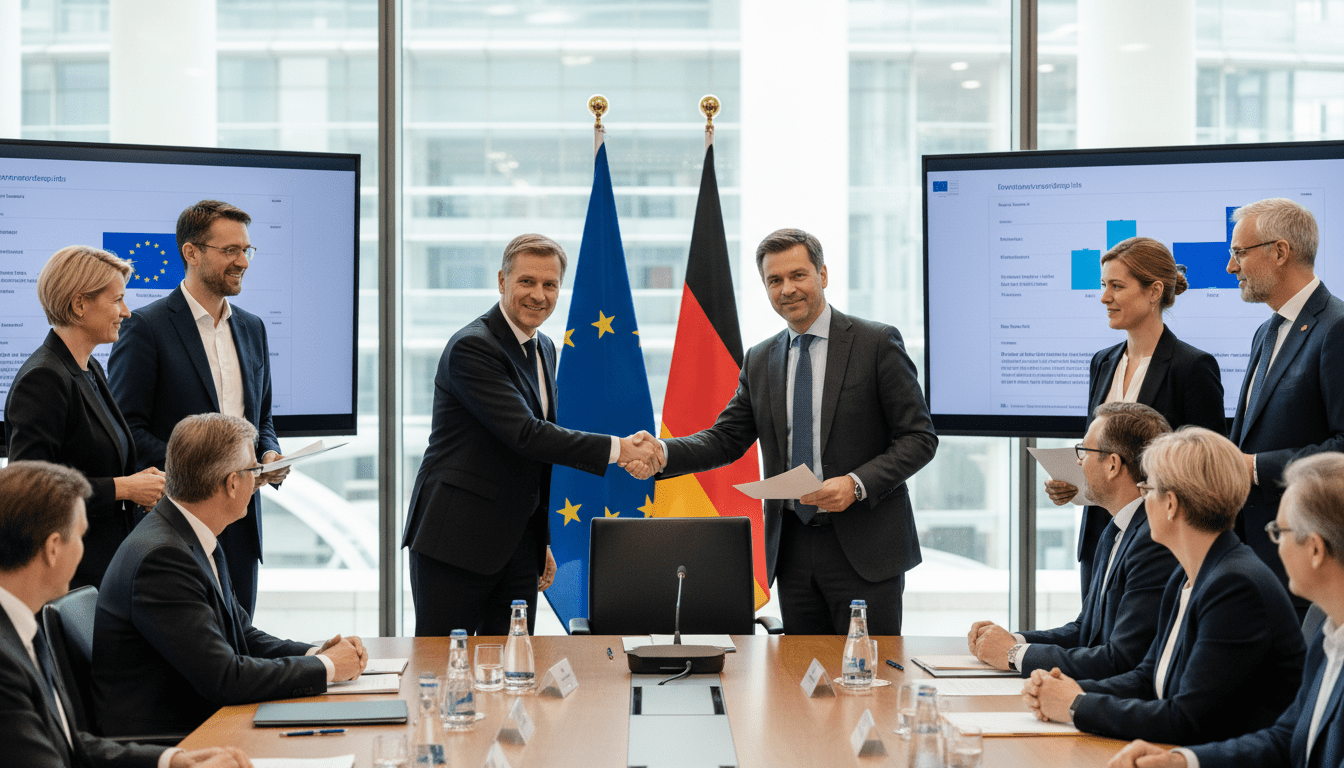
EU Approves German Industrial Electricity Price Support, Clearing €3.8bn Aid
EU approves Germany’s industrial electricity price support, allowing €3.8bn in state aid for energy‑intensive companies, subject to strict EU safeguards.
Germany has won European Commission approval to introduce a discounted industrial electricity price, a measure designed to shield energy‑intensive companies from high power costs. The Commission cleared a state aid package that allows Berlin to spend up to €3.8 billion under a set of conditions intended to limit market distortion. The approval, announced on April 16, 2026, permits targeted relief for sectors such as steel, chemicals and aluminium while requiring oversight and reporting to Brussels.
Commission greenlights targeted electricity relief
The European Commission authorized the measure after assessing its compatibility with EU state‑aid rules and the single market. The clearance permits Germany to subsidize part of industrial electricity costs for qualifying firms, with the declared aim of preserving competitiveness and preventing relocation of heavy industry. Brussels emphasized the need for the measure to be narrowly tailored and temporary to avoid unfair advantages across member states.
The approval reflects the Commission’s assessment that the support can be justified by exceptional energy price volatility and security concerns. In its decision, the Commission required mechanisms to ensure aid is limited to genuine cases of need and does not translate into windfall gains for firms already insulated from high prices. Monitoring and periodic reviews will form part of the oversight framework.
Conditions imposed to limit market distortion
Brussels attached several safeguards to the German plan to reduce potential distortions in the internal market. These include targeting criteria that restrict eligibility to energy‑intensive installations and provisions that prevent cross‑subsidization of non‑eligible activities. The package also requires time limits and clear reporting obligations so the Commission can verify compliance and effectiveness.
Authorities in Germany must submit regular data on beneficiaries, amounts disbursed and the duration of support. The Commission indicated that it will retain the right to reopen its decision if new information suggests the aid is not being applied as approved. These controls are intended to strike a balance between emergency relief and maintaining a level playing field within the EU.
Sectors set to receive the most support
Industrial sectors with high electricity intensity are expected to receive the bulk of the €3.8 billion allocation. Steelmakers, chemical producers and non‑ferrous metal plants face particularly steep energy bills and have lobbied for targeted relief to sustain output and employment. Energy‑intensive manufacturers argue that predictable, lower power costs are crucial while they invest in low‑carbon technologies and process innovations.
Small‑scale energy users and non‑industrial consumers are not the focus of the scheme, which aims to avoid reallocating public funds where market mechanisms remain appropriate. The Commission’s conditions specifically seek to limit support to installations that would otherwise be exposed to severe competitive pressure from international rivals.
Government and industry reactions in Berlin
German officials welcomed the decision as a tool to protect strategic industries during a period of elevated energy prices. The federal government characterized the approval as a recognition of the need to maintain industrial capacity and technological leadership in sectors central to the national economy. Berlin said it would implement the measure quickly while respecting the safeguards required by Brussels.
Industry associations expressed relief that targeted relief is now permissible, saying the measure provides short‑term certainty while longer‑term decarbonization investments proceed. Some business groups called for clarity on eligibility criteria and the administrative timeline so companies can plan investments and production schedules with greater confidence.
Environmental and market risk concerns
Environmental groups and market analysts cautioned that state support should not delay the transition to cleaner energy or entrench fossil‑fuel‑dependent processes. Critics warned that poorly designed subsidies risk locking in high‑emission activity and distorting incentives for electrification and efficiency upgrades. The Commission’s insistence on stringent conditions aimed to address these concerns by linking aid to clear decarbonization objectives where possible.
Economists also noted potential risks of unequal treatment between EU members if similar schemes are not applied consistently across the bloc. Brussels’ decision sets a precedent and may prompt other capitals to seek comparable approvals, increasing pressure on the Commission to apply rigorous, transparent standards.
Implementation steps and oversight mechanisms
Following the clearance, German ministries must present implementing rules detailing beneficiary selection, payment modalities and reporting timelines. The administrative phase will determine how quickly support is disbursed and whether emergency criteria are met in individual cases. Officials in Berlin have signaled that national legislation and administrative guidance will follow within weeks to ensure firms can access relief without undue delay.
The Commission will monitor implementation and retain authority to ask for adjustments or suspend the scheme should evidence emerge that the aid exceeds what is necessary. Regular reporting to Brussels and potential audits are part of the oversight architecture, ensuring transparency for member states and market participants.
The Commission’s approval of Germany’s industrial electricity price measure on April 16, 2026, opens a pathway for immediate, conditional relief aimed at stabilizing energy‑intensive sectors. While the €3.8 billion package provides breathing space for companies grappling with high power costs, its ultimate impact will depend on strict implementation, timely reporting and alignment with the EU’s broader climate and competition objectives.
