
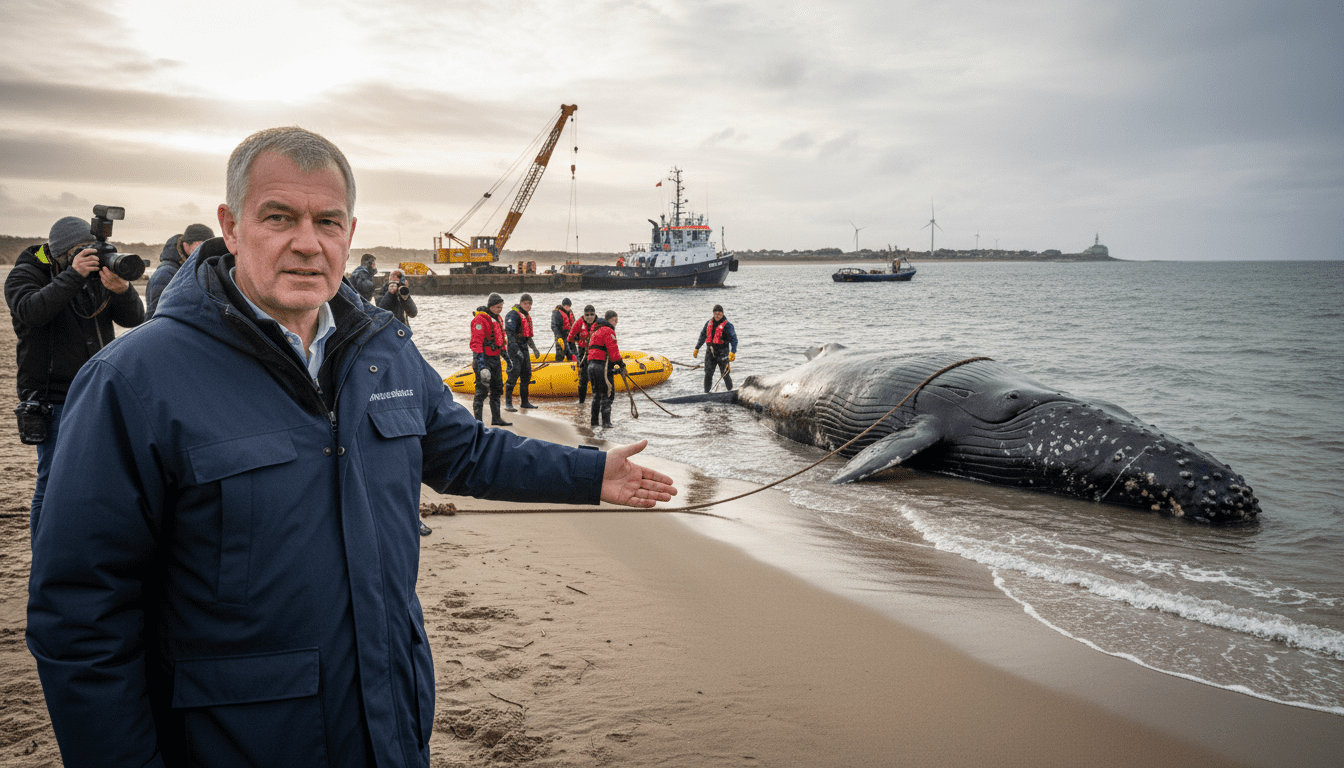
Till Backhaus Oversees Stranded Humpback Whale Response as Rescue Debate Intensifies
Mecklenburg-Vorpommern environment minister Till Backhaus has taken a prominent role in the response to a stranded humpback whale in the Wismar Bay, drawing national attention and sparking a heated debate over rescue risks and public pressure.
The stranded humpback whale, roughly twelve metres long, has remained in shallow water off the island of Poel for weeks, alternately moving short distances and resting on sandbanks, while local volunteers and officials weigh the chances and consequences of attempting a high-risk rescue.
Minister at the Scene
Till Backhaus has been a constant presence at the small Ostsee harbour near Neudorf, often observing the animal through a telescope and briefing the public multiple times a day. The long-serving environment minister, in office since 1998, has drawn nationwide scrutiny by positioning himself as both a responder and a spokesperson in the unfolding situation.
Backhaus says he still holds out hope for the whale and emphasizes a hands-on, humane approach to ailing animals, describing the case in terms he compares to treating a seriously ill patient. His visibility has amplified political attention ahead of the state election scheduled for September 20, as residents and activists converge on the coast.
Whale’s Condition and Local Care
Authorities and volunteers report the animal appears exhausted and injured, frequently lying on sand to avoid drowning and showing laboured breathing at times. Responders have tried to keep the whale cool and comfortable—feeding it fish, applying zinc-based salves, covering parts of its body to shield it from the sun, and washing sand from under its belly.
The mammal’s behaviour—remaining largely immobile and periodically drifting short distances—has led experts to conclude it is too weak to navigate the shallow, enclosed waters of the Baltic for itself. With the animal located off Wismar and previously observed in the Lübeck Bay, responders face logistical and welfare challenges in any intervention.
Scientific Assessment and Official Ruling
A restricted zone around the animal was established so only authorised specialists, including teams from the Deutsches Meeresmuseum and the Institute for Terrestrial and Aquatic Wildlife Research (ITAW), could assess the situation. Those experts produced a report advising against a full-scale rescue attempt, citing the high risk of inflicting further harm on the weakened whale.
Initially, the ministry announced it would allow the animal to die without a forceful rescue based on that assessment. In the days following, however, Backhaus authorised a more limited, so-called “minimalinvasive” initiative after private sponsors proposed an alternative plan and pledged to act within animal-welfare parameters.
Private Initiative’s Plan and Expert Criticism
The private group granted permission to attempt a rescue includes veterinarians and other supporters, but has also featured non-specialist participants and high-profile influencers, according to accounts of the operation. Their controversial scheme reportedly envisages stabilising the whale and moving it on a net toward the North Sea—a journey that would cover many hundreds of kilometres.
Marine scientists have been openly sceptical of that concept. ITAW leadership distanced the institute from the private plan, and international experts voiced alarm, arguing that transport would subject the dying animal to extreme stress and likely worsen its condition. One senior researcher described the idea as “a terrible prospect” for an animal already near death.
Public Pressure, Social Media and Safety Concerns
The case has been fuelled on social media by campaigners who have emotionally amplified the whale’s plight, prompting fundraising drives and viral calls for action. That online momentum has translated into on-the-ground interference, with outsiders attempting to swim toward the whale and activists arriving from other German states and abroad.
Backhaus says the wave of attention has crossed into harassment: private emails were exposed, and his office and family have received threats, some of them violent. Police have intervened to protect the scene and to prevent well-meaning but potentially dangerous approaches by untrained volunteers.
Political Stakes and Backhaus’s Long Tenure
For Backhaus, the incident intersects with a broader political moment. The 66-year-old minister, a veteran of regional government since the late 1990s, is seeking reelection in a contest where his party faces slumping support and rising challengers. He frames his decisions as rooted in a humanitarian ethic and in scientific counsel, even as he acknowledges the powerful emotions the whale’s fate provokes.
Campaign dynamics in Mecklenburg-Vorpommern add pressure: local debates about migration policy, Russia, and media trust have already reshaped voter sentiment. Backhaus says he does not want to jeopardise his state’s governability, and he cast his involvement with the whale as consistent with long-standing commitments to animal welfare and environmental stewardship.
The stranded humpback whale remains at the centre of a complex mix of veterinary judgement, political calculation and public emotion, with experts warning that any intervention carries severe risks and activists insisting that more must be done. As the animal’s condition evolves, officials say they will continue to balance scientific advice, welfare considerations and public safety while the region watches and waits.
