
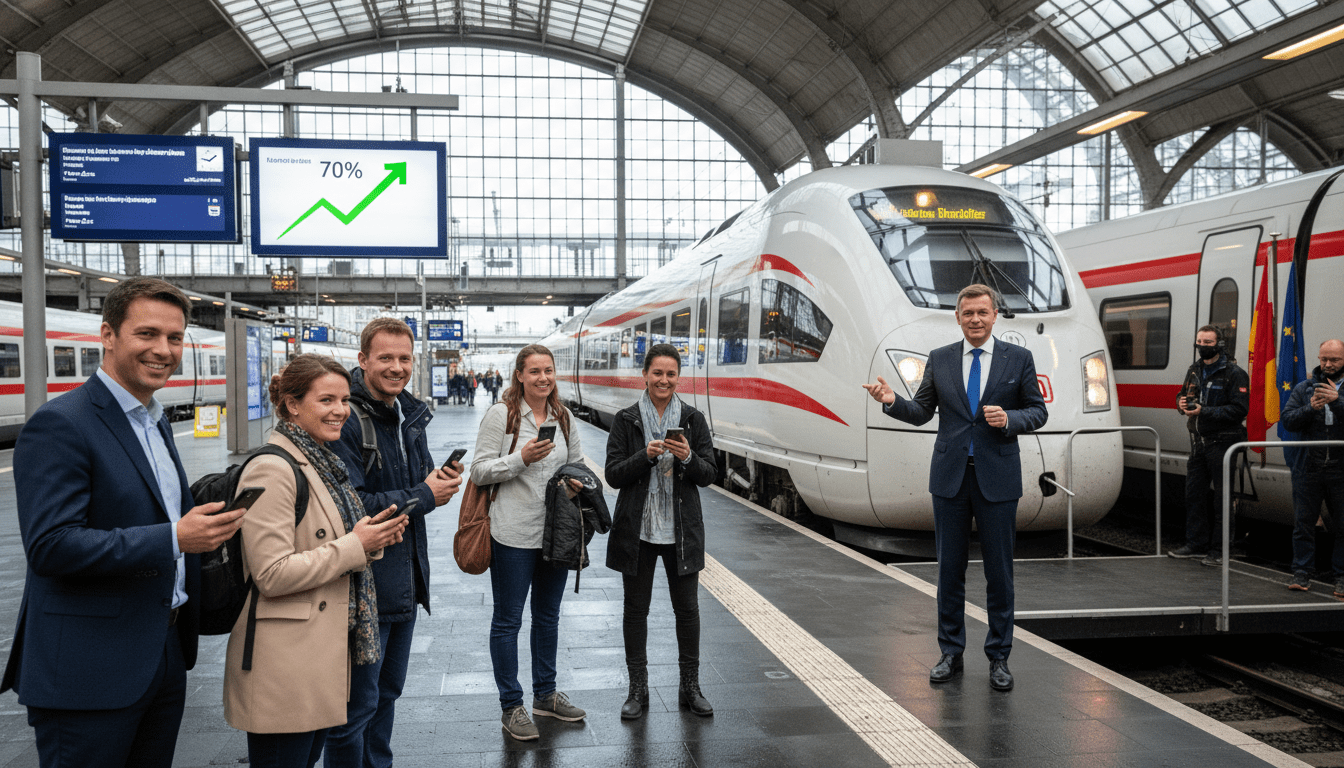
Deutsche Bahn says overhaul ahead of schedule as passenger satisfaction rises to 70%
Deutsche Bahn CEO Evelyn Palla says the overhaul is ahead of schedule; passenger satisfaction has climbed to 70% while the company expands security and invests €23bn in 2026. (157 characters)
Evelyn Palla, chief executive of Deutsche Bahn, told journalists in Berlin that the rail operator’s restructuring is progressing faster than planned and that customer sentiment in long‑distance travel has improved to roughly 70 percent. The company’s short‑term programs have, she said, begun to produce measurable results even as punctuality remains an unresolved challenge. Palla, appointed in autumn 2025, framed the progress as part of a wider effort to slim the state‑owned group and restore financial stability.
Improvement in passenger satisfaction and persistent punctuality gaps
Passenger satisfaction in Deutsche Bahn’s long‑distance services has risen steadily since January, reaching about 70 percent according to Palla’s latest update. The improvement has come despite continued low punctuality rates, which she described as the company’s “biggest worry” for 2026.
Punctuality figures have generally shown only about 60 percent of long‑distance trains arriving on time or within a six‑minute window in recent months, a performance that continues to constrain public confidence and operational targets. Palla said the immediate priority is to stabilise punctuality before pursuing longer‑term gains in reliability.
Expanded security, cleaning and onboard comfort measures
To bolster passenger experience and safety, Deutsche Bahn has hired roughly 500 new security staff, bringing the total in that division to more than 5,000 employees. The recruits are intended to strengthen presence at stations and on trains and to reduce incidents that undermine traveller confidence.
The operator is also ramping up cleaning resources, now fielding about 220 onboard cleaners — double previous levels — and has earmarked an additional €20 million in 2026 specifically for enhancing comfort on ICE trains. These measures are positioned as part of a package of immediate actions designed to improve the day‑to‑day experience for passengers.
Third information programme and planned AI deployment
Palla indicated a third rapid‑response programme aimed at improving passenger information will be announced shortly and is expected to be unveiled together with Transport Minister Patrick Schnieder. She singled out artificial intelligence as a key tool in the planned improvements, suggesting automated systems will play a growing role in real‑time updates and customer communication.
The proposed information measures aim to reduce confusion during disruptions by providing clearer, faster guidance to travellers and by integrating automated forecasting and messaging to frontline staff and passengers.
Financial trajectory toward break‑even in 2026
Since taking the helm last year, Palla has pursued a strategy to make the state rail group leaner and financially healthier. Deutsche Bahn reported a net loss of €2.3 billion in 2025, wider than the €1.8 billion shortfall posted in 2024, but management now projects movement toward a “black zero” — break‑even — in 2026 if current measures hold.
The company is cutting costs and reallocating resources, with Palla asserting that the restructuring is already delivering fiscal benefits. She warned, however, that achieving sustained profitability will require steady execution across operations, investment and infrastructure upgrades.
Massive infrastructure funding and the bottleneck problem
A crucial element of Deutsche Bahn’s recovery remains a more reliable and capable network. The German federal government has created a special fund of €500 billion intended in large part for modernising transport infrastructure, with a significant share earmarked for the ageing rail network.
Deutsche Bahn itself plans to invest more than €23 billion in 2026 to renovate tracks, upgrade signalling and manage a high volume of construction work. Paradoxically, those necessary works have also contributed to delays and capacity constraints, producing a cycle in which renovations both fix and temporarily hinder service reliability.
Operational realism and long‑term ambitions for European leadership
Palla was candid about the scale of the task, arguing that the company must first stabilise basic service levels before declaring broader success. She reiterated the ambition that Deutsche Bahn should become the best railway in Europe, but stopped short of setting a deadline for that objective.
The plan is steady, incremental implementation of concrete measures rather than headline targets, she said, with an emphasis on practical gains in safety, cleanliness, information and on‑time performance.
Looking ahead, Deutsche Bahn faces the twin challenge of sustaining short‑term service improvements while managing a multi‑year investment programme to rebuild infrastructure and capacity. The company’s recent hires, targeted spending on onboard comfort, and the integration of AI into passenger information systems signal a multifaceted approach to restoring public trust.
If the current trajectory continues, the operator may stabilise finances in 2026, but realising the vision of a reliably punctual and high‑performing Deutsche Bahn will depend on synchronising investment, operational changes, and the resolution of construction‑related bottlenecks.
