
Germany’s climate goals at risk as expert council warns the new climate package may fall short
Germany’s climate goals face fresh doubt after the federal government’s March Climate Protection Programme, which promotes electric cars, heat pumps and wind expansion, drew sharp criticism from the independent Expert Council on Climate Issues that says the country is likely to miss key targets. The warning puts the programme launched by Environment Minister Carsten Schneider at the center of a widening debate about whether current measures are sufficient to reach 2030 and 2040 reduction commitments. The council’s assessment challenges government assumptions about emissions reductions and calls for faster, stricter action. (bundesregierung.de)
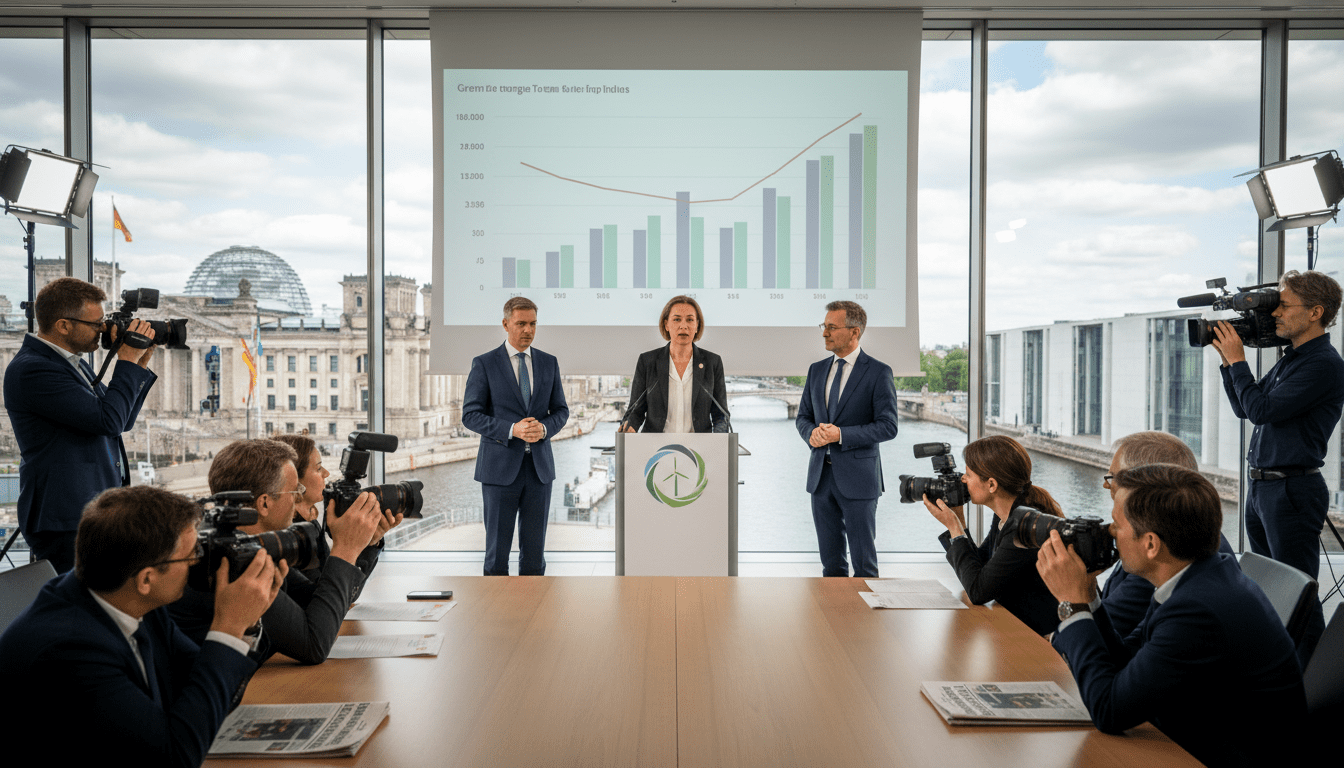
Minister presents Climate Protection Programme to the cabinet
The government approved a multi-sector Climate Protection Programme in March that includes incentives for electric vehicles, subsidies for heat pumps and a push to build more wind turbines to supply low-carbon electricity. The package was presented by Federal Environment Minister Carsten Schneider as a blueprint to accelerate Germany’s transition away from fossil fuels. Officials frame the measures as a mix of regulatory and financial steps intended to mobilize households and industry. (bundesregierung.de)
Independent council finds programme’s impact overstated
The Expert Council on Climate Issues reviewed official projection data and concluded that the programme’s emissions savings are likely overstated and that the country may miss its legally binding climate targets by a wider margin than previously estimated. The council said it could not confirm the narrow target achievement suggested by recent government projections and flagged serious shortfalls for later decades. Its critique underscores differences between government modelling and independent assessments of feasible emissions reductions. (cleanenergywire.org)
Shortfalls centre on transport, buildings and land use accounting
According to the council and secondary analyses, the largest gaps appear in transport and buildings sectors, where assumed reductions from technological uptake and efficiency measures may be overly optimistic. The treatment of land use, land-use change and forestry (LULUCF) also complicates the overall accounting and could worsen cumulative shortfalls. Experts argue that relying on future technology adoption without binding milestones risks leaving cumulative emissions above the law’s limits. (ewi.uni-koeln.de)
Wind expansion and infrastructure remain bottlenecks
A core pillar of the government plan is faster deployment of wind turbines to supply the growing demand from electrified heating and transport, yet permitting delays and local resistance continue to hinder build-out. Analysts cited by the council warn that slower-than-expected capacity growth will reduce the climate programme’s effectiveness and increase reliance on fossil backup generation. The gap between planned renewables capacity and deliverable projects is now a critical policy fault line. (background.tagesspiegel.de)
Administrative and political challenges could slow delivery
Beyond technical modelling disputes, the Expert Council stressed that cross-ministerial coordination, regional planning and municipal approvals must accelerate to turn the programme’s measures into real-world reductions. Implementation hurdles include planning law reform, grid upgrades and clear financing streams for local authorities charged with hosting projects. Lawmakers and state governments will need to reconcile national targets with local constraints if emissions trajectories are to change. (bundestag.de)
Household incentives and industry responses carry economic stakes
Subsidies for electric vehicles and heat pumps are designed to shift consumer behaviour and spur domestic manufacturers, but the council’s analysis suggests uptake rates must be higher and faster than the programme currently projects. Industry groups have welcomed the clarity of some measures while warning that uncertain permitting, inconsistent incentives and supply-chain bottlenecks could blunt investment signals. The balance of costs and incentives will shape whether consumers and firms move at the pace the climate law requires. (electrive.com)
The Expert Council has framed its findings not merely as critique but as a call to tighten policy, improve transparency in emissions accounting and introduce more ambitious, enforceable milestones across sectors. Government officials have defended the Climate Protection Programme as an important step while facing pressure to produce faster results. If the cabinet’s measures are to close the gap the council describes, policymakers will need to convert programmatic promises into accelerated construction, firmer regulatory targets and clearer timelines. (cleanenergywire.org)
