
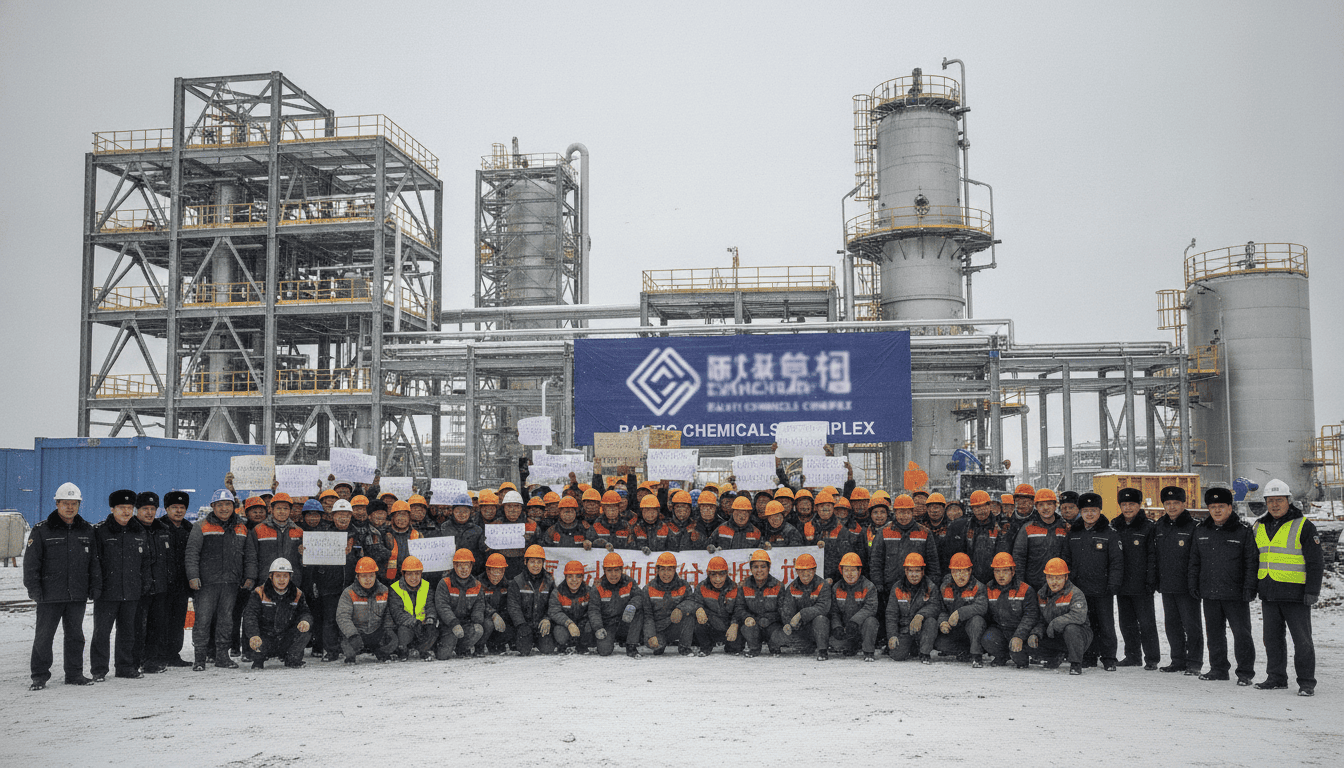
Chinese workers in Ust-Luga stage mass protests over unpaid wages and confined conditions
Chinese workers in Ust-Luga protest unpaid wages, seized passports and prison-like housing at a major chemical site, triggering strikes and partial payments.
Chinese workers in Ust-Luga have staged repeated demonstrations after months of unpaid wages, alleging that their passports were confiscated and that living conditions on the construction site are “prison-like.” The protests, which workers documented on Douyin and other social platforms, involve several hundred laborers and have forced partial payments and temporary returns to China for some. The unrest exposes frictions beneath the expanding economic ties between Beijing and Moscow and highlights risks for migrant labor on large cross-border projects.
Mass march across the Ust-Luga construction compound
Several hundred Chinese workers marched across the Ust-Luga plant complex using bed linens as makeshift placards, according to video posts shared on social media. Participants chanted demands for wages and denounced the detention of their documents, drawing public attention inside China even as the story remains muted in Russian mainstream channels. Organizers and witnesses say strikes have recurred since April and that the site, a major chemical installation on the Gulf of Finland, employs thousands of migrant workers.
Claims of withheld pay, confiscated passports and restricted movement
Workers including a man known online as “Lao Ye” posted that they had not received a single yuan in wages for months and that their passports were taken from them. Other employees described accommodation they called “prison-like” and said they were not allowed to leave the factory grounds year-round. Those accounts match broader complaints by migrant laborers who say they are vulnerable when contracts and pay are mediated through multiple agencies.
Project scale and the involvement of Chinese state firms
The site in Ust-Luga is being built with significant Chinese corporate involvement, notably the state-owned China National Chemical Engineering Group, which reported a 2025 investment participation figure of 134 billion renminbi—more than 17 billion euros—and said the project was about 71.38 percent complete. The company, which employs roughly 50,000 people nationwide, is a central contractor on the chemical complex with a contract running until the end of 2027. Workers on the ground say many are hired through recruitment agents rather than directly by the principal contractor, complicating accountability.
Consular warnings and worker vulnerability in subcontracting chains
Chinese consulates in Russia regularly warn citizens not to surrender passports, to secure formal employment contracts and to resolve disputes through official channels, documents and posts show. Labor-rights observers note that many recruits sign contracts with agencies in China and therefore have no direct legal ties to the foreign main contractor, leaving them as the weakest link in a multi-tier subcontracting chain. That structure, combined with language barriers and limited local recourse, makes wage enforcement difficult and conflicts easy to escalate.
Protests elsewhere and the rare public visibility in China
Similar demonstrations have occurred elsewhere in Russia: in April roughly 200 Chinese workers marched in Komsomolsk am Amur under slogans calling on President Vladimir Putin or Rosneft chief Igor Sechin for help. Local reporting indicated some tolerance by authorities for the march, but a regional court later fined an organizer 50,000 rubles—about 570 euros—and sanctioned other participants for obstructing passersby. Notably, many of the Ust-Luga and Komsomolsk complaints circulated widely on Douyin and WeChat in China, where authorities have at times allowed coverage of foreign labor disputes to surface.
Activists’ assessments and safety concerns on site
China Labor Watch and other labor advocates say Ust-Luga shows multiple indicators of coercive working conditions and estimate the on-site workforce at roughly 10,000, many of them Chinese. Reports from the site also include repeated accounts of workplace accidents in recent months, underscoring concerns about safety oversight. Activists argue that geopolitical closeness between Beijing and Moscow has not eliminated routine labor abuses at project level and that management, legal and cultural factors on large cross-border builds can produce systemic risks for migrant workers.
Protesters’ social-media posts suggest the demonstrations have had sporadic effects: some workers, including Lao Ye, reported receiving initial payments after public complaints, and several hundred are said to have returned to China in early July following partial settlements. But the appearance of new videos from Ust-Luga indicates unresolved grievances and the potential for renewed action. The episodes point to a fragile balance between high-level China–Russia cooperation and low-level labor friction that could persist until firms, recruiters and authorities address the structural gaps that leave migrant workers exposed.
