
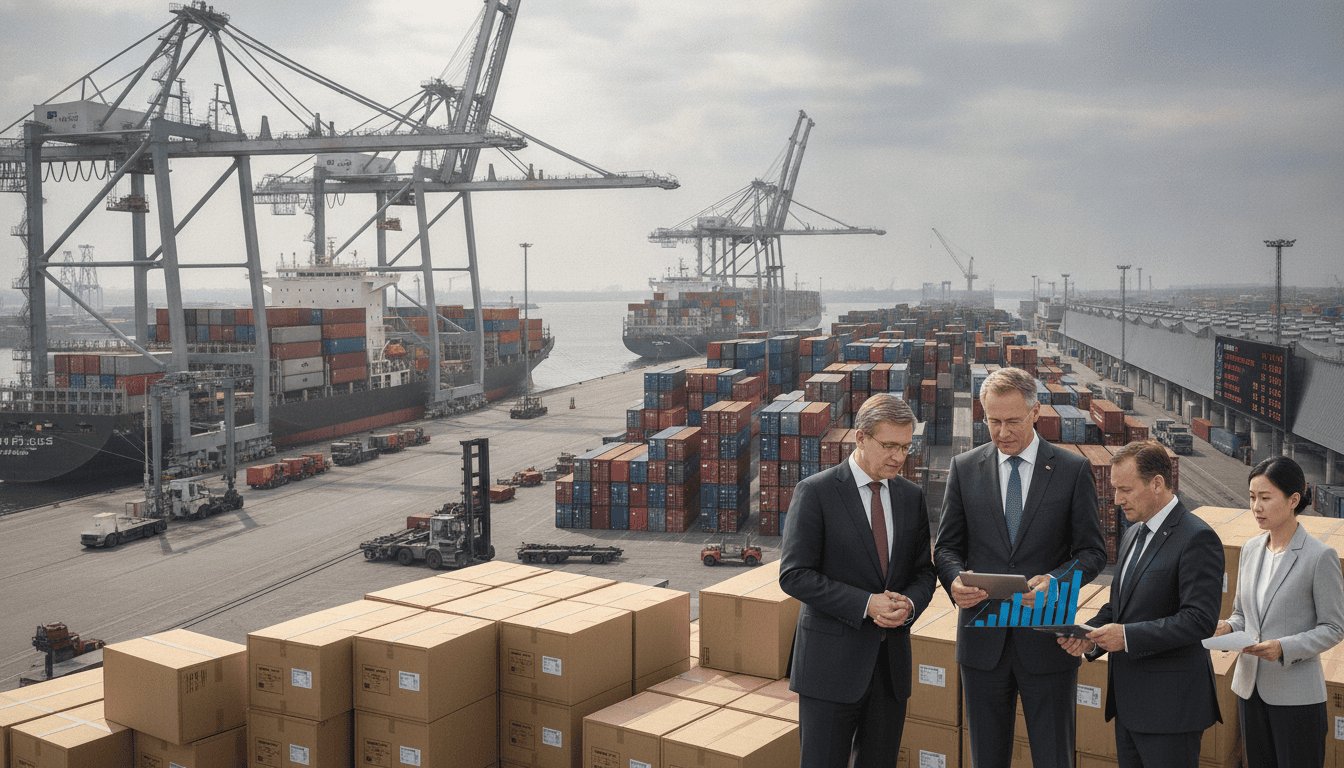
China exports to Germany surge in June, widening first-half trade deficit
China exports to Germany jumped 27.2% year-on-year in June, while imports from Germany rose just 3.1%, data from China’s customs authority show.
China exports to Germany climbed sharply in June, according to customs figures released in Beijing, signaling stronger outbound shipments to Europe’s largest economy. Imports into China from Germany increased only modestly by 3.1% in dollar terms, leaving Germany with a growing trade shortfall in the first half of the year. The divergence has pushed the six-month imbalance to more than $22 billion, underscoring an asymmetric recovery in bilateral trade.
June export surge and monthly figures
Customs statistics reported a 27.2% year-on-year rise in Chinese exports to Germany measured in U.S. dollars for June. That performance contrasts with German shipments to China, which expanded by just 3.1% in the same month, producing a notable monthly gap.
Analysts point to renewed external demand for manufactured goods, inventory replenishment in European supply chains, and competitive pricing as likely contributors to the sharp export growth. The figures do not break down sectoral contributions in the public summary, leaving questions about which product categories led the surge.
First-half totals and the widening deficit
Over the first half of the year, deliveries from China to Germany increased by 19% compared with the same period a year earlier, while German exports to China rose only 1.8%. In value terms, China shipped goods worth $67.5 billion (about €59.3 billion) to Germany, against German exports of $45.2 billion.
That gap leaves Germany with a trade deficit of $22.3 billion with China for the six-month period, roughly equivalent to €19.6 billion using the same exchange-rate proxy. The scale of the imbalance reflects an uneven pace of demand and highlights the continuing importance of China as a supplier to German markets.
Pressure points for German industry and supply chains
German manufacturers and retailers are likely to feel the effects of the growing import share from China, particularly in sectors where Chinese suppliers have expanded capacity and cut prices. Increased flows of Chinese goods can put downward pressure on domestic producers competing in overlapping product lines.
At the same time, German firms that rely on Chinese components may benefit from improved availability and potentially lower input costs, but they also face strategic risks tied to concentration of suppliers. Companies are now balancing short-term cost advantages with longer-term resilience concerns in sourcing and production networks.
Policy implications for Berlin and Brussels
The widening deficit may intensify discussions in Berlin and Brussels about industrial policy, strategic autonomy, and steps to rebalance trade relationships. Policymakers will weigh targeted support for sensitive industries against the risks and costs of protectionist measures.
European institutions and national governments could pursue deeper trade dialogue with Beijing or accelerate efforts to diversify supply chains, depending on how political and economic priorities evolve. Any policy response will need to navigate complex commercial ties and regulatory frameworks between the two economies.
Corporate reactions and market adjustments
Some German exporters are reporting only modest gains in sales to China so far this year, reflecting the relatively slow growth in outbound shipments to the Chinese market. Companies that previously depended on rapid expansion in China may now reassess growth forecasts and investment plans.
Import-dependent German firms and distributors may seize opportunities from lower-cost Chinese supplies, while others might explore alternative sourcing or invest in automation to protect margins. Financial markets and trade associations will be monitoring order books and purchasing managers’ surveys for signs of a sustained shift.
Looking ahead, the second half of the year will be critical in determining whether June’s export spike marks a sustained acceleration of China exports to Germany or a temporary rebalancing after earlier disruptions. Both business leaders and policymakers say they will watch forthcoming customs releases closely for sectoral detail and momentum.
The customs data from Beijing provide an early snapshot of bilateral trade dynamics, but further monthly and sectoral breakdowns will be needed to fully understand drivers and persistence. For now, the figures underscore a pronounced asymmetry in trade flows that could shape industrial strategy and diplomatic discussions in the months ahead.
