
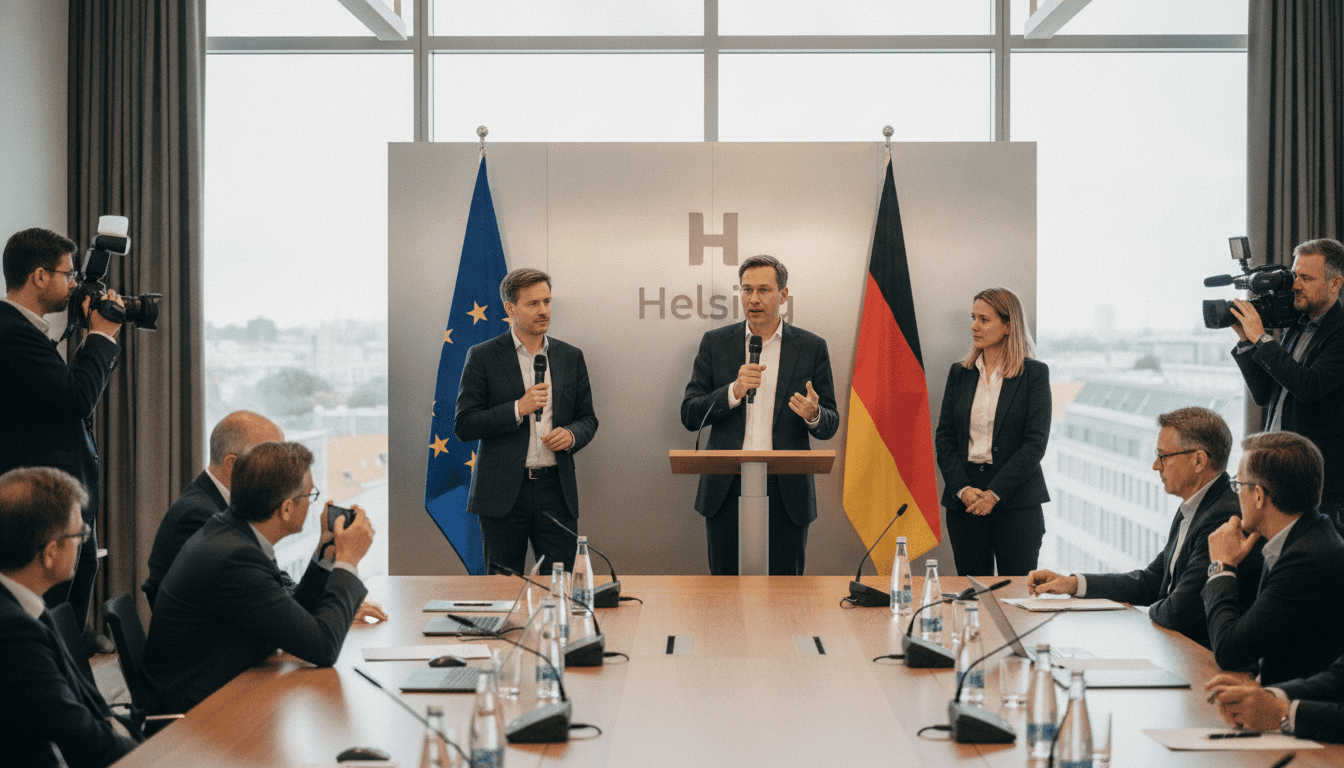
Helsing raises $1.8 billion, vaulting Munich drone firm to $18 billion valuation
Helsing raises $1.8 billion in a blockbuster round, lifting the Munich drone and AI company to an $18 billion valuation as it accelerates development of global military AI platforms.
Helsing, the Munich-based drone and software company, announced a $1.8 billion financing round that values the business at $18 billion and marks one of the largest startup fundraisings in Europe. The company said the new capital will fuel expansion of its AI-led control platforms and broader product development across unmanned aerial and underwater systems. Founded in 2021, Helsing now employs more than 1,000 staff and tells investors it has moved beyond the startup label into the ranks of so-called “Neo Primes” competing with established defence contractors.
Helsing completes one of Europe’s biggest startup funding rounds
Helsing confirmed the round was heavily oversubscribed, indicating stronger demand than the company expected. The injection of $1.8 billion pushes the firm into a new growth phase and substantially increases its firepower for research, development and scaled production. Management framed the raise as a long-term vote of confidence in its software-first approach to unmanned systems.
Major institutional investors back Helsing while majority ownership remains European
Among the lead backers Helsing named were CCP Investments, JP Morgan Chase and Goldman Sachs Alternatives, reflecting a mix of pension and global financial investors. Despite the participation of large non-European institutions, Helsing said the majority ownership of the company remains in European hands. Company officials emphasized that the investor mix supports international growth without relinquishing European control of strategic operations.
AI flight-control software sits at the heart of Helsing’s strategy
Helsing positions itself primarily as an AI and software company rather than merely a drone manufacturer, with its algorithms responsible for guidance, targeting and autonomous decision-making. The firm argues that software-defined capabilities create a competitive edge against legacy defence contractors by enabling rapid feature updates and networked operations. Executives say much of the new funding will be allocated to advancing those AI platforms, including scaling data pipelines and refining autonomy for contested environments.
Product lineup includes kamikaze drones, underwater systems and a planned unmanned fighter
Helsing supplies a range of unmanned systems, from loitering munitions reportedly used by Ukrainian forces to underwater reconnaissance drones the company began producing in 2025. The product pipeline also includes a longer-term project to develop an unmanned combat aircraft, aided by Helsing’s acquisition of Grob Aircraft in 2025. Company materials describe a modular approach that pairs off-the-shelf airframes with upgraded avionics and continuously trained autonomy stacks.
Defense-sector backdrop and investor appetite for “Neo Primes”
The funding comes as the market for defence companies has grown more selective, with valuations and equity dynamics shifting across the sector. Traditional arms manufacturers have seen share volatility this year, and some planned public listings have been delayed, yet investor interest in software-centric newcomers remains pronounced. Helsing’s oversubscribed round and a wave of other sizable private investments in European defence tech underscore continued appetite for firms that combine hardware with advanced AI.
Planned use of proceeds focuses on AI platforms, R&D and scale-up
Helsing says the bulk of the fresh capital will be channeled into developing new AI platforms, expanding production capacity and accelerating international sales and support. The company also flagged continued investment in R&D efforts tied to autonomy, sensor fusion and system integration for multi-domain operations. Management did not provide a detailed breakdown of spending but described the round as intended to sustain multi-year product roadmaps and industrial scaling.
The size and profile of Helsing’s financing round signal a shift in how European defence innovation is funded, with large financial institutions now placing significant bets on software-driven military technologies. As Helsing moves to deploy its capital, the company will face heightened scrutiny over export controls, customer selection and the dual-use implications of its systems even as it pursues rapid technical advancement.
