
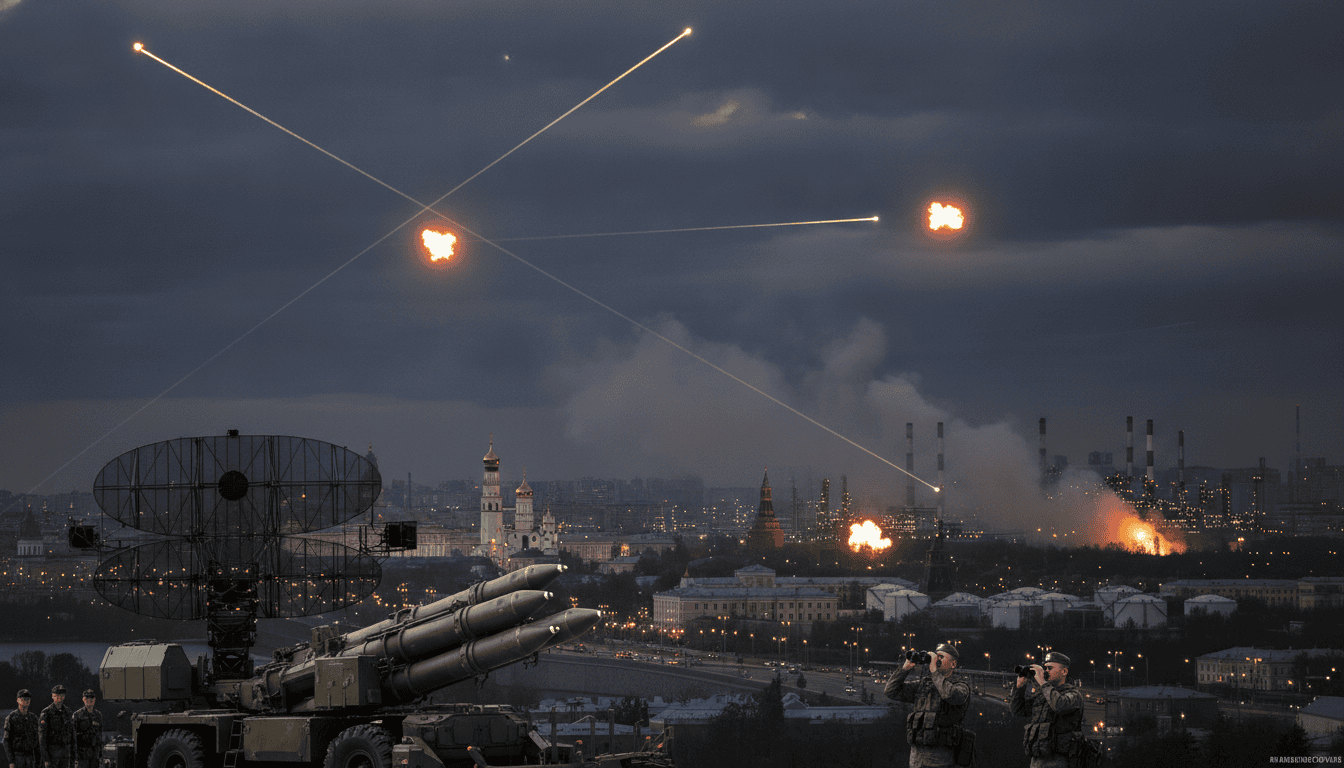
Russia Says 376 Ukrainian Drones Intercepted During Overnight Attacks
Russia says 376 Ukrainian drones were intercepted overnight, causing fires at oil sites in the south and near Moscow; officials report damage but no immediate casualties.
The Russian Defense Ministry reported that 376 Ukrainian drones were intercepted over Russian territory in the early hours of Friday, saying many were aimed at the Moscow region and energy facilities in the south. Russian regional authorities said debris from the strikes ignited fires at a Krasnodar refinery and at fuel storage facilities in the Azov district, while wreckage fell in a residential yard near Severskaya. Local emergency services reported damage to industrial sites but initially stated there were no casualties, and Moscow’s military statement was posted on the state online service Max.
Defense Ministry reports 376 drones intercepted
The Defense Ministry released figures early Friday asserting that air defenses engaged a mass drone wave and successfully brought down hundreds of unmanned systems before they reached key targets. The statement, carried on state platforms, identified the capital region among the areas targeted and said intercepts took place across multiple sectors of Russian airspace. Moscow framed the operation as a large-scale defensive action against a coordinated UAV campaign.
The ministry’s account describes a high rate of engagement by integrated air defense systems, but those numbers have not been independently verified outside official channels. Independent monitoring groups or foreign ministries had not confirmed the scale of the interceptions at the time of the ministry’s announcement. Analysts caution that state tallies in active conflicts can vary from third-party assessments.
Fires at Krasnodar refinery and Azov fuel depots
Regional authorities in Krasnodar reported that drone debris struck and sparked a blaze at a refinery complex, prompting an immediate response from firefighting units. Officials said two fuel storage sites in the Azov district also caught fire after being hit, heightening concerns about secondary explosions and environmental damage. Emergency commanders posted images and updates on messaging platforms indicating localized containment efforts.
In the Severskaya district, debris from a downed drone reportedly landed in the courtyard of a residential building, according to the regional emergency command. Authorities there said the impact caused property damage but initially reported no injuries among residents. Local officials emphasized that response teams were dispatched to assess structural safety and to extinguish remaining hotspots.
Debris in populated areas raises civilian safety concerns
Reports that wreckage fell into residential spaces underscore the risks posed by drone operations in populated regions, whether the devices are intercepted in flight or strike their intended targets. Emergency services said they were conducting sweeps of affected neighborhoods to check for unexploded ordnance and to secure damaged infrastructure. Residents described disrupted power supplies and visible damage to fencing and outbuildings in nearby settlements.
Humanitarian observers note that even when air defenses successfully neutralize incoming drones, falling fragments can injure civilians, damage housing, and disrupt essential services. Local authorities have advised residents to stay clear of crash sites and to follow instructions from emergency responders while investigations proceed.
Targeting energy infrastructure to disrupt funding
Russian statements and independent analysts say Ukrainian strikes have increasingly focused on energy infrastructure, including refineries, storage facilities, and pipelines, as part of a campaign to pressure Moscow’s revenue streams. Kyiv has previously acknowledged targeting assets it says support Russian military operations, while stressing efforts to minimize civilian harm. The reported overnight attacks fit a pattern of strikes aimed at degrading logistical and economic resources.
Such targeting reflects a strategic intent to impair the adversary’s ability to finance and sustain military operations, according to military analysts. Destruction of fuel supplies and refining capacity can have ripple effects on military mobility, local economies, and civilian supply chains, complicating recovery and reconstruction in the affected regions.
Diplomatic fallout and stalled ceasefire talks
The wave of drone activity comes amid stalled negotiations over a ceasefire, with U.S.-led mediation efforts reported to be at an impasse in recent days. Officials involved in talks have warned that intensified strikes on energy and civilian-adjacent infrastructure make diplomatic progress more difficult. Moscow’s public framing of the interceptions underscores how battlefield developments feed directly into the political and diplomatic narrative.
International actors monitoring the conflict expressed concern about escalation and urged restraint, while also calling for independent verification of damage and casualty claims. The interplay between military operations and negotiation dynamics suggests the potential for further rounds of retaliatory strikes if diplomatic momentum does not return.
Military strain and verification challenges
A large number of intercepted drones, if confirmed, signals continued pressure on Russian air defenses and highlights the evolving use of unmanned systems in the conflict. Military experts note that mass drone swarms are intended to saturate defenses and to force the redeployment of air defense assets across wide territories. Verifying the full scope of damage and the origin of individual UAVs remains difficult in the fog of conflict.
Independent observers and open-source intelligence groups typically take time to corroborate official tallies, and comparisons between state claims and external analyses often emerge over subsequent days. For now, Russian authorities’ figures form the primary public account of the overnight events.
The situation remains fluid as emergency crews complete recovery and safety checks at affected sites and as authorities continue to provide updates on damage assessments and any civilian impact.
