
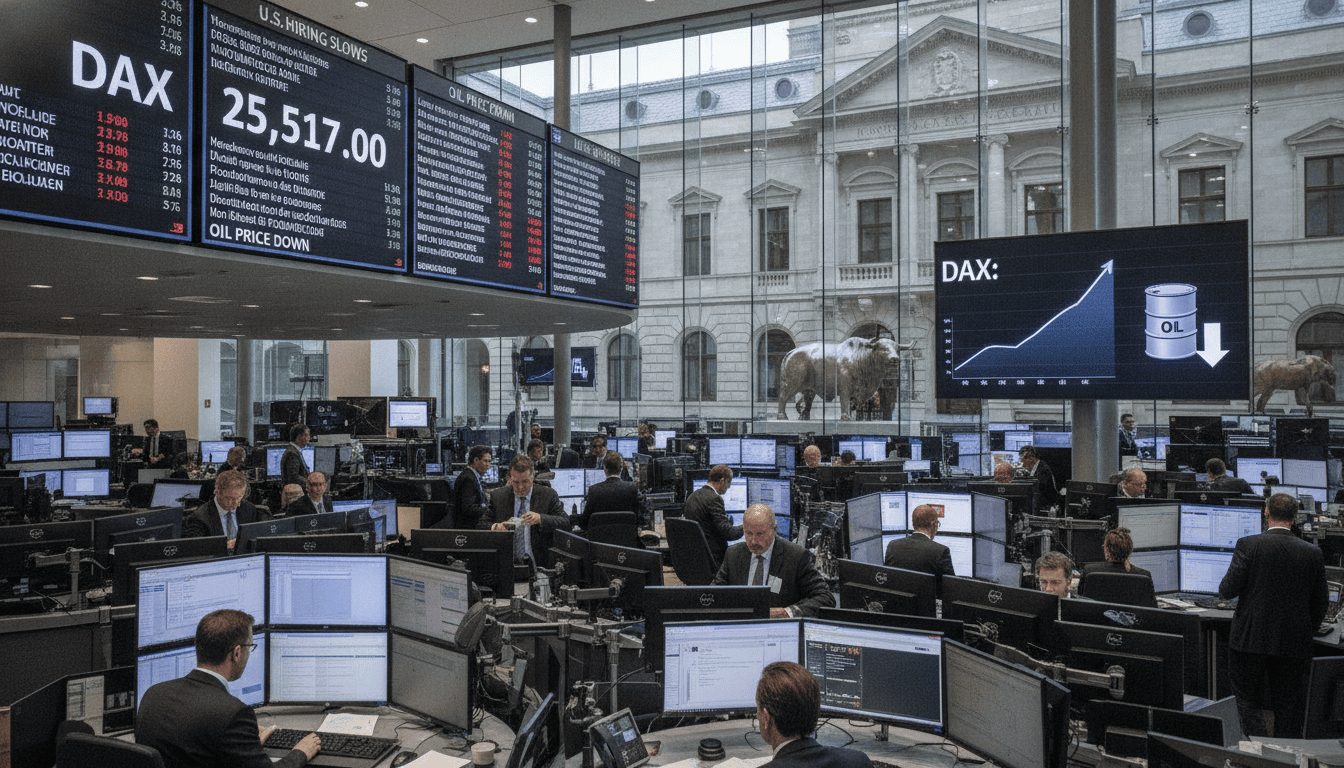
Dax record: German benchmark climbs to 25,517 points as markets rally on US jobs slowdown and falling oil
Dax record at 25,517 points as German benchmark jumps 1.9% after US jobs slowdown and lower Brent oil; Euro Stoxx 50 also reaches a fresh peak on Fed hopes.
The Dax record was set on Thursday when Germany’s leading equity index surged to 25,517 points, gaining 1.9 percent from the previous close. The move, described by traders as broad-based, pushed the Euro Stoxx 50 to a new high of roughly 6,370 points as continental blue chips also advanced. Investors pointed to a softer-than-expected US jobs report and easing oil prices as the primary catalysts for the rally.
US jobs slowdown cools rate-hike expectations
The June US payroll data showed a marked deceleration in hiring, weakening expectations for an immediate interest-rate increase by the Federal Reserve. Market participants interpreted the slowdown as reducing the probability of a near-term Fed tightening, prompting a risk-on shift across global equity markets. That pivot in expectations underpinned gains in rate-sensitive sectors and helped lift major European benchmarks.
The softer labour-market momentum prompted a reassessment of monetary policy paths among investors, with futures markets pricing in a higher chance of a Fed pause. Analysts noted that even a modest delay in further US rate increases can have an outsized effect on equity valuations, particularly for large export-oriented firms with substantial dollar revenues.
Energy markets and the Iran situation weigh less on sentiment
A decline in Brent crude prices also supported the rally, with front-month Brent trading around $71 per barrel on the session that produced the Dax record. Prices had spiked to near $119 earlier this year amid disruptions linked to the Iran conflict and temporary closures in the Strait of Hormuz, but recent developments have eased some of those supply concerns. While the geopolitical situation remains volatile and reciprocal attacks were reported recently, traders appear to be pricing in a lower immediate risk premium for oil.
Lower energy costs brighten the outlook for euro-area producers and household purchasing power, removing a significant near-term headwind for corporate margins. Still, strategists cautioned that any renewed escalation in the region could quickly reverse market optimism and lift energy prices once again.
Euro Stoxx 50 also posts an all-time high
The broader Eurozone benchmark, the Euro Stoxx 50, rose about 1.4 percent to approach 6,370 points, marking its own record. The advance reflected coordinated gains across sectors, with industrial, technology and financial stocks contributing to the uptick. Market breadth suggested confidence beyond a few headline names, signaling a more generalized risk appetite among institutional and retail investors.
Cross-border flows into European equities increased as yields stabilized and the euro remained relatively steady against the dollar, encouraging international buyers. Commentators noted that simultaneous records in regional benchmarks reinforce the narrative of a synchronized European equity rally rather than an isolated rise in Germany.
Dax decouples from weak domestic growth, analysts say
Analysts at DZ Bank pointed out that the Dax’s ascent increasingly diverges from Germany’s lagging economic indicators, driven largely by the international footprint of its constituents. Dax-listed companies generate roughly four-fifths of their revenue abroad, insulating index performance from weaker domestic demand and amplifying sensitivity to global cycles. That dynamic helped the Dax deliver strong returns last year, when it rose about 23 percent, its best showing since 2019.
Investors and strategists highlighted earnings resilience among major exporters and the role of currency movements in boosting reported profits in euro terms. Nevertheless, forecasters warned that slower German GDP growth and downgraded forecasts from leading institutes remain a potential constraint on longer-term index gains.
Market risks and what could derail the rally
Despite the optimism, several downside risks persist that could unsettle recent gains and challenge the Dax record’s durability. Renewed geopolitical flare-ups in the Middle East would likely boost oil prices and increase volatility, while any unexpected strength in US inflation or labour markets could prompt a faster-than-anticipated Fed response. Domestically, weaker-than-expected corporate guidance or disappointing factory orders could also prompt profit-taking among investors.
Portfolio managers advised caution in positioning, recommending staggered exposure and hedging ahead of major economic releases and central-bank communications. Traders pointed to the possibility of rapid reversals in sentiment, especially given the elevated valuations in parts of the market following consecutive rallies.
Outlook for investors and upcoming catalysts
Looking ahead, market attention will turn to upcoming US inflation prints, next Fed commentary and corporate earnings updates from several Dax heavyweights. Those data points are likely to influence whether the recent upward momentum holds or encounters resistance. For now, investors appear willing to price in a softer path for rates and a moderation of geopolitical risk—factors that helped lift the Dax to its new record.
Short-term market watchers will also monitor oil-market developments and any fresh domestic economic indicators from Germany that could alter the narrative of decoupling. The balance between still-elevated geopolitical hazards and easing monetary concerns will determine if the Dax can sustain its record levels beyond the current bout of optimism.
The Dax’s milestone reflects a complex mix of global drivers: softer US employment figures that temper rate fears, easing energy costs after months of pressure, and the outsized international exposure of Germany’s largest companies that blunts the impact of a weak domestic economy.
