
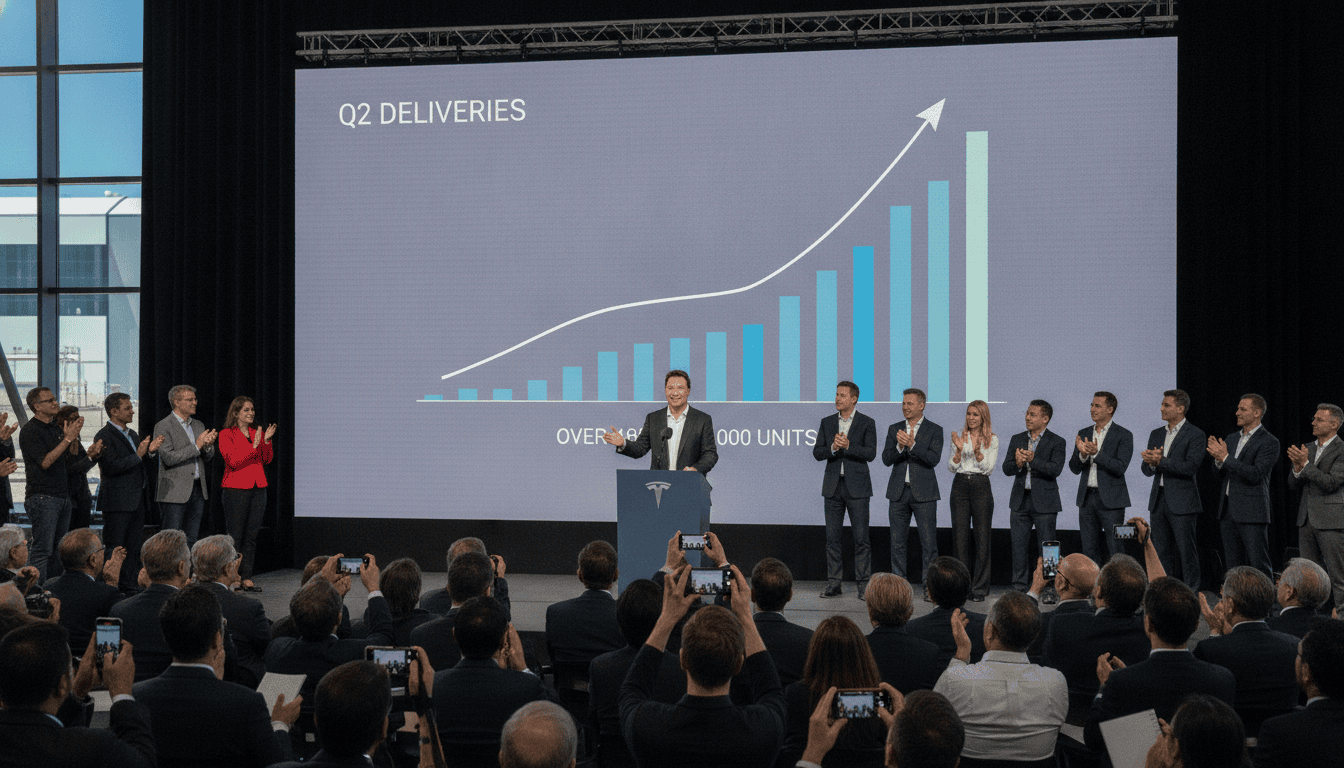
Tesla deliveries rise 25% in Q2 to over 480,000, but shares dip as investors focus on future ventures
Tesla deliveries jump 25% in Q2 to over 480,000 vehicles, beating estimates; shares fell as investors weigh future projects ahead of July 22 quarterly results.
Tesla reported a 25 percent year‑over‑year increase in Tesla deliveries for the second quarter, with more than 480,000 vehicles shipped to customers, a result that outpaced analyst expectations. The stronger‑than‑anticipated delivery figures arrived even as the company’s shares slipped sharply in intraday trading, underscoring investor attention on longer‑term prospects rather than current auto sales. Management will present the full second‑quarter financial results on July 22, a date the market is watching for profit and margin detail.
Delivery figures and market reaction
The company said deliveries exceeded 480,000 units in Q2, representing a notable rebound after a down year for the automaker. Analysts had forecast a lower tally, and the surprise beat initially failed to buoy the stock; Tesla shares fell more than eight percent at one point on Thursday. Year‑to‑date the stock has lost over 13 percent of its value, leaving the firm with a market capitalization near $1.2 trillion.
Investors’ muted response highlights a decoupling between current vehicle performance and broader market sentiment about Tesla’s future businesses. The market appears to be pricing in the value of promised new ventures even as quarterly delivery metrics improve.
Profit slump and last year’s sales drop
Tesla’s recent recovery follows a difficult period in which the company reported a nine percent decline in deliveries in the prior year and a 46 percent fall in net profit. That contraction weighed on investor confidence and prompted scrutiny of both operations and strategy. Management has since emphasized cost controls and production efficiency, while also reiterating long‑term ambitions that stretch beyond passenger cars.
Policy shifts and political headwinds
A range of external factors contributed to the prior weakness in demand, including shifts in government incentives and political controversy surrounding the company’s leadership. U.S. federal tax credits for electric vehicles — previously offering up to $7,500 — were phased out at the end of September 2025, removing a key purchase incentive for American buyers. Separately, the public profile and political activities of the company’s CEO have prompted debate about reputational risk in key markets.
Those elements combined to compress sales and margins in 2025, but the latest delivery figures suggest at least a partial recovery in buyer interest.
European rebound drives volume gains
Although Tesla does not publish a regional breakdown of vehicle deliveries, industry registration data point to a strong recovery in Europe. The European Automobile Manufacturers Association reported a 77 percent increase in Tesla registrations in the first five months of the year compared with the same period last year. That contrasts with a 38 percent decline in Tesla registrations for the full year 2025 across the region, indicating a sharp swing in momentum.
Executives and analysts cite improving availability of models in European showrooms and intensifying fuel‑price sensitivity among consumers as factors supporting demand on the continent.
Fuel prices and geopolitical volatility
One proximate driver of renewed interest in electric vehicles has been the recent rise in petrol prices tied to geopolitical tensions in the Middle East, particularly activity related to the Iran conflict. Higher pump prices have made the total cost of ownership for EVs more attractive in the short term, contributing to a lift in demand in some markets. However, oil prices have eased from their peaks, raising questions about the durability of that effect.
Market watchers say the sustainability of the recovery will depend on how fuel costs evolve, the competitive launch cadence of rival EV makers, and Tesla’s ability to convert deliveries into stable profits.
Investor focus on robotaxis and other future bets
For many investors the headline car business is only part of Tesla’s valuation story, and the stock’s recent volatility reflects growing emphasis on future initiatives. The company has publicly promoted ambitions in autonomous ride‑hailing, so‑called robotaxis, and humanoid robotics, businesses that could reshape its long‑term revenue mix if they materialize. Investors appear to be balancing near‑term operational improvements with skepticism about the timeline and cost of those projects.
Complicating that picture, a recent public listing of another company linked to the firm’s leadership reportedly produced a market capitalization that now exceeds Tesla’s, shifting some investor attention away from the automaker.
Second‑quarter financial statements will be released on July 22, when investors will get fuller disclosure on margins, deliveries by category, and guidance that will be critical to assessing whether the current upturn in Tesla deliveries represents a lasting turnaround or a temporary rebound.
