
Extremists in Berlin Rise to 9,720, Report Links Eco‑Anarchism and Online Recruitment
Verfassungsschutz: extremists in Berlin rose to 9,720 in 2025, driven by left‑wing eco‑anarchism, online Islamist recruitment and violent right‑wing networks.
The number of extremists in Berlin rose to 9,720 last year, the city’s Verfassungsschutz reported, marking a measurable increase from 9,370 the year before. The Landesverfassungsschutz attributed the rise to growth across several ideological strands, with left‑wing militants accounting for the largest share. Berlin’s Innensenator Iris Spranger presented the 2025 state security report and highlighted both street‑level violence and a shift in recruitment methods.
Verfassungsschutz records 9,720 extremists in 2025
The Berlin domestic intelligence service logged an increase of 350 individuals classified as extremists between 2024 and 2025. Officials said the total now stands at 9,720 people who fall under the agency’s monitoring across different ideological categories. The report uses established criteria to classify activity as extremist in nature and places emphasis on dynamics rather than static membership alone.
The agency stressed that changes were uneven across sectors, with some scenes expanding more rapidly than others. Analysts emphasized that raw headcounts do not fully capture threat levels, which depend on capabilities, networks and willingness to use violence.
Left‑wing scene accounts for roughly 40 percent of extremists
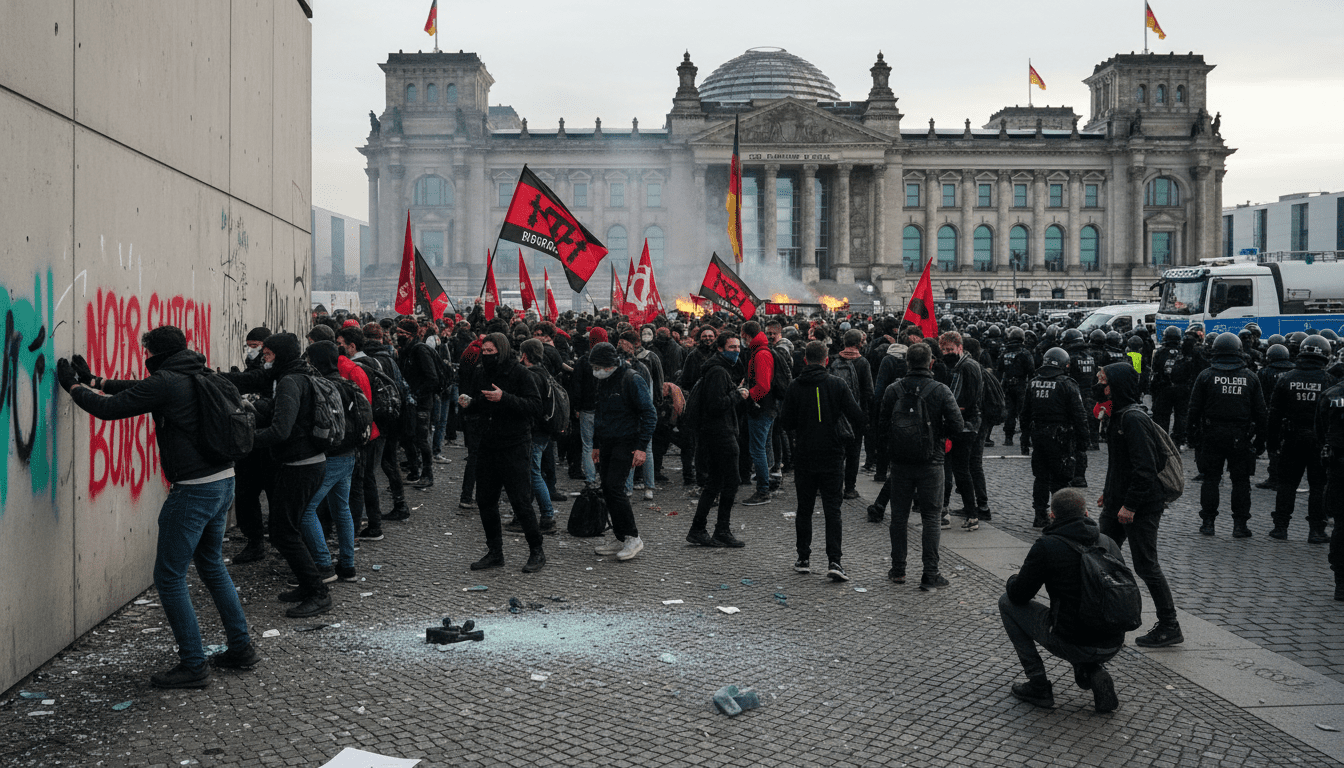
Left‑wing extremism made up about 40 percent of the total, with the Verfassungsschutz estimating roughly 3,950 individuals in the city. That figure represents an increase of about 150 people compared with the previous year, a rise the agency said was notable given recent operational activity. Investigators linked part of the radicalisation to an emergent “eco‑anarchist” ideology that fuses environmental militancy with anti‑state tactics.
The report underlined that left‑wing groups also exploited broader geopolitical tensions to mobilise supporters. Officials pointed to targeted demonstrations and collaborations with other radical actors around Middle East‑related events as amplifying recruitment and visibility for parts of the scene.
Arson attacks on power grid in September 2025 and January 2026 remain under probe
The Verfassungsschutz report singled out a September 9, 2025 arson attack on the electricity grid in Treptow‑Köpenick as a turning point that made the threat visible to many residents. That incident caused widespread outages and prompted a large investigative response, though consequences were mitigated by mild weather at the time. A more severe attack in January 2026 in Steglitz‑Zehlendorf left tens of thousands without heat during an extended cold spell, and authorities say investigations into both incidents continue.
Spranger told reporters that probes into the attacks were ongoing and would remain a priority for police and intelligence services. She warned that such operations illustrated how extremist tactics could escalate from damage to critical infrastructure to direct risks for public safety.
Islamist numbers and foreign‑oriented extremists show modest growth
The Verfassungsschutz put Islamist extremism in Berlin at about 2,590 people in 2025, up from 2,440 the year prior. Separate figures for extremists with foreign‑oriented ideologies climbed slightly from 1,680 to 1,700, with approximately 1,100 identified as linked to the PKK. Agency officials noted that these changes were incremental but worrying because of evolving recruitment strategies and transnational ties.
The head of the Berlin Verfassungsschutz, Michael Fischer, said online channels had become a primary vector for outreach and radicalisation. Fischer described a pattern in which recruiters from regions in Africa and Asia used polished messaging to entice young people in Berlin to participate in foreign conflicts.
Online recruitment and school‑targeting prompt prevention talks
Authorities raised particular concern over the rise of digital recruitment and attempts to reach pupils near schools, according to Spranger’s remarks. She said she would coordinate with Education Senator Katharina Günther‑Wünsch to develop targeted prevention measures and to restrict recruiters’ access to young people. Officials outlined plans to expand monitoring of online platforms while strengthening local prevention and civic education in vulnerable neighbourhoods.
The Verfassungsschutz warned that internet‑based recruitment often presents scant traces and leverages social media and private messaging apps to groom recruits. That pattern makes early detection harder and increases the importance of community‑level awareness and school‑based interventions.
Violent right‑wing net cultures behind uptick in right‑wing extremists
Although the overall number of right‑wing extremists in Berlin remained relatively small, it rose from 1,450 to 1,480 last year, the report shows. The agency attributed much of this increase to “violence‑oriented right‑wing net cultures,” loose online networks that radicalise users and promote attacks against minorities. Inspectors named groups such as “Deutsche Jugend voran” as examples of the sort of decentralised subcultures driving recruitment.
Berlin’s approach differs from some other federal states in how it treats certain political formations; the Verfassungsschutz does not classify the local AfD branch as extremist. That distinction helps explain why the municipal right‑wing tally is lower than in some other Länder, even as covert and violent online communities cause concern.
Officials pledge intensified investigations and stepped‑up prevention
Both Spranger and Fischer said the state would “intensively” pursue leads and work to disrupt networks that plan or glorify violence. They called for enhanced information sharing between police, intelligence services and educational bodies to close gaps exploited by recruiters. The report’s release has prompted commitments to refine digital monitoring, boost school prevention programmes and maintain heightened investigative resources.
Officials also warned residents to remain vigilant and to report suspicious activity, particularly where it concerns attempts to recruit minors or actions targeting infrastructure. The administration framed the response as balancing civil liberties with necessary safeguards to protect public order.
The Verfassungsschutz report paints a picture of a city where multiple extremist currents are expanding in different ways, from street mobilisation and infrastructure attacks to targeted online recruitment. As Berlin adapts law‑enforcement and prevention strategies, authorities say they will continue monitoring developments closely and prioritise measures that reduce risks to residents.
