
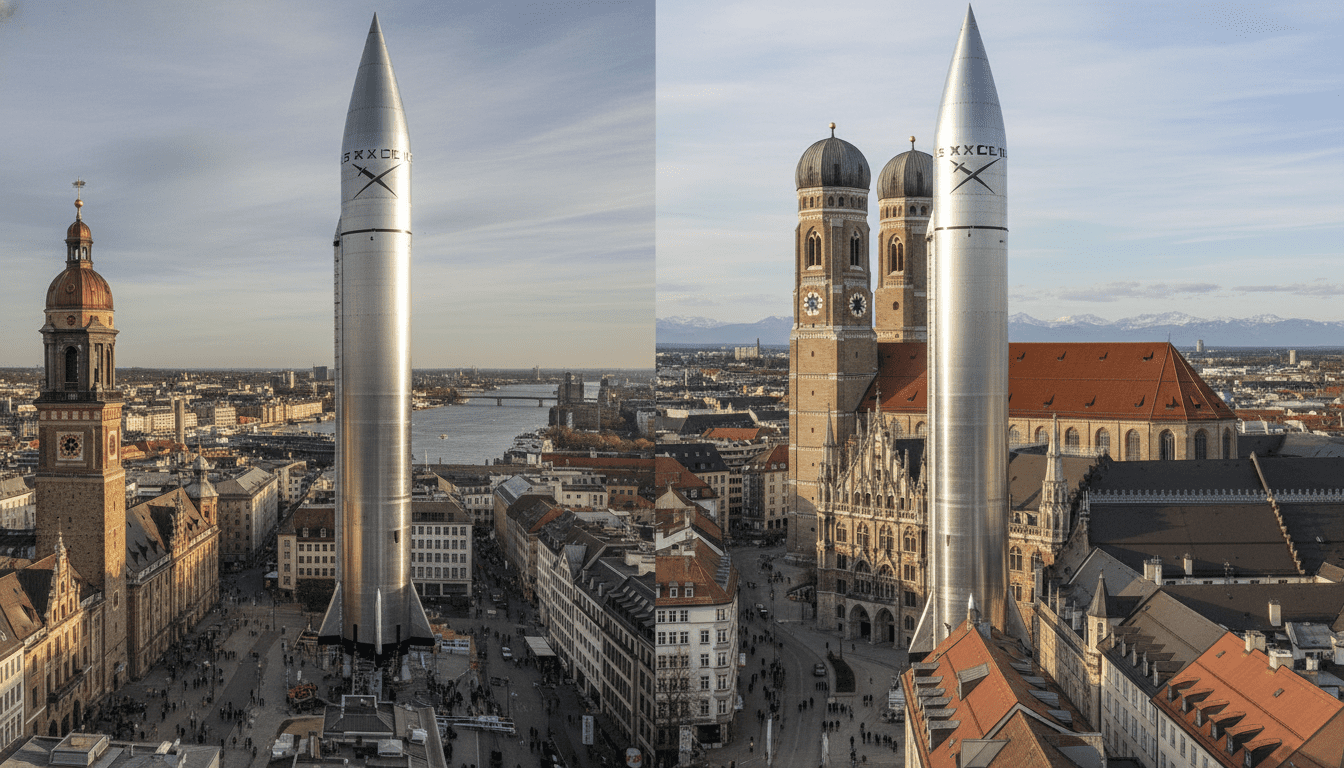
SpaceX Starship Launch in Germany Would Tower Over Historic Church Spires and Trigger Wide Debate
Hypothetical Starship launch in Germany could dwarf historic church spires, prompting debate over safety, permits, environment and local economic opportunity.
Elon Musk’s SpaceX Starship has become the center of a speculative scenario in which a launch from German soil would dramatically alter skylines and public debate. The idea of a Starship launch in Germany captured attention because the rocket’s full stack would, in hypothetical comparisons, exceed the heights of landmarks such as Hamburg’s St. Michaelis and Munich’s Frauenkirche. That visual contrast — a modern orbital launcher looming above centuries-old spires — encapsulates the mix of wonder, logistical questions, and political pushback surrounding the proposal.
Starship would exceed several familiar German landmarks by meters
Observers have pointed out that a fully stacked Starship would surpass well-known church towers by notable margins, creating a striking visual juxtaposition in city skylines. The comparison has helped crystallize abstract technical details into an image the public easily understands: a new space-age structure beside historically rooted architecture. That contrast has driven much of the popular coverage and helped focus attention on practical implications beyond spectacle.
Speculation names Hamburg and Munich as hypothetical sites
Media and commentators have suggested locations such as Hamburg or Munich when imagining where a Starship launch in Germany might occur, though those suggestions have mostly been hypothetical. Port cities and large transport hubs are often proposed because they can offer deep-water access, heavy-lift logistics and existing industrial infrastructure. Real-world site selection for orbital launches, however, requires terrain, airspace and safety profiles that many inland or urban areas do not meet.
Permits, airspace coordination and safety regulations would be complex
A spaceport proposal in Germany would face dense regulatory hurdles from national and European authorities, including aviation regulators and environmental bodies. Coordinating temporary or permanent airspace closures, emergency response planning, and public safety zones would demand detailed risk assessments and multi-agency agreements. Those tasks alone could delay or restrict any plan, especially where dense urban populations or heritage sites are nearby.
Economic gains would include jobs, infrastructure and new supply chains
Advocates point to potential economic benefits such as high-skilled jobs, upgrades to port and transport facilities, and spillover contracts for engineering and manufacturing firms. Local economies could see increased activity from construction, logistics and supporting services tied to launch operations. However, the scale and distribution of economic returns would depend on long-term commitments from private operators and clear national policy support.
Environmental impact and community opposition could slow plans
Local residents and conservation groups are likely to press concerns about noise, air pollutants, and habitat disruption, especially near coastal launch sites and protected areas. Nighttime launches, sonic booms and marine safety corridors would all require mitigation strategies that meet strict German and EU environmental standards. Community consultations and thorough impact studies would be necessary prerequisites for any credible permit application.
Political and international dynamics would shape feasibility
A decision to host large orbital launches in Germany would touch broader policy questions about national space strategy, links with the European Space Agency, and bilateral relations with the United States. Lawmakers would weigh sovereignty, regulatory control and strategic industrial benefits against safety and environmental obligations. International partners and regional stakeholders would also influence whether such an undertaking could proceed smoothly.
The image of a Starship casting a shadow over historic church spires has crystallized a public conversation that stretches far beyond aesthetics into regulation, economics and environmental stewardship. Whether the proposal remains a thought experiment or moves toward formal consideration will hinge on technical feasibility, regulatory approvals and political will. The debate already underway illustrates how rapidly advancing space technology collides with local priorities and national policymaking.
