
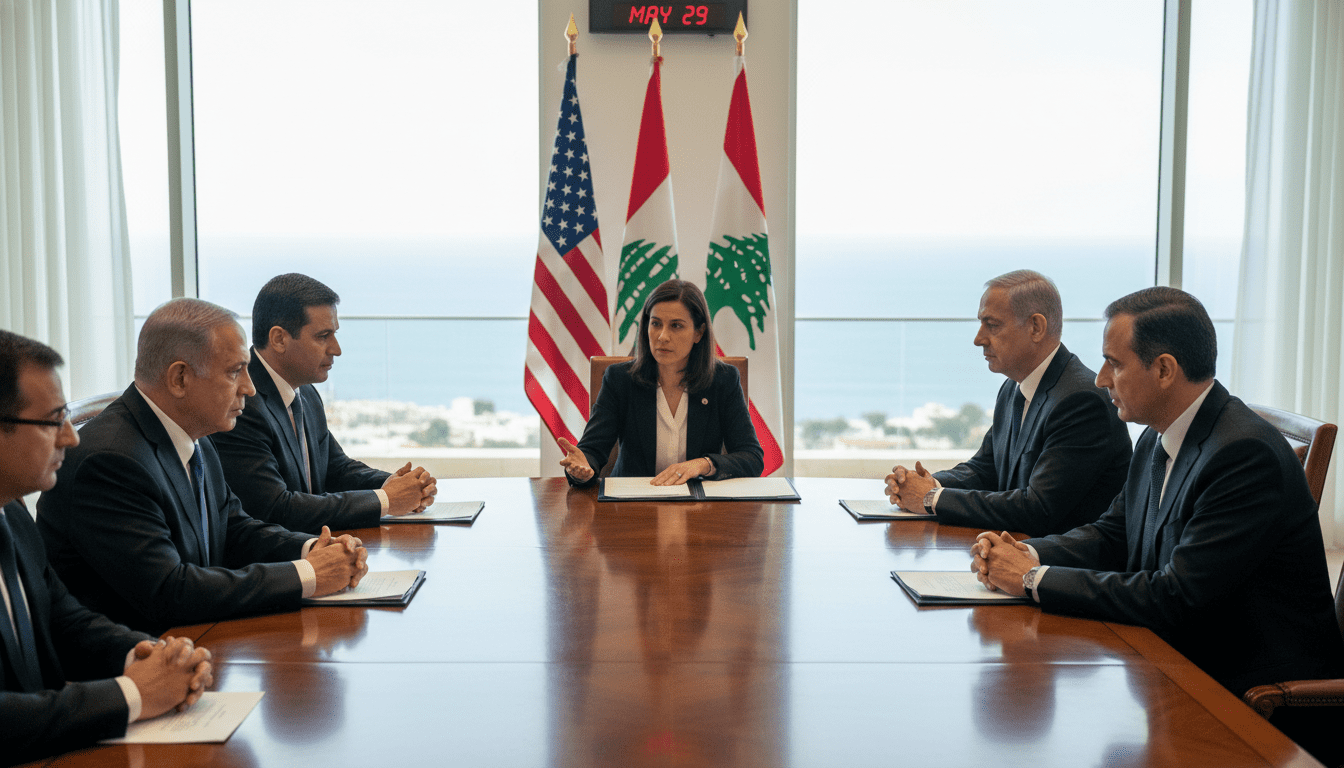
US Extends Israel-Lebanon Negotiations; Pentagon to Host Security Track on May 29
US-mediated Israel-Lebanon negotiations extended; security talks at the Pentagon on May 29 and political talks June 2-3 aim to secure the shared border.
US Extends Mediation After Two Days of Productive Talks
The United States has extended its mediation of Israel-Lebanon negotiations after two days of what the State Department called “highly productive” discussions. State Department spokesperson Tommy Pigott said the extension follows intensive dialogue aimed at narrowing outstanding disputes between the two sides. The moves reflect a concerted U.S. effort to keep both diplomatic and military channels open as negotiators work toward concrete outcomes.
Pigott framed the talks as part of a dual-track process, separating political and security discussions to address different dimensions of the bilateral relationship. Officials described the extension as a necessary step to convert initial progress into binding arrangements on the ground. Both sides have shown willingness to remain engaged, according to the department’s statement.
Pentagon to Host Security Track on May 29
A security track of the talks, involving Israeli and Lebanese military delegations, is scheduled to begin at the Pentagon on May 29. The session is intended to focus on practical measures to stabilize the shared border and prevent incidents from escalating into broader confrontation. Military-to-military engagement at the Pentagon signals a shift toward operational planning and the possible development of confidence-building mechanisms.
Participants are expected to discuss rules of engagement, incident deconfliction procedures, and the placement of forces or monitoring assets near contested areas. While details of the agenda were not released, the timing underscores U.S. interest in pairing diplomatic initiatives with security arrangements. Pentagon-hosted talks also create a venue for technical experts to translate political agreements into actionable military protocols.
Political Track to Resume in Washington on June 2–3
The State Department said the political track of Israel-Lebanon negotiations will resume on June 2 and 3, bringing diplomats and senior officials back to the negotiating table. Those sessions aim to consolidate progress on sovereignty, territorial integrity and mutual recognition while addressing contested claims. The political talks will likely tackle the legal and diplomatic frameworks needed to underpin any operational security measures agreed at the Pentagon.
Diplomats will have to reconcile divergent political priorities while ensuring that any accord is durable and implementable. The early-June schedule gives negotiators time to absorb outcomes from the Pentagon security talks and to coordinate positions. U.S. mediators have positioned themselves as facilitators of both tracks, seeking to bridge gaps and accelerate implementation.
Stated Goals: Sovereignty, Territorial Integrity and Border Security
U.S. officials said the overarching objectives of the talks are lasting peace, full recognition of each country’s sovereignty and tangible security along the shared border. Pigott emphasized that negotiators hope to establish “genuine security” that reduces the risk of clashes and protects civilian populations on both sides. Those priorities reflect long-standing tensions over maritime boundaries, territorial claims and armed groups operating near the frontier.
Achieving mutual recognition and legally defined borders would be a significant diplomatic milestone with implications for regional stability. Arrangements that combine political agreements with enforceable security mechanisms are viewed as essential to preventing future flare-ups. The dual-track format is designed to ensure that political commitments are matched by on-the-ground measures.
Implications for Regional Diplomacy and Security
An agreement between Israel and Lebanon would reverberate across the region, affecting actors with vested interests in Lebanon, northern Israel, and adjacent maritime zones. Neighboring states and international organizations have previously expressed support for negotiated solutions that reduce militarized tensions. A successful U.S.-mediated process could also serve as a model for resolving similar disputes elsewhere, by pairing diplomatic negotiations with military-level implementation talks.
However, obstacles remain, including divergent domestic political pressures in both countries and the presence of non-state armed groups that may resist constraints. Any accord will need monitoring, verification and dispute-resolution mechanisms to endure. The fragility of the regional security environment means that even modest progress will require careful calibration and follow-through.
Unresolved Questions and Next Steps for Negotiators
Officials have not disclosed the full roster of participants or the precise agenda for either track, leaving key procedural questions open. Observers will watch whether the parties agree to third-party monitoring, timelines for implementation, or specific incident-management protocols. The split into security and political tracks does not eliminate the difficulty of translating high-level commitments into enforceable, verifiable actions on the border.
If talks proceed as scheduled, negotiators will have a narrow window to convert momentum into measurable agreements. The United States has indicated it will continue to play a convening and facilitation role through the scheduled meetings. How quickly that role evolves into longer-term international involvement will depend on progress achieved at the Pentagon and in Washington.
The extension of US-mediated Israel-Lebanon negotiations signals a sustained American push to stabilize a volatile frontier through coordinated political and military engagement, with both security protocols and diplomatic recognition on the agenda.
