
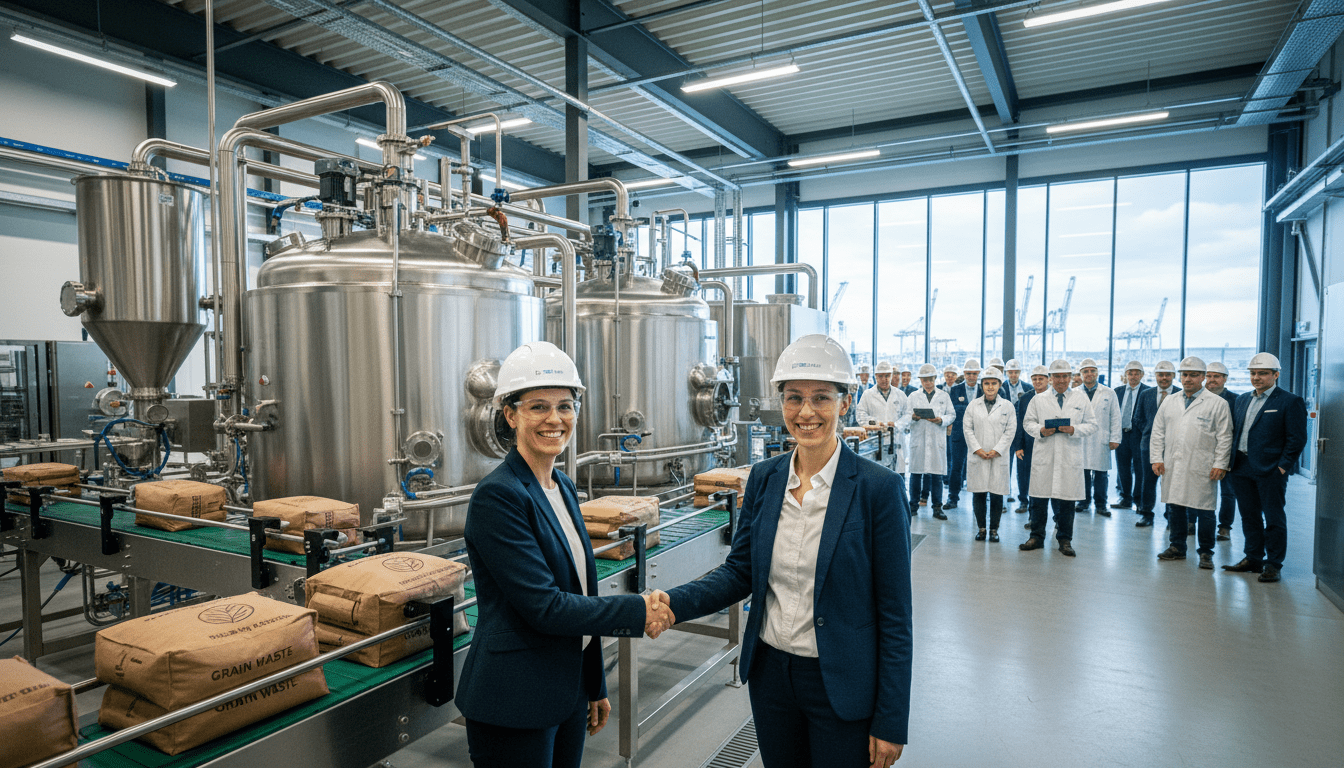
Traceless opens Hamburg plant to produce bio-based plastic replacement at industrial scale
Traceless opens a Hamburg factory producing bio-based plastic replacement from food residues, aiming to scale to 40–60k tonnes and make compostable items.
Traceless inaugurated a new production facility in Hamburg’s Neuland district on Friday, launching commercial manufacture of a bio-based plastic replacement made from food-industry residues. The company said the plant will begin with a phased ramp-up toward 3,000 tonnes per year and form the basis for much larger plants planned through 2030. Company founders, industrial partners and government officials attended the opening as Traceless framed the site as a first step toward integrating a new material into existing supply chains.
Factory inauguration in Hamburg’s Neuland
The converted site was formerly a bread factory and has been repurposed to house a fully automated production line that extracts natural polymers from cereal and other agricultural residues. Traceless founder Anne Lamp described the opening as “the start of a new material industry” and positioned the plant as a practical demonstration that bioeconomy innovations can move from laboratory to factory floor. Officials noted the symbolism of the Neuland location while stressing the technical and commercial significance of the project.
The ceremony drew senior figures from industry and government, including Germany’s environment minister, who hailed the project as an example of homegrown environmental technology. Hamburg’s environmental senator recalled early local support for the company and underscored the need for reliable power and continued public and private financing to scale production.
Planned output, investment and timeline
Traceless said the current factory is designed to reach an initial production volume of roughly 3,000 tonnes annually after several months of scale-up. The company also disclosed plans for a major expansion: a future plant with an annual capacity of 40,000 to 60,000 tonnes by 2030. The current facility represents an investment of about €20 million, with just over a quarter of that funding provided through environmental ministry grants.
Management emphasized that the Hamburg site is only the first commercial step and described the 2030 target as part of an aggressive industrialisation plan. Executives urged banks and institutional investors to support the next phases of growth so the material can be made available at meaningful scale for packaging and other uses.
Patent-protected process and feedstock
At the heart of Traceless’s approach is a patented process for extracting long-chain natural polymers from plant-based food waste without altering their chemical structure. The company sources starting material from cereal-processing streams and similar residues, turning by-products into a feedstock for a thermoplastic granulate. Traceless says the process follows cradle-to-cradle principles, operates with minimal waste and leaves non-usable fractions that are compostable.
The resulting granules behave like conventional thermoplastics in many industrial forming processes, allowing the material to be processed on existing machinery. Traceless positions the feedstock and extraction method as key competitive advantages that enable transition away from fossil-derived polymers.
Performance, limitations and applications
Traceless markets the material as compostable in natural environments and free of persistent microplastics, but it concedes limitations for long-term water exposure. That constraint narrows suitability for certain durable or aquatic applications while opening markets where products are likely to enter the environment or where technical recycling is impractical. Packaging, single-use items, and coated paper products were cited as immediate target segments.
Industrial partners provided testimony to the development pathway. Mondi’s production head described early material trials as challenging before reaching a processable formulation, and noted that adhesion to paper was a pivotal milestone. The company and other early adopters said they are now testing formats and supply configurations that could be commercialised in the coming months.
Industry partnerships and early customers
Traceless has secured partnerships with established players across packaging and distribution, naming Mondi, Otto and chemical distributor Biesterfeld among its early collaborators. Executive leadership stressed that these partnerships were crucial to proving the material at scale and to adapting formulations for specific industrial uses. Board and advisory figures with deep logistics and corporate experience are helping to bridge production with customers who need reliable supply chains.
Commercial customers were portrayed as willing to engage before all risks are eliminated, a stance Traceless’s advisory chair said is necessary for rapid market adoption. Company executives argued that this kind of industrial risk-sharing will be essential to displace substantial volumes of oil-based plastics.
Political backing and calls for financing
Government officials at the opening framed the plant as a German success story in environmental technology and urged private financiers to back expansion. Hamburg’s environmental senate recalled an early €30,000 transfer under a local funding programme that helped seed the company, and ministers pointed to public grants that covered a notable share of the current investment. Calls at the event were clear: public support enabled the first factory, but long-term scaling will require substantial private capital.
Speakers underlined the twin environmental arguments for replacing certain plastics—reducing marine pollution and lowering greenhouse-gas emissions associated with fossil-based polymer production. They also emphasised the need for stable electricity and infrastructure to enable larger-scale plants.
Traceless’s Hamburg inauguration marks a visible step in bringing a bio-based plastic replacement from lab to market, but the company and its partners acknowledge significant hurdles remain. Scaling to tens of thousands of tonnes will require sustained investment, supply-chain coordination and customer acceptance across multiple industries.
The coming years will test whether this model can move from regional demonstration to broad industrial adoption, and whether bio-based, compostable alternatives can capture material volumes currently supplied by conventional plastics.
