
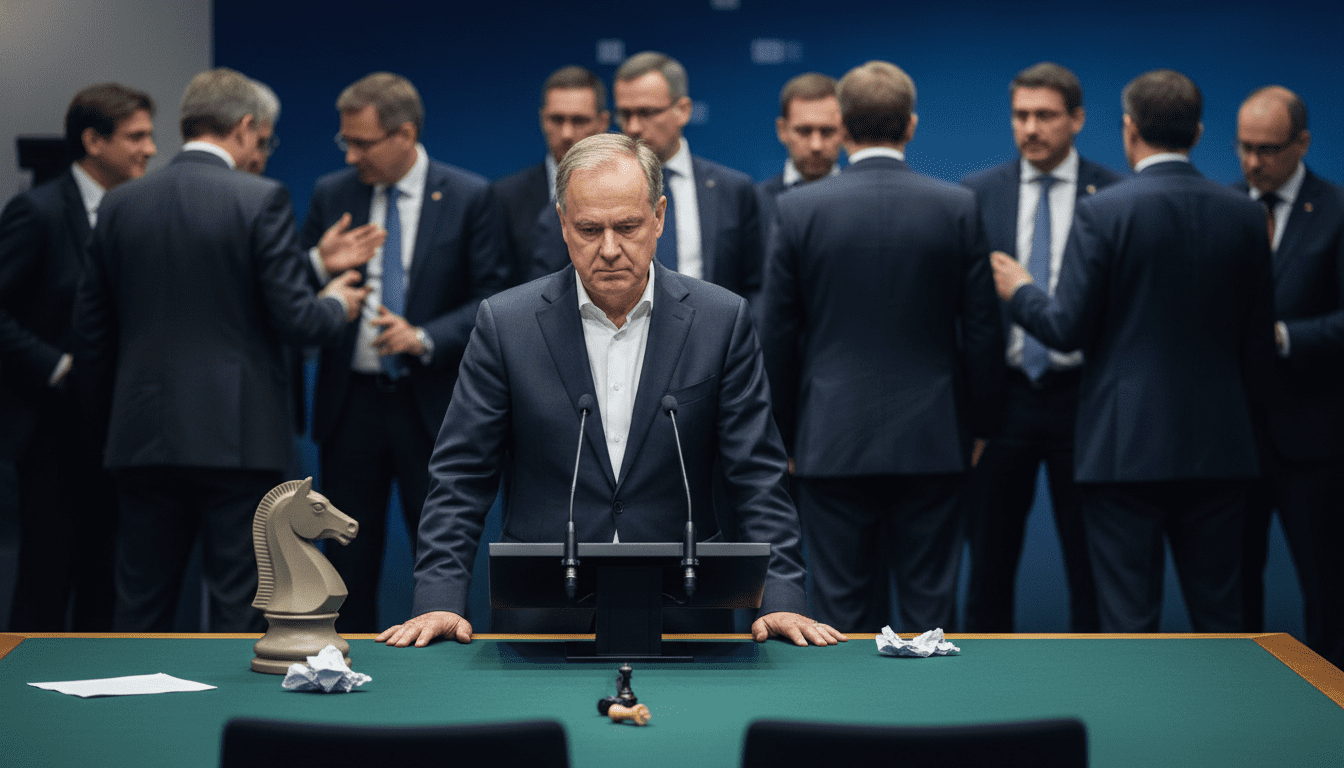
Richard Lutz Withdraws DSB Team Bid Ahead of May 16, 2026 Bundeskongress
Richard Lutz withdraws his DSB team candidacy three weeks after first announcing, citing deep divisions and insisting on selecting his own vice presidents publicly.
Richard Lutz, the former Deutsche Bahn chief, has withdrawn his bid to lead the Deutscher Schachbund (DSB) less than three weeks after announcing his candidacy in mid‑April 2026. In a second letter sent ahead of the extraordinary Bundeskongress scheduled for May 16, 2026, Lutz said he would not proceed unless he could appoint his full slate of vice presidents. The move leaves the federation facing an uncertain vote on leadership amid accusations of factionalism and procedural conflict.
Lutz frames withdrawal as response to entrenched factionalism
In a five‑page letter to voting delegates, Lutz described what he called widespread mistrust, self‑interest and division within the DSB. He singled out regional associations as holding most of the votes and accused some actors of resorting to manipulation and intrigue that he labeled “reprehensible and indecent.”
Lutz presented his demand to choose his three vice presidents as a condition for taking office, saying he needed a loyal, collegial team to restore effective cooperation. His insistence on a pre‑approved slate, however, appears to have alienated supporters who view the requirement as undemocratic.
Mixed reaction from state associations and club leaders
Conversations with numerous state associations in recent weeks produced two dominant reactions: relief that a manager with executive experience had offered to step in, and puzzlement at his terms. Many regional leaders welcomed the prospect of a seasoned administrator tackling the federation’s organizational problems, while others bristled at Lutz’s demand for team approval.
That split weakened Lutz’s backing at precisely the moment his candidacy needed broad, cross‑regional support. Sources close to several Landesverbände said they were uncomfortable endorsing a ticket assembled behind closed doors rather than chosen through the customary political give‑and‑take within the federation.
Recent governance disputes that set the stage
The campaign to change the DSB leadership comes after a year of internal disputes that intensified following the June 2025 re‑election of incumbent president Ingrid Lauterbach. Critics have focused less on policy outcomes — the current board has navigated the federation through a difficult financial phase — and more on leadership style and internal communication.
Tensions escalated last autumn when the dismissal of a long‑standing, widely respected staff member sparked demands for accountability from several state chairs. The subsequent resignation of the federation’s vice‑president for finance further sharpened calls for an extraordinary congress to address the leadership crisis.
The vice‑president demand as a political flashpoint
Lutz’s requirement that he be permitted to select his three vice presidents became the central stumbling block in negotiations. Supporters of reforms understood his rationale — a cohesive executive team could facilitate decisive change — but many delegates regarded the demand as an attempt to circumvent collective selection mechanisms.
Detractors also raised questions about some of the people Lutz proposed for the team, arguing that their inclusion would complicate the federation’s internal balance. The debate crystallized a broader fault line: whether reform should come through negotiated internal compromise or via a more top‑down managerial approach.
Scenarios for the May 16, 2026 Bundeskongress
With Lutz out of the running, the extraordinary Bundeskongress in Frankfurt on May 16, 2026 may take a number of paths. One possibility is that delegates press ahead with a motion to remove the sitting presidency and then face a shortfall of immediate alternatives to replace it. That could produce the unusual outcome of an ousted president standing for re‑election without a formal challenger.
Alternatively, the withdrawal could prompt new candidacies to emerge in the days before the congress, or lead to a negotiated interim arrangement among leading state associations. Much will depend on whether the regional chairs can bridge their differences and present a unified slate acceptable to a majority of delegates.
Implications for reform, transparency and unity in the DSB
The episode underscores the depth of governance challenges inside the Deutscher Schachbund and highlights the difficulty of translating managerial solutions into volunteer‑driven sport governance. Calls for modernizing structures and improving transparency are likely to persist whether or not a leadership change occurs on May 16.
Observers say the federation faces a choice between intensified factional struggle and a determined effort to build broader consensus around concrete reform measures. The coming days will test whether the DSB’s membership can convert frustration into constructive institutional change without further eroding trust.
The withdrawal of Richard Lutz’s candidacy leaves the DSB at a crossroads just days before a pivotal congress, with delegates now tasked with deciding whether to press for immediate leadership change or to seek a collaborative path toward stabilizing the federation.
