
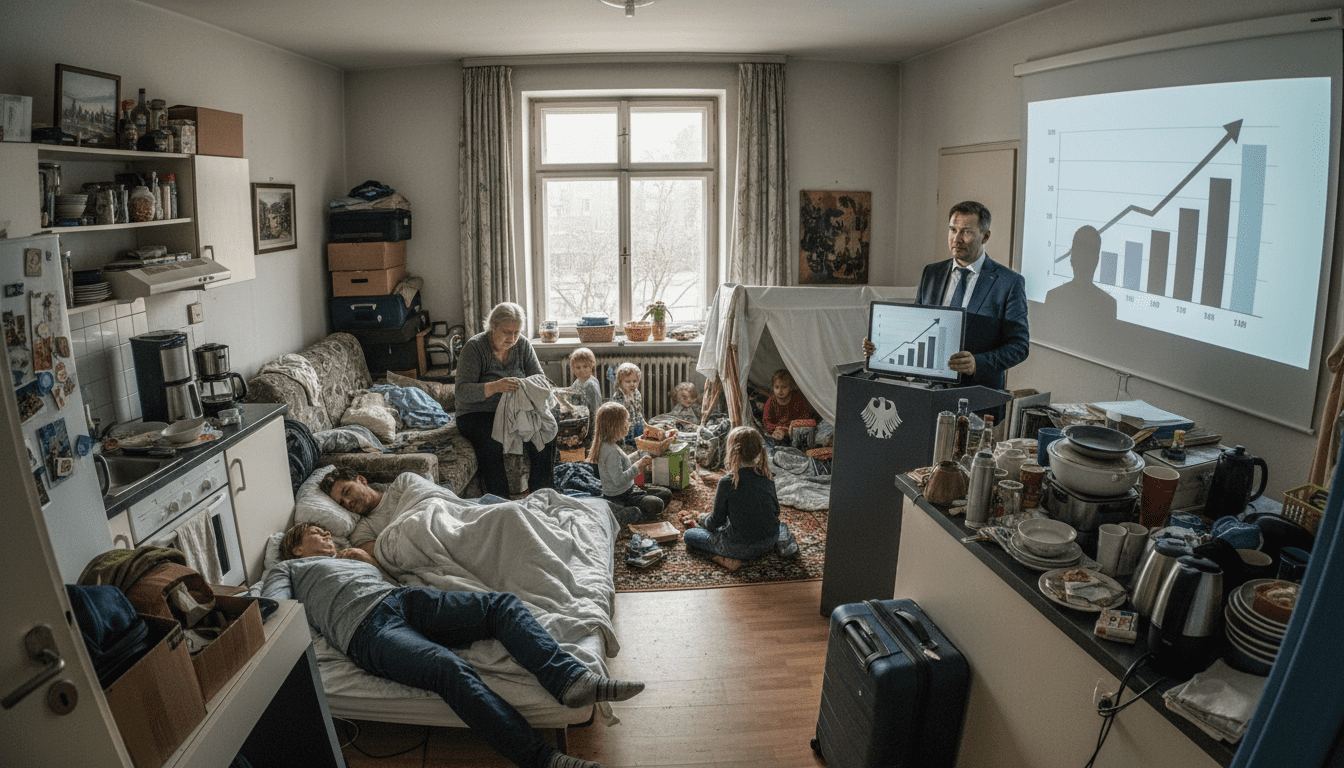
Overcrowded Housing in Germany Rises to 11.7% in 2025, Data Show
New 2025 figures show overcrowded housing in Germany at 11.7%, with migrants, low-income families and children most affected amid wider EU disparities now.
The share of people living in overcrowded housing in Germany rose to 11.7 percent in 2025, according to figures compiled by the Federal Statistical Office from EU-SILC survey data. That marks an increase from 10.2 percent in 2020 and highlights growing pressure on families seeking suitable and affordable living space. Officials say the trend is especially pronounced among migrants, households at risk of poverty and families with children.
Statistics show an overall rise and demographic split
The 2025 data place 11.7 percent of the German population in dwellings judged to have too few rooms for the household composition. The Federal Statistical Office presented the results using the European Union’s EU-SILC methodology, enabling direct comparison across member states. Analysts note that the increase since 2020 is statistically meaningful and reflects broader housing and affordability pressures.
Adults with foreign nationality were disproportionately affected, with 30.8 percent living in overcrowded conditions compared with 6.7 percent of German nationals aged 18 and over. People classified as at risk of poverty had a rate of 27.4 percent, underscoring the close link between income vulnerability and inadequate housing.
Children and single-parent families face acute strain
Households with children experienced overcrowding far more often than childless households, with 17.6 percent of people in family homes living with too few rooms. By contrast, only 7.2 percent of people in households without children lived in similarly constrained conditions. The data further show that single parents and their children faced some of the highest rates, with 29.6 percent reported as living in overcrowded accommodation.
Minors overall were hit hardest by the shortage of space. In 2025, 19 percent of people under 18 lived in homes classified as overcrowded, whereas the share among those aged 65 and over was just 3.1 percent. Demographers warn that persistent overcrowding in childhood can have long-term effects on educational attainment, health and social mobility.
EU definition clarifies what counts as overcrowded housing
The statistics use the EU-SILC definition of overcrowding, which evaluates the number of rooms relative to household composition and the ages of household members. Under that rule, a single-person household is considered overcrowded if it lacks at least two rooms, such as separate living and sleeping spaces. The definition also specifies room requirements for children, differentiating by age and sex to assess adequate sleeping arrangements.
Experts say the EU-SILC standard offers a consistent yardstick but does not capture all aspects of housing quality, such as floor area, condition or access to amenities. Policymakers frequently combine these measures with rent burden and energy efficiency indicators to form a fuller picture of housing need.
Germany below EU average but lags behind several peers
Despite the rise, Germany’s overcrowding rate remained below the EU average of 16.8 percent in 2025. Countries at the top of the overcrowding scale included Romania, at just over 40 percent, and Latvia, near 39 percent. At the lower end, Cyprus reported 2.2 percent and the Netherlands 4.1 percent, illustrating wide variation across the bloc.
Officials caution that relative position in the EU does not negate domestic challenges, particularly in urban centres where demand for family-sized housing outstrips supply. Variations within Germany between cities and rural areas are significant, with affordability pressures concentrated in major metropolitan regions.
Housing market pressures and policy implications
Housing experts link the rise in overcrowding to a combination of constrained new construction, rising rents, and demographic shifts including migration and household formation patterns. The Federal Statistical Office noted that finding suitable and affordable housing has become harder for those who need more space. Short-term solutions such as temporary accommodation or subsidised shares of larger flats do not address long-term supply deficits.
Policy responses under discussion include accelerating construction of family-sized units, increasing subsidised social housing, and expanding targeted support for at-risk groups such as single parents and low-income migrants. Urban planners and social services emphasise coordinated approaches that couple housing supply with income support and integration measures.
Persistent overcrowding also raises questions for education and health services, as cramped living conditions can hinder remote learning, increase stress and complicate infection control. Stakeholders from local governments to housing associations say a multi-faceted strategy will be necessary to reduce the number of households living with inadequate space.
The 2025 EU-SILC-based report from the Federal Statistical Office highlights a growing challenge for Germany’s housing policy as it seeks to balance regional differences, demographic needs and fiscal constraints.
