
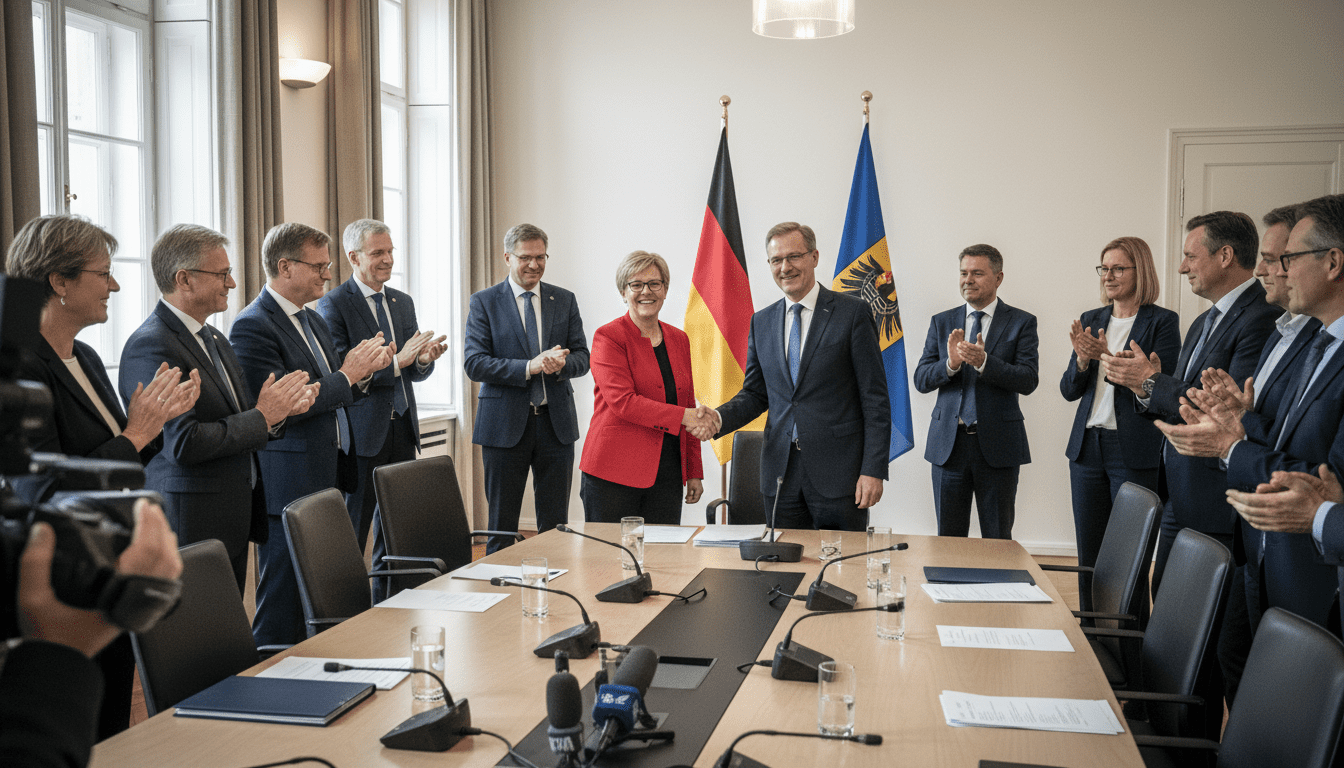
Rhineland-Palatinate grand coalition sealed as CDU and SPD reach agreement in Mainz
CDU and SPD have agreed to form the first Rhineland-Palatinate grand coalition; parties will ratify the pact this weekend and Gordon Schnieder is expected to face a May 18 Landtag vote.
The Christian Democratic Union and Social Democratic Party have reached an agreement to form the first Rhineland-Palatinate grand coalition, party leaders confirmed in Mainz on Thursday afternoon. The deal, settled after closed-door talks nearly six weeks after the state election, sets the stage for a formal ratification process and a scheduled minister-president vote on May 18.
Agreement announced in Mainz
The CDU and SPD presented the framework of their coalition understanding in Mainz, ending a negotiating period that produced few public leaks. Party negotiators led by Gordon Schnieder for the CDU and Alexander Schweitzer for the SPD conducted intensive talks on key policy areas and portfolio distribution, officials said.
Both parties stressed that detailed allocation of ministries and the naming of individual ministers would wait until internal approval processes concluded. The announcement was limited to the existence of an agreement and a roadmap for ratification.
Ratification timetable and party procedures
SPD delegates are set to vote on the proposed coalition contract at a party congress on Saturday, while the CDU’s state party committee will decide the same day. Only after both bodies have given their consent will the coalition agreement be formally published and personnel appointments revealed.
Those internal votes are expected to be decisive but not merely ceremonial, as each party negotiates how to present compromises to their members. The parties have indicated they aim for a swift sequence: internal ratification, public presentation of ministry portfolios, and the Landtag vote to confirm the government.
Gordon Schnieder expected to be elected on May 18
If the ratification proceeds as planned, Gordon Schnieder is expected to be elected minister-president by the Rhineland-Palatinate Landtag on May 18, which coincides with the state’s constitution day. Schnieder’s election would mark the end of 35 years of SPD-led governments in the state and the beginning of CDU leadership in Mainz.
The transition would represent a major political shift after decades in which SPD and CDU alternated between government and opposition roles. Party strategists on both sides framed the move as a pragmatic response to electoral math and pressing fiscal and economic challenges.
Parliamentary arithmetic grants a commanding majority
Together the CDU and SPD will command a two-thirds majority in the 105-seat Landtag, holding 71 seats between them. The CDU increased its representation to 39 seats, eight more than in the previous legislature, while the SPD won 32 seats.
That arithmetic gives the new coalition the capacity to pursue far-reaching legislative changes, including amendments that require a constitutional majority. Observers note the unusual breadth of the majority increases the coalition’s policy latitude but also raises expectations for decisive action on municipal finances and economic policy.
Negotiation flashpoints: municipal finances, economy and education
Municipal financing and the economic outlook were identified as central sticking points during the negotiations, with both parties seeking formulas to stabilize local budgets. The coalition framework reportedly includes measures aimed at shoring up municipal finances and creating incentives for regional economic development.
Education emerged as another sensitive area where the parties entered with divergent campaign positions and had to find compromise solutions. Sources familiar with the talks said the pact balances investments and structural reforms, while leaving several technical details to forthcoming ministerial work plans.
Opposition realigned after election results
The post-election composition of the Landtag reshaped the opposition landscape. The AfD emerged as the largest opposition party with 24 seats, gaining 15 mandates compared with the previous term, while the Greens returned with 10 seats and will sit in opposition for the new legislature.
No other parties passed the electoral threshold to enter the Landtag, leaving the chamber dominated by the two large parties and a far-right presence as the principal opposition. Critics have already signaled close scrutiny of the coalition’s majorities and policy ambitions.
The coalition partners stressed their immediate priorities will include stabilizing municipal finances, bolstering the state economy, and finalizing a policy agenda that can be operationalized quickly after ministerial appointments are announced.
If both parties ratify the contract as scheduled, the new government will take office with a mandate to govern from a commanding parliamentary majority that also raises the stakes for accountable, measurable outcomes in the months ahead.
