
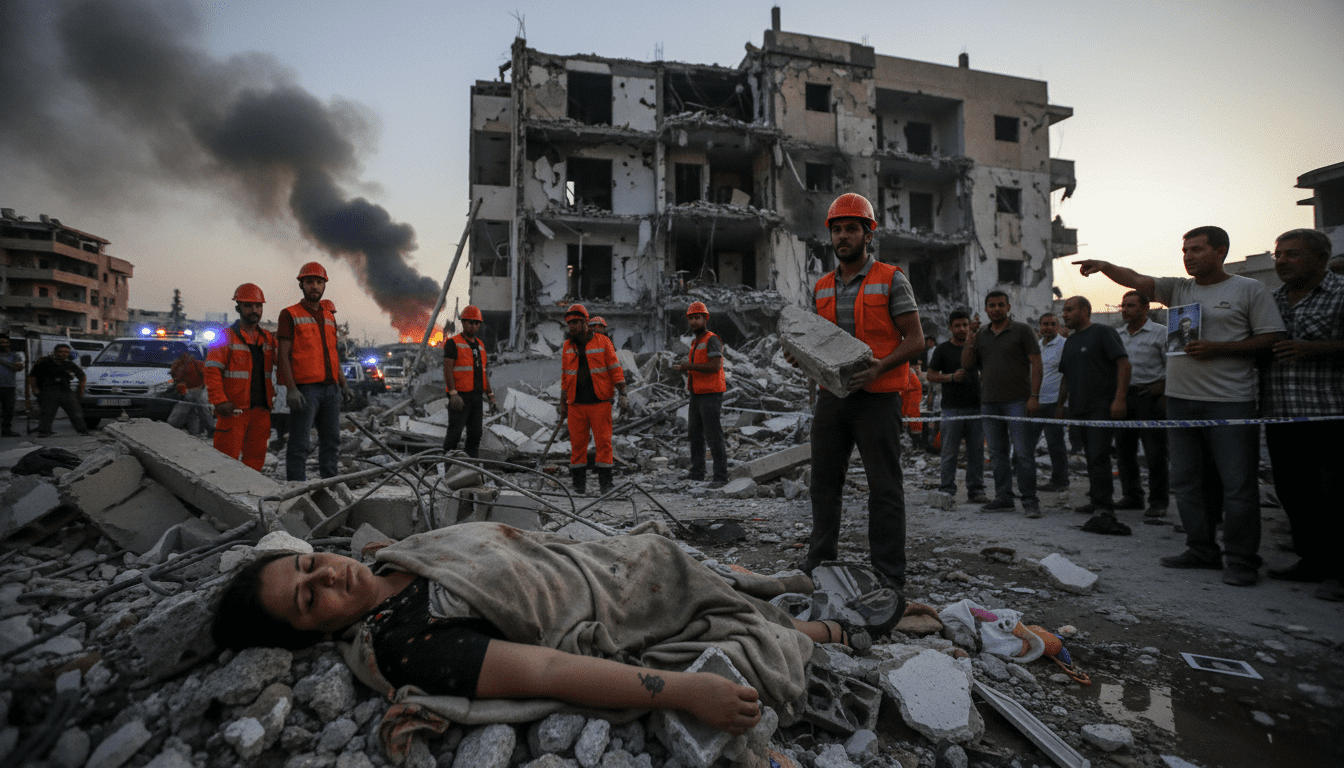
Lebanese journalist Amal Khalil killed after house sheltering reporters struck, Israel denies targeting
Lebanese journalist Amal Khalil was killed when a house where she had taken shelter was struck, her employer and Lebanese military officials said, while Israel denied that it targeted journalists in the attack.
Amal Khalil’s employer confirmed her death on the day of the strike and described the loss in terse public statements that identified her as a working journalist sheltering from earlier violence. The confirmation was followed by a briefing from a senior Lebanese military official, who said Khalil’s body was recovered from under rubble at the site. Local authorities and medical services have provided preliminary accounts but full forensic details have not been released.
Employer and Military Confirm Death
A statement from Khalil’s employer announced that the journalist had been killed in the strike, a development that the organization said came after attempts to account for staff in the area. The employer did not immediately provide additional operational details beyond confirming her identity and the circumstances of the strike.
A senior Lebanese military official corroborated the employer’s account, saying rescue teams found Khalil’s body beneath the collapse of the building. The official description emphasized the damage at the scene and the challenges faced by first responders in recovering victims amid ongoing hostilities.
Circumstances of the Strike
According to Lebanese authorities, Khalil and fellow journalist Zeinab Faraj had moved into the house after an earlier shelling or assault on the area. Officials said the two were sheltering together at the time a subsequent strike struck the residence, producing extensive structural damage.
Local responders described difficult conditions for search and recovery operations, with rubble and unstable debris complicating efforts. Authorities have not yet released a full chronology of the events leading up to the strike or reconciled differing accounts of what occurred in the hours before the house was hit.
Health Ministry Accuses Israel of Targeting
Lebanon’s health ministry issued a statement attributing the strike to Israeli forces and accused the military of targeting the home where the journalists were sheltering. The ministry said medical teams were treating casualties and that its preliminary reports pointed to a direct hit on the residential structure.
The health ministry’s public remarks framed the incident within the broader pattern of civilian harm seen in the conflict, urging accountability and greater protections for noncombatants. The ministry did not publish forensic evidence in its initial communication, and it called for further investigation.
Israeli Army Denies Targeting Journalists
The Israeli army responded to the accusations by denying that journalists were targeted in the operation and rejecting assertions that the strike was aimed at media personnel. The military said it does not deliberately target journalists, asserting that operations are intended to address specific security threats.
The denial did not, in the initial statement, dispute that a strike took place in the area or directly address the identity of the victims recovered by Lebanese authorities. The Israeli response framed the incident as part of ongoing hostilities and emphasized the complexity of urban operations where civilians may be present.
Implications for Press Safety and Reporting
The killing of Amal Khalil underscores the acute risks faced by journalists working in active conflict zones, particularly when civilians and reporters shelter in residential areas. Media organizations and rights groups have long warned that front-line reporting and displacement into civilian buildings heighten vulnerability to harm during strikes and crossfire.
The incident is likely to intensify calls for clearer protections for journalists and for independent investigations into attacks that result in civilian casualties. Observers note that establishing facts on the ground is often difficult amid active fighting, making impartial inquiry and documentation critical to understanding responsibility.
Limited Details and Calls for Investigation
At the time of the initial reports, details remained limited and fragmented, with official accounts differing on aspects of the strike and its immediate causes. Lebanese medical and military sources provided the primary public narrative, while Israeli authorities issued a rebuttal to accusations of deliberate targeting.
Both national and international actors frequently call for transparent investigations in such cases, but the working environment in active conflict zones can delay or restrict comprehensive fact-finding. Humanitarian and media safety organizations typically press for prompt access to sites and evidence to determine whether international humanitarian law has been breached.
The death of Amal Khalil marks a fresh and grim episode in a conflict where journalists, civilians and combatants continue to be at serious risk. As investigations proceed and more information emerges, the circumstances of the strike and its wider implications for civilian protection and press safety will remain central to the public record and to calls for accountability.
