
Exploring Hansaviertel: Hans Uhlmann’s Sculptures and the Architecture of Berlin’s Postwar Renewal
Discover Hansaviertel through its postwar modernism and public sculpture, where Hans Uhlmann’s works join Interbau ’57 buildings to shape a unique Berlin neighbourhood experience.
Hansaviertel sits at a crossroads of Berlin history and postwar design, and the district’s public art — including key pieces by sculptor Hans Uhlmann — is central to its identity. The neighbourhood’s mix of Interbau ’57 modernist housing, open parkland and stand-alone artworks makes Hansaviertel a concentrated lesson in how sculpture and architecture were recomposed after 1945. This article traces the district’s origins, the role of Uhlmann and other artists, and why the area remains vital for visitors and residents alike.
Interbau 1957 and the rebirth of Hansaviertel
The transformation that produced today’s Hansaviertel began with Interbau in the summer of 1957, an international building exhibition intended to model modern urban living. Supported at the federal level and financed in part through postwar reconstruction funds, the project invited more than fifty architects from across Europe and beyond to design residences, public buildings and communal spaces on a cleared wartime site. The resulting plan deliberately left broad lawns and tree-lined promenades between the buildings, creating opportunities to site sculpture as focal points for pedestrians and drivers alike.
Interbau’s cultural ambition was explicit: to remake a devastated quarter into a showcase for democratic, humane architecture after years of violent destruction. Architects and planners sought new spatial relationships between housing, mobility and leisure, replacing dense prewar blocks with free-standing structures set within landscape. That spatial generosity made the Hansaviertel unusually receptive to large-scale public art and allowed sculptors to work at human scale while remaining visible from circulation routes such as Altonaer Straße and Bartningallee.
Hans Uhlmann’s sculptures anchored in public space
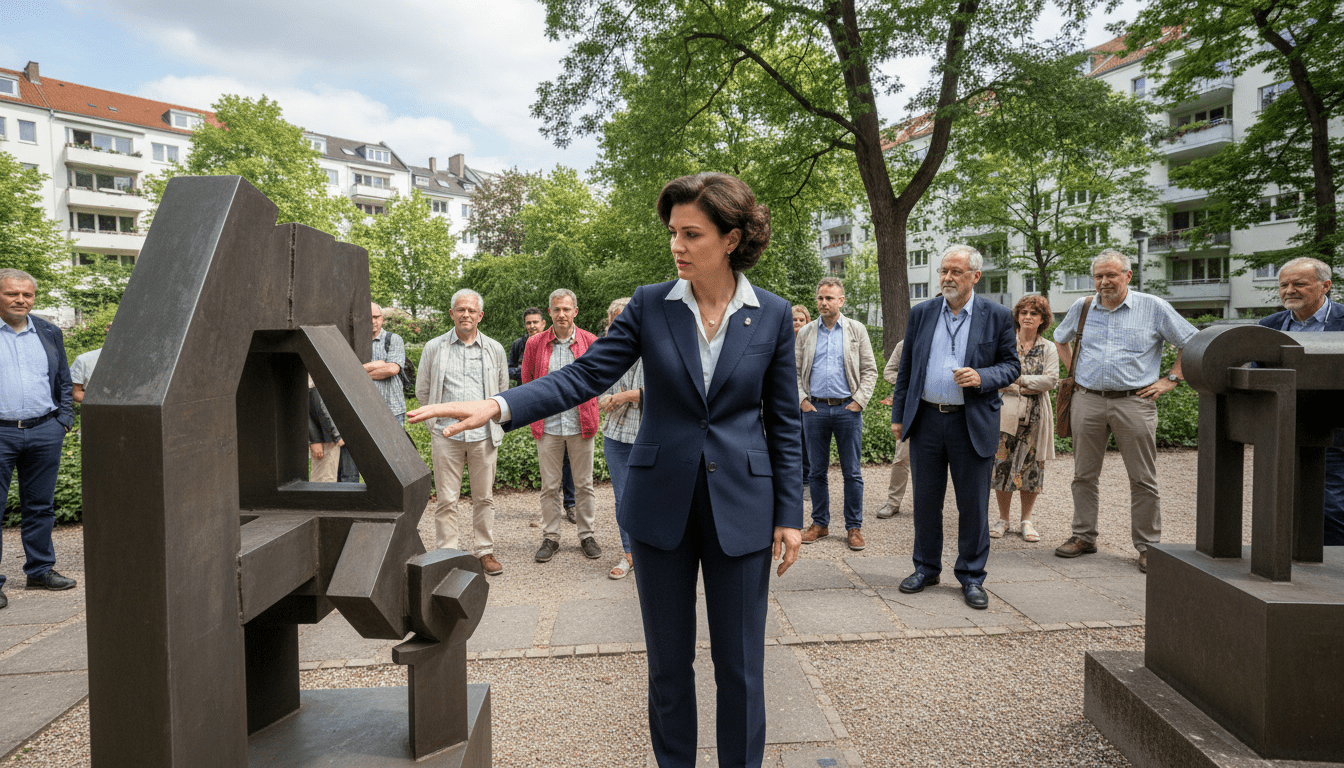
Hans Uhlmann is one of the sculptors whose work helped define the visual rhythm of Hansaviertel, contributing pieces that resonate with the district’s modernist vocabulary. Uhlmann’s sculptures—often abstract or semi-abstract forms in bronze and other metals—are sited to invite encounter rather than demand reverence, positioned along pathways and at corners where residents and visitors pass daily. His work shares the neighbourhood with figures by international artists, but Uhlmann’s forms retain a distinctly Germanic modernist lineage that dialogues with the architecture around them.
Seen in situ, Uhlmann’s pieces function as wayfinding markers and as moments of pause, encouraging viewers to consider scale, material and shadow against the light, open lawns. The patina of bronze and the geometric clarity of many Uhlmann works create a counterpoint to the concrete and Eternit facades of nearby buildings. Over time, weathering and oxidation have added texture and colour, integrating the sculptures into Hansaviertel’s seasonal cycle and giving them a presence that changes slowly with light and rain.
How sculpture and architecture were conceived together
The Hansaviertel project intentionally blended built form and public art: planners and patrons treated sculpture not as decoration but as a civic instrument. Open spaces were arranged to accommodate large works, and architects regularly coordinated sightlines so that a sculpture would complement a facade or terminate a pedestrian axis. This integrated approach was part of a broader postwar conviction that art could assist in cultural recovery and moral reorientation by creating shared aesthetic experiences in everyday settings.
Architectural ensembles in the district—ranging from low-rise rows to elevated slab buildings—were frequently designed with specific sculpture sites in mind. The result is a readable sequence of visual encounters, where movement through the district reveals successive artistic statements rather than a single monumental centre. In many cases, the artists and architects worked in direct conversation, leading to installations that respond to materials, proportions and human movement rather than existing as isolated objects.
Notable buildings and the residential fabric
Hansaviertel’s architectural roll call includes buildings by internationally recognised figures alongside work by German architects of the postwar generation. Oscar Niemeyer’s contribution near Altonaer Straße and the Academy of Arts becomes a focal cluster, while vernacular modernist apartment blocks by the likes of Günther Gottwald add a quieter domestic rhythm to the streets. Many of these buildings feature characteristic mid-20th century materials—concrete balconies, Eternit cladding and large windows—whose juxtaposition with mature planting softens the visual austerity.
Living in the Hansaviertel still feels like sharing an open-air exhibition: stair cores, long balconies and communal gardens provide both privacy and points of observation. Some blocks conceal wartime relics beneath them—reinforced underground corridors and shelters built into foundations—reminders of why the district was reimagined in the first place. Residents and students often use the public lawns and edges of courtyards to sketch, photograph and study the formal qualities of both buildings and artworks, sustaining an ongoing engagement between everyday life and architectural history.
Public art policy and the international cast of artists
The district’s public art program was deliberately international, reflecting West Berlin’s postwar positioning as a cultural showcase. Alongside Uhlmann, sculptors such as Henry Moore and Alfredo Ceschiatti contributed prominent works, each bringing distinct formal languages and material practices. These commissions were part of an ideological project: to project openness, modernity and cultural renewal through visible, accessible art in the city’s public realm. The presence of international names served diplomatic and symbolic ends as well as aesthetic ones.
Because the artworks were intended for enduring public use rather than museum display, their commissioning bodies paid attention to durability, siting and maintenance. Over decades, conservation has become part of the conversation, as bronze surfaces oxidise and concrete weathers in Berlin’s climate. The evolution of patina and wear is often accepted as part of an artwork’s life; yet municipal stewardship remains essential to preserve sculptural form and to keep the relationship between art and architecture legible for new generations.
Walking routes and how to experience Hansaviertel
A deliberate, unhurried walk is the best way to experience Hansaviertel, combining street-level views with pauses at sculpture sites and vantage points toward the Tiergarten and the Siegessäule. Start near Bellevue S-Bahn and proceed along Altonaer Straße, where architecture and public art form successive visual notes, then follow the descending curve of Bartningallee to see how buildings frame movement. Short detours to inner courtyards reveal quieter sculptures and residential portals that rarely make guidebooks but are essential to the district’s texture.
Time your visit for late morning or late afternoon if you want to observe how light shifts across bronze and concrete surfaces; seasonal changes also alter the character of the parkland, from spring blossoms to autumn leaf fall. Bring a sketchbook or camera, but allow time to stand still without an agenda, listening to ambient sound and observing how residents use benches, pathways and common spaces. Informational plaques are sparse in some spots, so guided walks or a local map can enrich understanding by linking works to their creators and contexts.
Everyday life inside a modernist experiment
Hansaviertel is not only an architectural showcase; it is home to families, students and long-term residents who shape the area’s daily rhythms. Shops, a public library, churches and childcare facilities were integral to the original plan and remain anchors of neighbourhood life. The spatial generosity envisioned by Interbau supports community activities in public green spaces and allows for small-scale placemaking that keeps the district livable rather than merely ornamental.
This coexistence of exhibition and domesticity is one of Hansaviertel’s enduring strengths. Ball games on the lawns, bicycle traffic along the lanes and neighbours chatting on balconies are as much a part of the district’s identity as the sculptures and façades. The presence of art in everyday routes subtly influences behaviour and perception, creating moments of reflection and familiarity rather than distancing viewers behind velvet ropes or museum walls.
Conservation challenges and contemporary relevance
Preserving the Hansaviertel’s integrated legacy involves maintaining buildings, protecting sculptures and negotiating changing urban pressures. Conservation decisions must balance the original design intent against contemporary needs for accessibility, energy efficiency and public safety. For sculptures, this means regular assessment of bronze patination, anchoring systems and the impact of urban pollutants, while for architecture it can involve retrofitting for insulation and modern mechanical systems in way that respects historic fabric.
At the same time, there is a contemporary conversation about how to keep the district relevant to a diverse city. New interpretations, programming and community engagement help avoid treating Hansaviertel as a frozen relic. Events that combine talks, temporary art projects and neighbourhood initiatives can reanimate the public spaces and attract younger audiences without undermining the integrity of the original modernist plan.
A fitting way to appreciate the district is to treat it as a living archive: each bench, balcony and bronze work records an afterlife of use and weather, and the best stewardship invites public participation in telling that story.
Hansaviertel remains one of Berlin’s clearest demonstrations of how mid-20th-century planners and artists sought to rebuild not only structures but civic life, and Hans Uhlmann’s sculptures remain an integral part of that urban narrative. The district rewards slow attention—walking, watching and listening reveal how architecture and sculpture continue to shape daily movement and communal memory in the city.
