
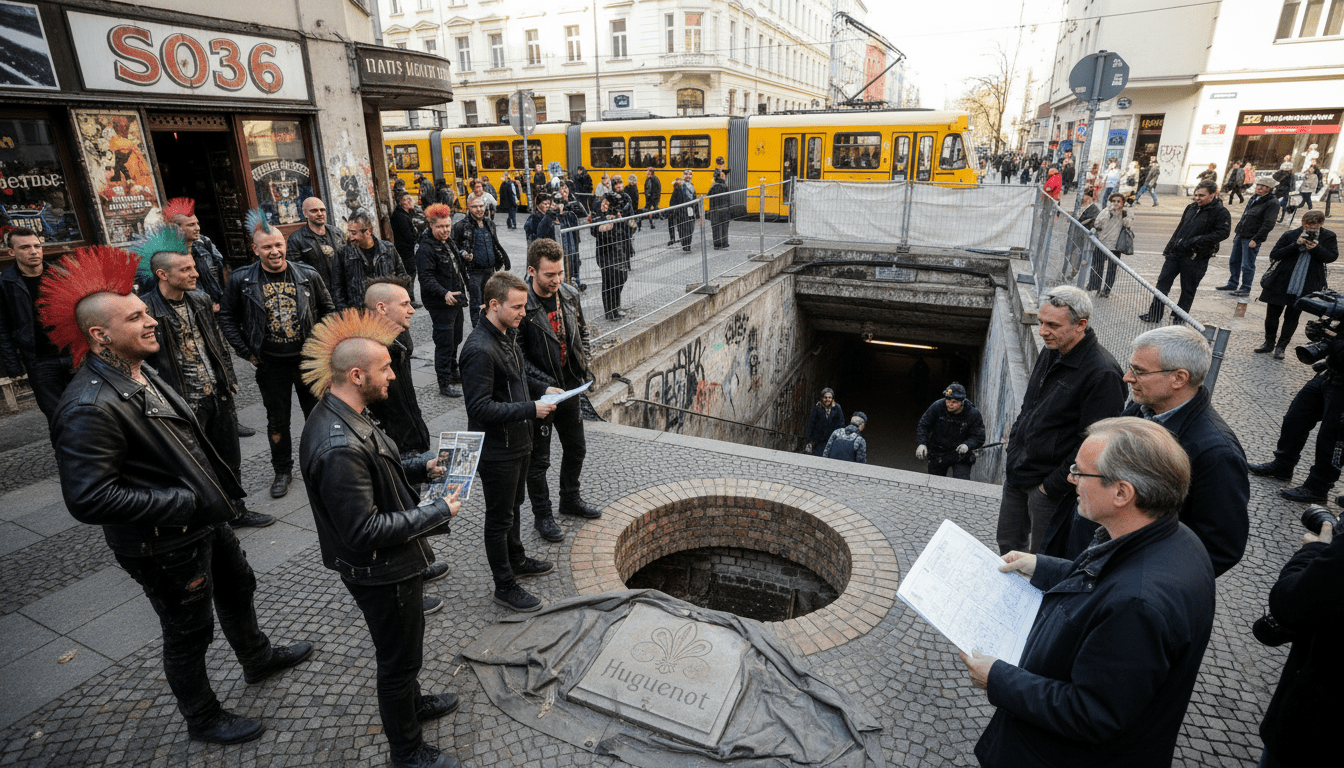
Oranienstraße: Kreuzberg’s layered boulevard from Huguenot gardens to punk era
Oranienstraße traces Kreuzberg’s history from 18th-century Huguenot gardens and the Melonenkirche to wartime ruin and today’s vibrant counterculture, offering a living archive along one street.
Oranienstraße is one of Berlin’s most storied streets, where a succession of arrivals, losses and reinventions remain visible in facades, parks and hidden corners. The street’s name and many of its oldest traces recall French Huguenot settlers who cultivated gardens here in the early 1700s, and later layers of commercial glamour, wartime destruction and postwar counterculture shaped the route into the dense urban corridor it is today. Walking Oranienstraße is a compact history lesson: the past sits beside contemporary boutiques, and monuments coexist with graffiti and reclaimed public space. For visitors and residents alike the street rewards those willing to slow down and look for signs of what came before.
Huguenot settlers and the origins of the name
The first significant chapter of Oranienstraße’s history began with Protestant refugees from France who arrived in the region in the late 17th and early 18th centuries. These settlers brought horticultural knowledge and established extensive gardens and greenhouses in what was then a more open landscape, cultivating fruits and vegetables that included citrus in heated structures. The association with oranges is one plausible explanation for the earlier name Orangenstraße, while another local theory links the street to settlers from the former principality of Orange in southern France. Both explanations underline the French imprint on this part of Berlin.
By 1700 a house of worship for the French-speaking community stood near the present street, later known in local parlance as the Melonenkirche because of the produce grown in adjacent gardens. A permanent church structure replaced the temporary chapel in 1728, and the congregation’s presence anchored a compact immigrant quarter that would eventually take the name Luisenstadt. The district itself was formally named in 1802 after Queen Luise of Mecklenburg-Strelitz, who had become a public figure of national significance during the Napoleonic era. Traces of that Huguenot settlement survive not as whole neighborhoods but as street names, plot lines and occasional buildings that hint at a once-gardened landscape.
Industrial growth, canals and a 19th-century boulevard
The 19th century brought rapid urbanisation to the street that would be renamed Oranienstraße during its extension to Heinrichplatz in 1849. In 1852 the Luisenstadt Canal was completed, connecting the Landwehr Canal with the Spree and rerouting water and commerce through a newly dense neighborhood. Tenement housing, workshops and cafés multiplied along the thoroughfare, serving artisans and a growing working population as the area urbanised at pace.
Commercial life intensified into the early twentieth century when large department stores and entertainment venues established themselves on or near the street. A notable example was the Wertheim department presence that occupied number 53–54 before relocating to a larger building at Moritzplatz in 1913; the site later became known for a large café and a concert venue that seated more than a thousand people. By the 1930s contemporaries described Oranienstraße as one of Berlin’s principal shopping and leisure streets, a boulevard of the east with the bustle and variety typical of central urban thoroughfares.
Artists, inventors and notable residents
Oranienstraße’s dense urban fabric attracted a surprisingly diverse roster of residents whose work reached beyond Kreuzberg. Composer Paul Lincke lived on the street, adding a musical note to the neighborhood’s cultural map, while the pioneering computer engineer Konrad Zuse resided at a different address there during the early part of the twentieth century. The theatre director Erwin Piscator also counted among the street’s notable inhabitants, connecting Oranienstraße to the city’s theatrical and intellectual life.
Those individual stories are reminders that the street was not only a commercial artery but also a place where creative and technical innovation flourished. Buildings that hosted small businesses, rehearsal rooms and private flats formed a mixed-use environment that encouraged exchange across social and professional lines. Even where original structures have been lost, commemorative plaques and archival references preserve the memory of residents whose work rippled outward well beyond Kreuzberg.
War damage, survival and the reshaping of urban space
The Second World War left a deep imprint on Oranienstraße, with heavy destruction concentrated particularly to the west of Moritzplatz. Several notable properties and private houses were destroyed in the fighting and aerial bombardment, and whole blocks were left in ruins or subsequently cleared. The war’s physical damage disrupted the street’s prewar continuity and erased some address-level histories, including properties associated with long-term residents.
Acts of resistance and private courage are woven into the wartime record of the neighborhood. Some houses on the street sheltered people targeted by the Nazi regime, and local residents risked their lives to protect friends and neighbours. At the same time, other stretches of Oranienstraße east of Moritzplatz survived with comparatively less damage, leaving a patchwork of preserved prewar façades beside sites of postwar redevelopment. That uneven survival has given the street its layered appearance: fragments of nineteenth-century urbanism stand next to twentieth-century repairs and newer infill development.
Cold War borderlines and the birth of SO36
After 1945 Kreuzberg became part of the American sector of West Berlin, a geopolitical placement that profoundly affected Oranienstraße’s development. The border that separated East and West Berlin cut the district off on multiple sides and made areas like the route of the old Luisenstadt Canal into a frontline of sorts. Authorities assigned parts of the former Luisenstadt the administrative label SO36 — shorthand for southeast district 36 — in 1962, a label that would carry cultural as well as bureaucratic meaning in the decades to come.
The Wall’s proximity and the neighbourhood’s physical isolation created a distinctive urban ecology. Lower rents and a degree of official neglect drew newcomers whose cultures and lifestyles did not always align with the more affluent city centers. From the 1950s onwards, guest workers and later waves of migrants settled in the area, bringing new languages, shops and social institutions. That demographic shift, combined with a growing streak of cultural dissent among younger residents, set the stage for Kreuzberg’s emergence as a multicultural and countercultural enclave.
From punk to present day counterculture
By the late twentieth century Oranienstraße had become synonymous with alternative culture, political activism and a lively nightlife scene. Squats, social centres and grassroots cultural projects proliferated in the district, and the street’s cafés, bars and music venues hosted scenes that were both locally rooted and internationally noticeable. This long-running countercultural presence is one reason Oranienstraße retains a reputation as a centre of Berlin’s creative energy.
At the same time the street has accommodated shifting tastes: earlier punk and squat movements gave way to newer forms of alternative entrepreneurship, including independent boutiques, galleries and cafés that seek to balance commercial viability with cultural value. That duality — preservation of rebellious spirit alongside commercial adaptation — defines much of Oranienstraße’s contemporary character. The result is a neighborhood where activism, artistic practice and everyday commerce are interlaced.
Walking the street today and discovering hidden traces
A walk along Oranienstraße today reveals layers if you know where to look, from traces of the old canal line to plaques and street names that recall vanished gardens and churches. Waldeckpark and small green spaces nearby offer a sense of the open ground that once sustained horticulture on the street, while architectural fragments to the east of Moritzplatz preserve older street surfaces and brickwork. Visitors who pause for detail will notice variations in cornices, doorway styles and the occasional institutional stone that mark different construction eras.
The street also contains quieter surprises: an unused or partly sealed U-Bahn platform tucked into subterranean space, modest memorials to wartime lives and actions, and pocket courtyards that reveal domestic life behind shopfronts. Contemporary street art, posters and shopfront displays themselves act as an evolving layer of history, recording campaigns, cultural moments and community concerns. A route that begins at Rio-Reiser-Platz and runs toward Görlitzer Bahnhof will pass both the busy, social heart of Oranienstraße and quieter stretches that invite exploration.
Practical visits and what to look for
Start a visit with curiosity rather than a fixed itinerary and allow time for detours into side streets and courtyards, where many of the most evocative traces can be found. Look for plaques that identify former residents and buildings, and pay attention to how the street widens or narrows and how building heights change; these physical variations often point to the boundaries of older plots and postwar rebuilding. Parks and linear green strips mark where canals or gardens once lay, and these open areas are useful stops to read the street as landscape history.
Take note of surviving façades east of Moritzplatz if you are interested in nineteenth-century urban fabric, and seek out local cafés and small museums that contextualise the neighbourhood’s past. Conversations with long-standing shopkeepers, neighbours and cultural workers can also yield anecdotal histories not captured in guidebooks. Above all, allow the street’s contrasts — from refurbished apartment blocks to evidence of wartime loss and from nineteenth-century inscriptions to modern murals — to shape your impression rather than expecting a single, neat narrative.
This street’s history is visible in layers rather than a straight line, and Oranienstraße rewards slow observation: every corner holds a chapter, every plaque and doorway a reminder of Berlin’s capacity to absorb arrivals, survive upheaval and reinvent itself.
