
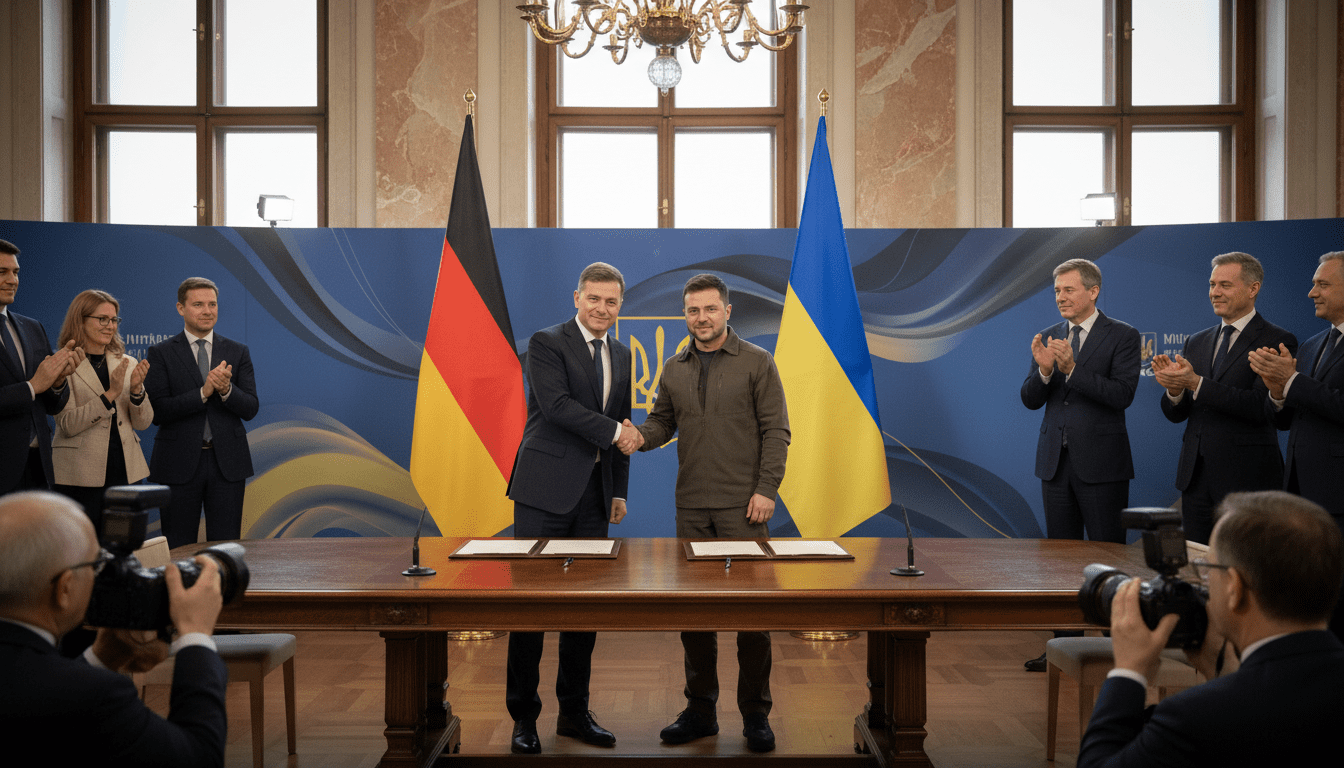
Germany-Ukraine strategic partnership set in Berlin as Merz and Zelenskyy sign defense and reconstruction pacts
Germany-Ukraine strategic partnership set as Merz and Zelenskyy sign defense and reconstruction pacts, advancing EU accession, energy security and trade.
Germany and Ukraine agreed in Berlin to elevate their bilateral ties to a formal strategic partnership, Chancellor Friedrich Merz and President Volodymyr Zelenskyy announced after government consultations at the Chancellery. The Germany-Ukraine strategic partnership centers on deeper defense cooperation, economic reconstruction and closer political alignment with the European Union. Officials said the talks produced multiple accords, including arrangements on defense data sharing, industrial rebuilding and joint work on energy and critical infrastructure.
Chancellor and President frame new partnership
Chancellor Merz described the move as a forward-looking investment in “our common future,” saying Germany seeks a sovereign, democratic Ukraine as a strong partner in Europe. President Zelenskyy called Germany “partner number one” for his country’s defence and praised sustained German support. Both leaders agreed that the new partnership would formalize long-standing cooperation and expand it into new technical and industrial areas.
The announcement followed private consultations at the Chancellery and a public press conference where leaders highlighted practical deliverables alongside political commitments. German officials emphasized that the upgrade is intended to translate battlefield experience and reconstruction needs into reusable capabilities for European security.
Defense data exchange and drone cooperation
A central pillar of the partnership is an agreement to exchange digital combat data to support the development of new weapon systems, a measure Merz presented as part of a wider defense collaboration. Zelenskyy said Ukraine’s combat-tested forces and manufacturing capacity could be leveraged to strengthen European defenses. He also disclosed ongoing talks on a major drone procurement arranged with German partners that he characterized as potentially the largest of its kind in Europe.
Officials noted that Ukraine currently produces military materiel at rates exceeding domestic needs and that scaling up for wider European supply will require additional financing, which they said should come from EU instruments. Defence ministers and senior officials from both governments signed a cooperation accord intended to speed technical interoperability and joint procurement planning.
Germany’s support for EU accession and reforms
Merz reiterated Germany’s support for Ukraine’s eventual EU membership and described closer ties as a “strategically important” step for security and prosperity in Europe. He framed that support as contingent on continued reforms, notably stronger anti-corruption measures and a sustained “approximation” process toward membership. Both leaders said a clear roadmap of political and administrative benchmarks will guide bilateral assistance.
German officials said the partnership is designed to help Ukraine meet those benchmarks by supporting institution building and public administration modernization. A newly announced working group on economy and trade will monitor progress and coordinate technical assistance linked to accession-related reforms.
Economic cooperation and industrial rebuilding
Germany and Ukraine committed to intensified economic cooperation across digitalization, agriculture, hydrogen infrastructure and critical raw materials, with an explicit focus on post-war reconstruction. The governments signed an industrial reconstruction agreement intended to channel investment and technology into rebuilding damaged sectors and modernizing state services. Berlin said it will establish a dedicated working group to coordinate trade and investment opportunities.
Development Minister Reem Alabali Radovan and Ukrainian Economy Minister Oleksij Soboljew signed the reconstruction accord, officials confirmed, signalling German intent to mobilize private and public resources for large-scale projects. Both sides stressed that European firms should play an active role in rebuilding Ukraine’s infrastructure and industrial base.
Energy protection and winter preparedness
Zelenskyy and Merz highlighted cooperation on securing Ukraine’s energy infrastructure ahead of the next winter season as a top priority. They agreed to accelerate projects that harden power systems and to coordinate technical assistance from European suppliers. The leaders framed these measures as essential both for civilian resilience and for preventing energy disruptions that could have wider regional effects.
The partnership includes plans to integrate European energy firms into Ukraine’s reconstruction to help restore reliable electricity, heat and grid resilience. Officials noted that fast-tracked assistance will be necessary to ensure the country’s energy infrastructure can withstand potential attacks or seasonal stress.
Signatures, unannounced visit and political context
Two formal agreements were signed during the visit: a defence cooperation understanding and an industrial reconstruction pact. The defense accord was signed by the relevant ministers and senior officials, and the reconstruction deal was signed by Germany’s development minister and Ukraine’s economy minister, according to statements from the Chancellery. The visit had not been publicly announced ahead of time and Zelenskyy received military honours on arrival.
Both leaders addressed the recent political roadblocks in European support, noting that earlier EU loan disbursements had been delayed by a veto from Hungary’s previous government. German representatives expressed hope that the new political trajectory in Budapest would allow the December-agreed EU loan to move forward, a point Merz linked to unlocking further reconstruction financing.
Germany and Ukraine said they will also expand people-to-people ties, including a jointly planned cultural year in 2027–2028, and will work to ease the voluntary return of Ukrainian refugees while supporting measures to reduce departures of men of military age. The partnership is presented as a multi-year framework combining immediate defense needs with long-term political and economic integration.
The leaders concluded that elevating bilateral relations to a strategic partnership was meant to both accelerate Ukraine’s recovery and to embed Ukrainian experience and capacity into European security and industry planning.
