
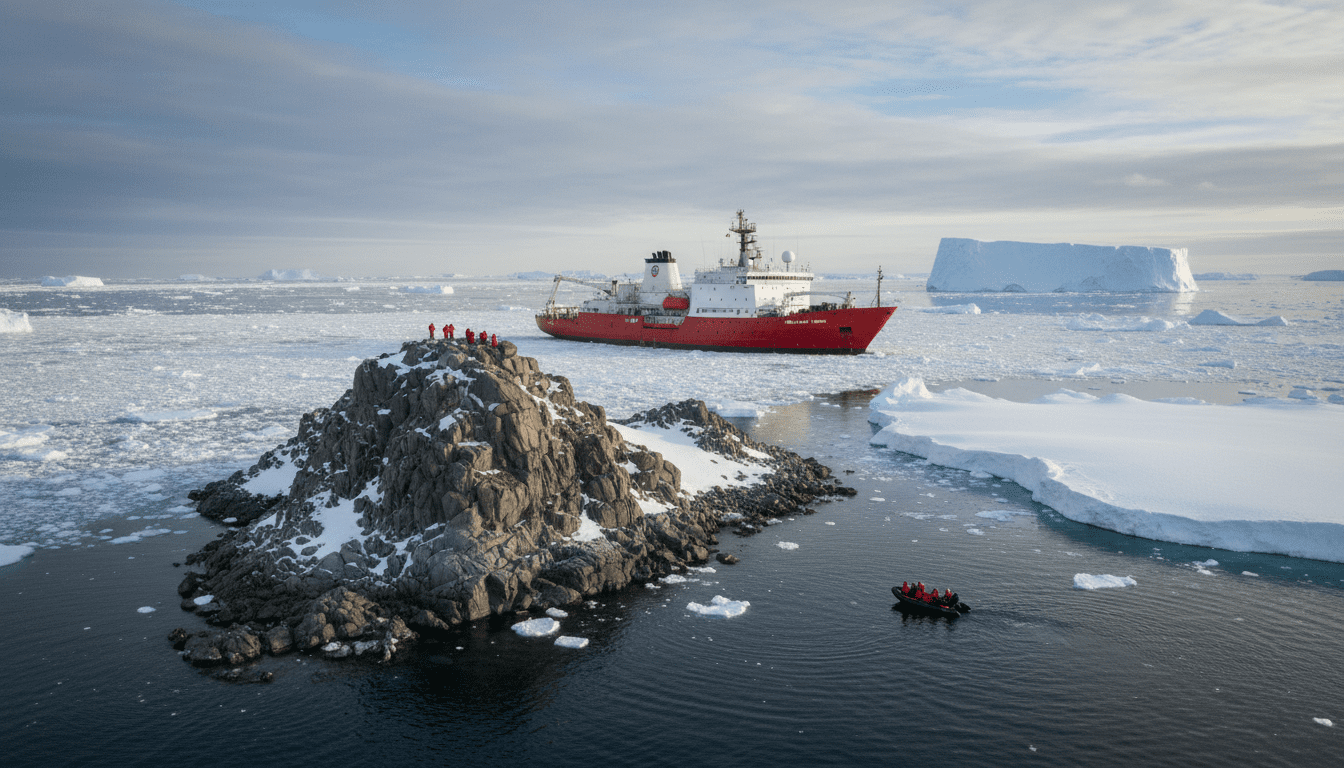
Polarstern crew discovers a new Antarctic island in the Weddell Sea
Polarstern crew from the Alfred Wegener Institute discovered a new Antarctic island in the Weddell Sea; surveys measured size, position and await formal naming.
The German research icebreaker Polarstern has identified a previously uncharted island in the northwest Weddell Sea, a rare find in the satellite era. The discovery occurred while the vessel sought shelter in the lee of Joinville Island during rough weather, and the crew initially mistook the feature for a dirty iceberg. The Alfred Wegener Institute (AWI) confirmed that subsequent survey work established the feature as solid rock and not floating ice, marking a bona fide new Antarctic island.
Initial sighting and expedition context
The sighting took place as Polarstern was conducting routine research operations in the northwestern Weddell Sea, investigators said. Crew members reported a dark, apparently dirty mass amid ice floes that prompted the ship to change course for a closer look.
Simon Dreutter, an AWI expert involved in seabed mapping aboard Polarstern, described the moment the crew realized the object was unlikely to be ice. What began as a visual curiosity rapidly became a focused scientific survey that confirmed the presence of emergent land.
Shipboard mapping and remote surveys
Polarstern carried out a systematic circumnavigation of the feature to collect geophysical and photographic data. The team used a multibeam echosounder to map the adjacent seafloor and deployed a drone to capture aerial imagery for photogrammetric processing.
Data from the echosounder and drone were combined to produce a coastal outline and a digital elevation model, allowing researchers to determine the island’s dimensions and topography with precision. No signs of human activity or vegetation were reported during the surveys.
Measured dimensions and physical description
Survey results show the island measures roughly 130 metres in length, about 50 metres across, and rises to a maximum height of approximately 16 metres above sea level. These figures indicate a modest but permanent emergence of rock above the surrounding sea.
From the air, researchers noted the island’s rounded profile resembled an oversized humpback whale breaking the surface, a comparison that aided in visual identification but has no bearing on its geological origin. The feature contains no known landmarks or notable geological outcrops visible at the time of assessment.
Charting discrepancies and navigational implications
The position of the newly identified island differs from existing nautical charts that had flagged the area only as a general hazard and placed that hazard about one nautical mile from the actual location. That mismatch underscores residual inaccuracies in some charted warnings for remote Antarctic waters.
AWI officials said they will coordinate with international hydrographic authorities to update nautical charts once a formal name and precise coordinates are agreed. For mariners, the addition of a fixed landform in current charts will reduce uncertainty in a region already challenging for navigation.
Naming process and release of coordinates
The Alfred Wegener Institute indicated that coordinates and the island’s official name will be released after stakeholders reach consensus on nomenclature and reporting procedures. Antarctic naming typically involves national naming authorities and the Scientific Committee on Antarctic Research (SCAR) geographic gazetteer to ensure consistency.
Until formal publication, AWI has withheld exact coordinates to allow time for internal verification and international notification. Officials said this step will ensure the feature is entered correctly into global sailing charts and scientific databases.
Scientific significance and rarity of the find
Discoveries of previously undocumented land in Antarctica are uncommon in the age of high-resolution satellite imagery and widespread marine surveying. New islands typically appear through volcanic activity or exposure of land previously covered by ice; in this case, researchers believe the island was simply overlooked in earlier mapping efforts.
The find offers a fresh opportunity for on-site geological study if conditions and logistics permit future visits, and it serves as a reminder that even highly surveyed regions may hold surprises that only direct observation can reveal.
The Polarstern team plans to catalog the collected data with AWI archives and to propose follow-up investigations that could include geologic sampling and more detailed bathymetry if permitted by environmental and logistical constraints.
