
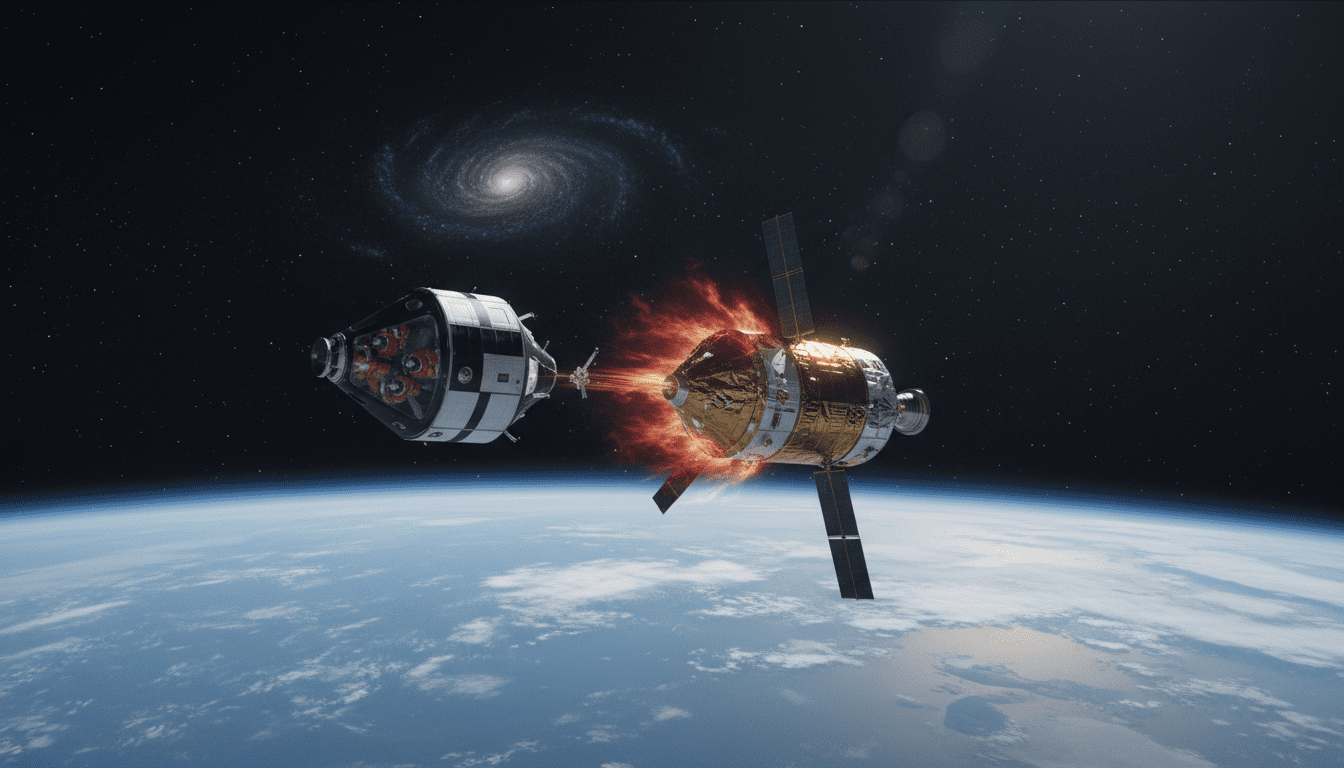
Artemis reentry: Crew completes final burns as service module is jettisoned and heat shield faces intense descent
Artemis reentry: Crew secures capsule, prepares for jettison of the European Service Module and relies on Avcoat heat shield to withstand extreme atmospheric temperatures.
The Artemis crew has begun final preparations for reentry, with an eight‑second engine burn and timed system shutdowns setting the spacecraft on its return to Earth. Artemis reentry procedures include wearing pressure suits, disabling nonessential systems, and the scheduled jettison of the European Service Module before atmospheric braking. Mission controllers tightened the timeline with precise maneuvers to ensure the correct entry angle and protect the crew during the high‑heat phase of descent.
Final burn set reentry trajectory
An eight‑second thrust at 20:53 German time gave the spacecraft a small but critical velocity change, accelerating the capsule by roughly 4.6 kilometers per hour. That adjustment was designed to place the crew module on the narrowly defined corridor that will produce the correct entry angle into the atmosphere. Flight controllers have emphasized that even minor speed changes at this stage materially affect heat loading and deceleration profiles during the descent.
The burn followed hours of systems checks and internal stowage, with crew members securing food boxes, lashing down luggage and confirming suit readiness. Mission logs show the crew powered down nonessential hardware and performed final communications checks ahead of reentry interface.
Crew protocols and suit precautions
Astronauts Christina Koch, Victor Glover, Jeremy Hansen and Reid Wiseman donned full pressure suits to protect against potential cabin depressurization and to ensure an independent oxygen supply. The suits also act as a last‑resort survival system should any major leak or structural failure occur during the high‑stress return phase. NASA and partner agencies routinely train crews for these contingencies and require suiting procedures well before atmospheric contact.
Crew behavior during reentry is tightly scripted: systems are manually monitored but largely automated, and crew tasks are limited to essential checks and emergency responses. The team also disabled the onboard sanitation system shortly before peak heating, a routine step to conserve power and avoid nonessential fluid systems during reentry.
Jettison of the European Service Module
At 01:33 German time the mission planned to jettison the European Service Module (ESM), the unpressurized propulsion and supply element built in Bremen that supported the crew through transit. Once separated, the ESM will reenter the atmosphere independently and burn up, a standard procedure that removes mass and exposes the heat shield and crew module for direct atmospheric entry. The separation is critical to ensure the heat shield is fully exposed and the capsule’s center of mass aligns with the planned entry trajectory.
The ESM provided propulsion, electrical power and life‑support resources during the lunar phase of the mission and carried hardware and supplies that cannot return. Engineers monitor the separation sequence closely because any residual connection or unexpected motion could change the reentry profile.
Avcoat heat shield and ablation performance
Beneath the crew module is an Avcoat ablative heat shield, a composite material that protects the capsule by gradually eroding away and carrying heat outward during atmospheric passage. NASA specifications for this mission state the shield must withstand peak heating in excess of 2,700 degrees Celsius, as the friction of reentry converts kinetic energy into intense surface temperatures. The ablation process is designed to erode predictably so underlying structure remains intact and internal cabin temperatures stay within survivable limits.
Avcoat was used on earlier deep‑space capsules and was the subject of scrutiny after the Artemis‑1 test flight, when inspectors observed localized loss of coating material. At the time, agency engineers concluded that uneven heating during that test led to atypical ablation patterns and that redesign was not immediately required. For the current crewed return, controllers adjusted the flight path to minimize heat‑shield dwell time at peak temperatures in order to reduce stress on the material.
Past incidents inform current safeguards
The loss of Space Shuttle Columbia in 2003 remains a solemn point of reference for reentry safety, as structural damage to thermal protection can have catastrophic consequences. Columbia’s breakup highlighted the vulnerability of returning spacecraft to thermal and aerodynamic forces when protective systems are compromised. Agencies now apply lessons from that tragedy across training, hardware inspection and mission planning to mitigate similar risks.
Mission teams have incorporated additional checks and procedural redundancies since earlier test flights, including more conservative reentry corridors and enhanced monitoring of thermal and structural telemetry. Officials emphasize that the current mission’s timeline and protective measures are designed to prioritize crew safety over other objectives.
The crew and ground teams continue to follow a tightly choreographed sequence as the capsule closes on Earth, relying on proven materials, redundant systems and the precise timing of maneuvers to carry the mission to a safe conclusion.
