
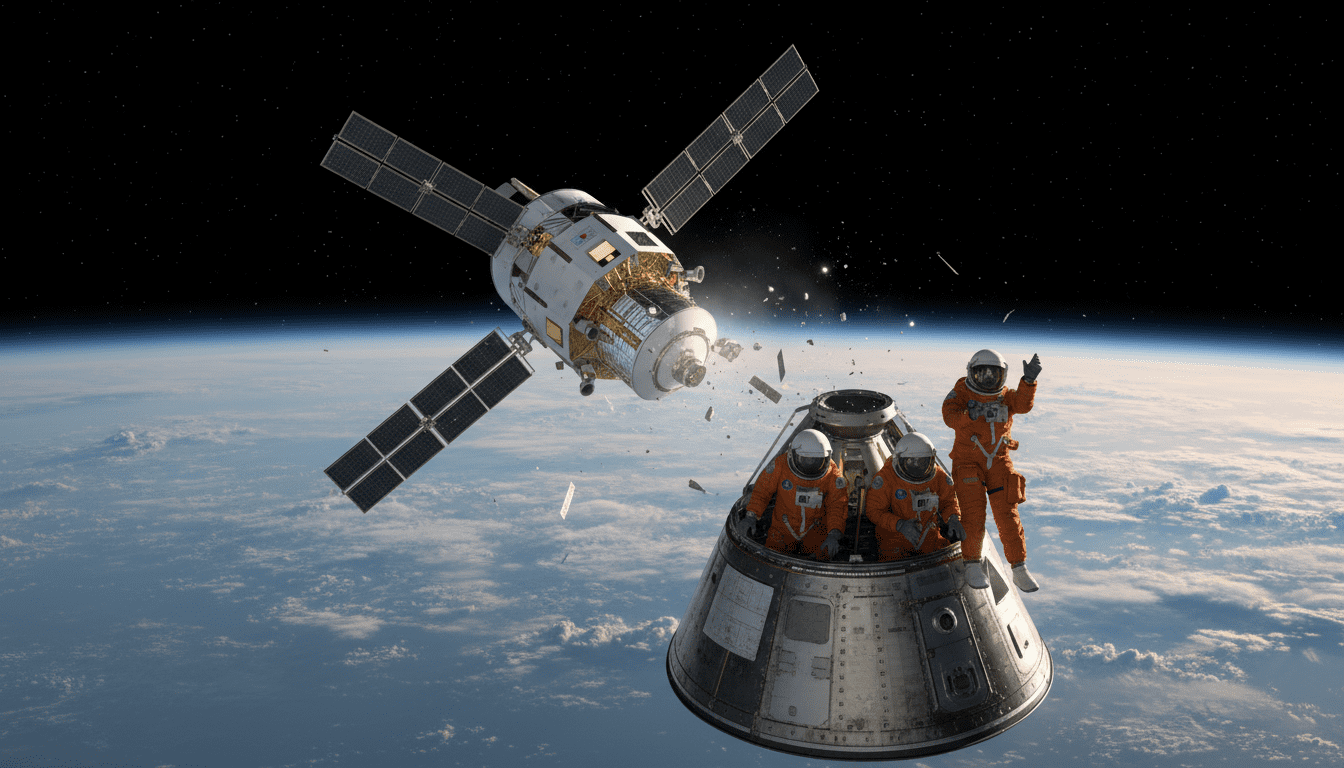
Artemis reentry: Crew prepares for fiery Earth return as service module is jettisoned
Artemis reentry: NASA astronauts Christina Koch, Victor Glover, Jeremy Hansen and Reid Wiseman prepare for Earth return as the European Service Module is jettisoned and the Avcoat heat shield faces temperatures up to 2,760°C.
The Artemis reentry sequence is underway as the four-person crew moves through final preparations for Earth return following the last service-module burn. At 20:53 German time an eight-second engine firing increased the capsule’s speed by roughly 4.6 kilometres per hour to set the precise reentry angle. The astronauts have donned pressure suits, secured cargo and completed routine systems shutdowns as the mission transitions from lunar operations to atmospheric descent.
Final propulsion and timeline
The crew executed a brief service-module burn designed to adjust the capsule’s trajectory for a controlled reentry into Earth’s atmosphere. That eight-second burn, performed in the evening hours by German time, was intended to fine-tune a narrow flight corridor where angle and velocity must align closely to avoid excessive heating or skipping off the atmosphere.
Following the burn, crew procedures continued through the night as engineers monitored telemetry and life-support parameters. Shipboard tasks included disabling nonessential systems and preparing consumables and waste management systems for the high‑stress return phase.
Crew safety and pressure-suit protocols
Astronauts Christina Koch, Victor Glover, Jeremy Hansen and Reid Wiseman wore launch-and-entry suits to ensure an independent oxygen supply and protection against sudden depressurization. Mission planners require suits during reentry to provide an immediate survivable environment should a cabin breach occur in the critical phases of descent.
The suits also include communication and cooling subsystems to keep the crew functional during high-G and high-heat periods. Routine checks on suit seals and oxygen lines remained part of the checklist as the capsule approached the final stages of its transfer back to Earth.
Jettison of the European Service Module
At approximately 01:33 German time the crew will separate from the European Service Module — the Bremen-built element that supplied propulsion, power and life support throughout the mission. The ESM, which supported the crew during lunar transit and operations, is scheduled to be released and allowed to disintegrate as it reenters the atmosphere.
Separation of the service module also triggers the deployment and exposure of the crew module’s heat shield, which must then absorb and manage the vast thermal load generated by atmospheric entry. The planned jettison is a standard phase of crewed capsule returns, leaving only the reentry vehicle and its protective systems to complete Earth landing.
Heat shield composition and thermal stress
The capsule relies on an Avcoat ablative heat shield applied beneath the crew module to carry heat away through controlled material loss. NASA has used Avcoat variants on multiple missions, tracing lineage to earlier programs, and mission data indicate the shield must withstand localized temperatures reaching as high as 2,760 degrees Celsius during peak heating.
Avcoat works by gradually charring and shedding material, carrying heat away from the underlying structure. To minimize wear, flight controllers chose a trajectory that reduces the duration of peak thermal exposure while keeping the deceleration and angle within survivable limits for both crew and equipment.
Engineering scrutiny and past concerns
The heat shield’s performance has drawn public and engineering scrutiny since fragments were observed to delaminate after earlier test flights. NASA previously attributed those observations to an uneven ablation process connected to lower-than-expected heating in portions of the shield, and engineers have adjusted flight profiles to manage thermal load rather than radically redesign the material on short notice.
Safety officials continue to cite the catastrophic Columbia loss in 2003 as a seminal precedent for the care with which heat-shield integrity is treated. Lessons from past accidents remain part of mission planning and inform both hardware design choices and operational decisions during reentry.
Crew perspectives and mission tone
Crew members have described the reentry as an intense but controlled phase of flight; veteran astronaut Victor Glover likened the experience to “riding a fireball through the atmosphere,” underscoring the visceral nature of returning at orbital and lunar-return velocities. Despite the dramatic imagery, the capsule’s systems and the flight plan are engineered to convert extreme energy into a survivable entry profile.
Mission teams on the ground maintained steady communications protocols and monitored telemetry in real time as the crew prepared for the final staging events that will culminate in parachute deployment and splashdown.
The mission’s closing hours hinge on precise timing and coordinated separations that have been rehearsed repeatedly in simulations. As the service module is cast off and the heat shield bears the brunt of atmospheric friction, the capsule and its crew will rely on a lineage of tested engineering and careful operational control to complete the journey home.
