
Artemis 2 reentry marks tense return as crew end historic lunar flyby
Artemis 2 reentry saw four astronauts—Reid Wiseman, Victor Glover, Christina Koch and Jeremy Hansen—brace for a fiery descent during the mission’s final hours on April 11, 2026. The crew completed a distant lunar flyby and then accelerated toward Earth at nearly 40,000 kilometres per hour before first contact with the atmosphere. Mission teams described the night operation as the most technically sensitive phase of the flight, with splashdown and recovery operations standing ready.
Final day and reentry sequence
The spacecraft began its final descent late Friday, with mission control initiating the deorbit burn that set the capsule on an intercept course with Earth’s atmosphere. As the vehicle approached at speeds approaching 40,000 km/h, flight controllers monitored a tightly choreographed series of events designed to manage heating, trajectory and attitude. The moment of atmospheric interface—the first contact with the thickening air—was identified by engineers as the single most demanding phase for vehicle systems and crew endurance.
Crew experience during high-speed descent
Onboard, the four-person crew reported higher-than-usual acceleration and a carefully sequenced set of actions to brace for reentry loads. Reid Wiseman, Victor Glover, Christina Koch and Jeremy Hansen all completed scheduled checks and harnessed into the capsule’s seats as temperatures rose outside the hull. Training simulations had prepared the astronauts for extended communication dropouts and intense G-forces, and mission sources said the crew executed procedures without deviation.
Heat shielding and guidance safeguards
Engineers highlighted the performance of the capsule’s heat shield and guidance systems as critical to a safe Artemis 2 reentry. Thermal protection was designed to shed the extreme heat generated during atmospheric passage while the guidance and control system maintained the correct angle of attack to avoid excessive heating or lift-off. Redundant avionics and automated fault-detection routines remained active to correct small deviations, limiting the need for manual intervention during the most volatile moments.
Communications, telemetry and blackout management
Flight teams anticipated and managed a brief communications blackout as plasma enveloped the vehicle at peak heating, a standard but closely watched effect during reentry. Ground stations and relay satellites coordinated to maximize telemetry return before and after the blackout window, allowing engineers to reconstruct trajectory and system performance in near real time. The restoration of continuous data streams after the blackout confirmed expected system behavior and informed the final approach plan.
Splashdown and recovery operations
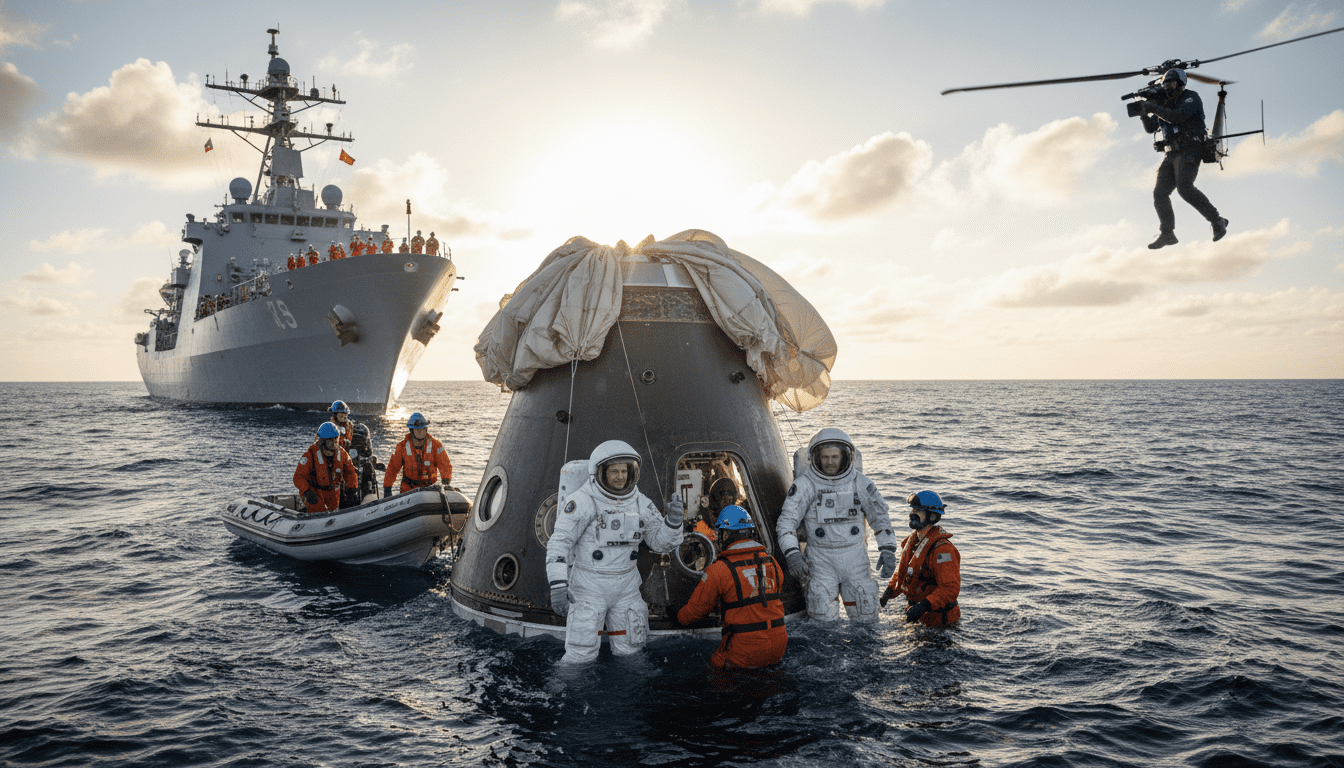
Recovery forces from partner agencies were positioned in a preplanned zone to receive the capsule after deceleration and parachute deployment, with contingency vessels and helicopters on standby. Recovery teams confirmed that splashdown procedures followed their rehearsed timeline, enabling rapid approach, stabilization of the spacecraft and initial medical checks for the crew. On-water retrieval and transfer to a nearby ship were expected to be completed within hours, allowing astronauts to undergo more detailed medical evaluations and debriefings.
Program implications and next steps
The successful completion of Artemis 2 reentry will provide engineers and mission planners with a wealth of flight data critical to the next phase of the lunar program. Analysts noted that a clean reentry and prompt recovery strengthen confidence in systems slated for follow-on missions, while telemetry gathered during atmospheric transit will feed iterative design and procedural updates. NASA and its international partners will now focus on postflight analysis, crew health assessments and formal mission reviews that inform schedule adjustments for upcoming Artemis missions.
The return of Wiseman, Glover, Koch and Hansen closed a landmark chapter in crewed lunar exploration and underscored the persistent technical challenges of reentry. As teams comb through performance logs and medical reports, the Artemis 2 reentry will be assessed not only for its operational success but for lessons that sharpen safety margins on future flights. The crew’s safe recovery will remain the immediate priority while the program charts its next steps toward sustained lunar operations.
