
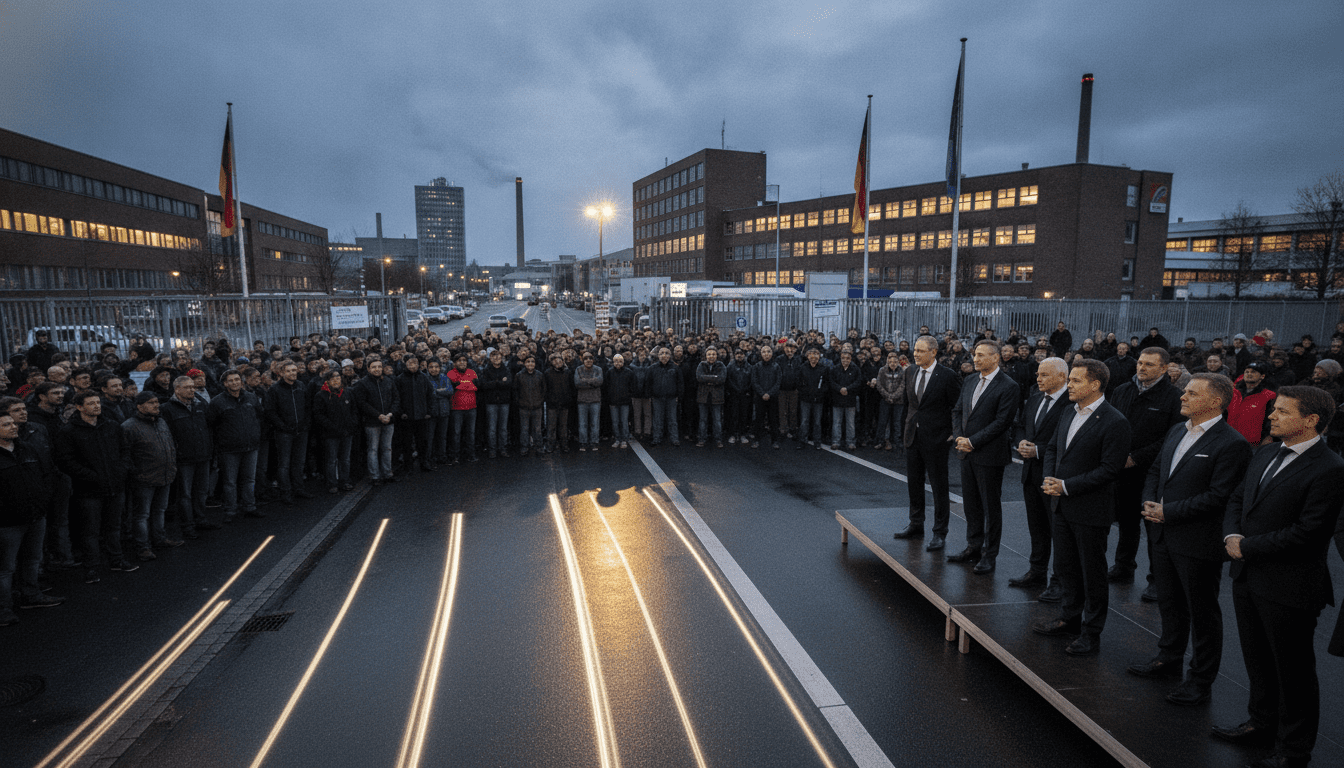
VW restructuring threatens German plants as states and unions dig in
German states, unions and automakers clash over VW restructuring plans that could target Neckarsulm, Zwickau, Hannover and Emden, raising fears of mass job losses.
The new Baden-Württemberg government has intervened as VW’s restructuring plan puts key German factories at risk, with Audi’s Neckarsulm plant and Volkswagen’s Zwickau, Hannover and Emden sites specifically named in management reviews. VW restructuring is now a political as well as industrial crisis, touching regional economies, supervisory-board politics and long-standing labor agreements. Governments from Baden-Württemberg to Saxony and Lower Saxony are mobilizing to protect jobs and local supply chains as the company argues deep cost cuts are needed to remain competitive. The escalating dispute sets up a high-stakes supervisory board meeting that could determine the future of tens of thousands of workers.
Özdemir’s meeting with Audi leadership raises alarm in Stuttgart
Three weeks after taking office, Baden-Württemberg’s Minister-President met Audi CEO Gernot Döllner in the Villa Reitzenstein to discuss threats to the Neckarsulm site and the region’s industrial ecosystem. The Audi plant in Neckarsulm, which employs about 15,500 people, is seen locally as a strategic employer central to the Heilbronn region’s innovation hub. Officials in Stuttgart emphasized the plant’s engineering capabilities and its links to nearby research initiatives, arguing these attributes should factor into any model allocation decisions under VW restructuring plans. The meeting signaled that state governments will lobby directly with automakers and try to shape the outcome before boardroom decisions are finalized.
Federal-state tensions deepen over model allocation and investment
The potential reassignment or loss of model production has pitted states against one another, with eastern and western regions trading accusations over who benefits and who loses. Zwickau in Saxony, which currently builds the electric ID models, fears losing the Q4 compact SUV and with it crucial assembly and supply-chain work. Lower Saxony, with political weight through its ownership stake, has stressed that any plan must respect its statutory rights and protect employment; its representatives on VW’s supervisory board are viewed as pivotal. The dispute has already produced sharp public comments from regional leaders, reflecting how deeply intertwined VW’s factory map is with local political and economic stability.
Four German factories named in management review
VW management has publicly identified four German plants under particular scrutiny: Zwickau, Neckarsulm, Hannover and Emden. Executives say the company must reduce capacity costs and optimize its factory network amid weaker global demand, rising competition from Chinese brands and trade pressures. Plant managers and local officials counter that some facilities are already improving efficiency or serve essential product segments, and they question whether proposed benchmarks accurately reflect local circumstances. The debate over which models will be produced where has become a proxy for broader questions about how VW will balance brand autonomy, investment priorities and regional commitments going forward.
Unions and workers prepare for a fight over job security
Labor representatives and IG Metall have publicly warned they will resist any moves that threaten plants, invoking past struggles to defend jobs and local communities. Works councils are urging solidarity across sites, recalling historical protests that saved plants in earlier crises, and they promise unified action if measures move toward closures or mass layoffs. Unions also emphasize the binding nature of recent tariff agreements, which set targets and deadlines for cost reductions and have been used to prevent closures in earlier rounds of restructuring. The prospect of up to 60,000 job reductions circulating in recent reports has amplified urgency and mobilized political support for protective measures.
Management cites global pressure and calls for deep cuts
VW executives, including CEO Oliver Blume, argue that incremental savings are no longer sufficient given structural market shifts and international competition. Management and shareholders including the Porsche and Piëch families have proposed a legal and organizational overhaul that would separate holding functions from operational brands, a plan that would also change governance and could dilute regional vetoes. Company leaders point to higher tariffs, overcapacity in Europe and the need to finance electrification and software investment as drivers for more radical change. Critics counter that a holding structure would sideline long-standing co-determination practices and weaken the special protections enshrined for certain owners and regions.
Supervisory board meeting sets a deadline for decisive action
A supervisory board session scheduled next week is expected to be a turning point, with voting members under pressure to reconcile shareholder demands, government intervention and worker protections. Lower Saxony’s ownership stake and its supervisory-board representatives are likely to play an outsized role, and political leaders have publicly asserted they will not agree to plans that threaten sites without credible alternatives. A tariff-era deadline requiring cost targets to be met by year-end adds another layer of urgency, meaning that outcomes from the upcoming meetings could trigger implementation steps or renewed rounds of negotiation. The next decisions may therefore determine which plants receive investment and which face restructuring measures.
The conflict over VW restructuring underscores how the auto industry’s transition to electrification and software-defined vehicles is not just a corporate challenge but a national political fault line. As management presses for competitiveness and states rally to defend jobs, the coming supervisory-board decisions and subsequent negotiations will shape not only the future of individual factories but the economic prospects of entire regions.
