
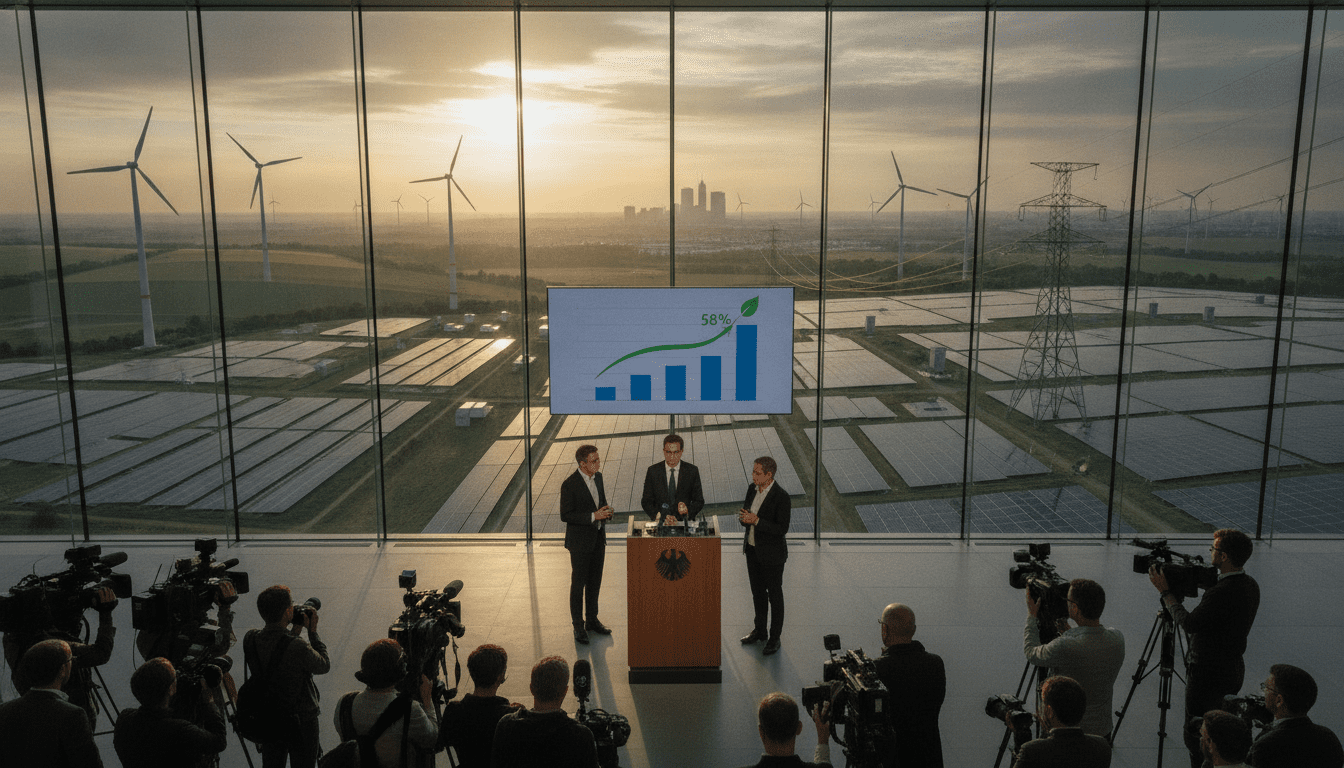
Renewable energy share hits record 58% of Germany’s electricity consumption in first half of 2026
Germany’s renewable energy share reached a record 58% of electricity consumption in Jan–Jun 2026, driven by higher wind and solar output, say ZSW and BDEW.
Germany’s renewable energy share climbed to a historic 58 percent of electricity consumption in the first half of 2026, according to joint projections from the Centre for Solar Energy and Hydrogen Research Baden-Württemberg (ZSW) and the German Association of Energy and Water Industries (BDEW). The increase of nearly three percentage points over the same period last year marks the strongest first-half contribution from wind, solar and hydropower on record. Officials attribute the gain primarily to markedly higher wind generation and a modest rise in photovoltaic production.
Record Renewable Share in First Half of 2026
The ZSW and BDEW estimate that renewables supplied 58 percent of Germany’s electricity demand from January through June 2026, topping the previous year’s level by almost three percentage points. For context, renewable sources accounted for 55.8 percent of electricity consumption across the full year 2025. Analysts say the first-half result underscores a steady upward trajectory for the energy transition, while also reflecting favorable weather conditions for wind generation compared with a wind-poor stretch in the prior year.
Wind generation drives the year-on-year rise
Wind power was the principal driver of the higher renewable energy share, with onshore generation rising by 7.0 percent and offshore output increasing by 28.3 percent versus the same period in 2025. The rebound follows a wind-weak first half in the previous year, amplifying year-on-year growth rates when conditions normalize. Together, onshore wind farms produced 52.9 billion kilowatt-hours in the first half of 2026, a substantial contribution to the country’s gross electricity supply.
Solar production posts steady gains
Photovoltaic generation also rose, though more moderately, with solar output up 3.7 percent year on year for the Jan–Jun period. PV accounted for 52.4 billion kilowatt-hours of generation, closely matching the onshore wind figure and highlighting the balanced contributions of the two technologies. Industry representatives noted that continued deployment of rooftop and ground-mounted arrays is helping to sustain solar’s role as a pillar of Germany’s power mix.
Renewables supplied 152.2 billion kWh of electricity
Overall, renewable-energy installations generated 152.2 billion kilowatt-hours of electricity in the first half of 2026, against a gross electricity production of 263.5 billion kilowatt-hours for the same period. That volume confirms renewables’ dominant share of domestic power supply in the first half and reduces the relative role of fossil-based generation. Observers caution, however, that seasonal patterns and demand fluctuations mean full-year outcomes will depend on weather, demand and market conditions in the coming months.
Industry voices link renewables expansion to price stability and climate goals
Frithjof Staiß, a board member at ZSW, emphasized that a larger renewable energy share improves Germany’s resilience to fossil-fuel import dependencies and to global price shocks. Staiß described the expansion of renewables as the “sharpest sword” against climate change and said recent heatwaves underline the urgency of accelerating emissions reductions. BDEW chief executive Kerstin Andreae urged the federal government to accelerate legislative work on the Renewable Energy Sources Act (EEG) and the Wind at Sea Act, stressing that draft bills had not been presented even though the first half of the year had concluded.
Policy and infrastructure hurdles remain
Despite the record share, industry groups and analysts say significant barriers persist, including grid bottlenecks, lengthy permitting processes, and gaps in storage and flexible generation capacity. Accelerating onshore and offshore project approvals, expanding transmission capacity, and scaling battery and hydrogen solutions were cited as priorities to ensure the new renewable output can be reliably integrated. The associations also urged clearer timelines and faster legislative drafting from the ministries responsible, noting that faster regulatory progress is essential to lock in the gains demonstrated in the latest data.
The strong first-half result offers momentum for Germany’s energy transition but also raises expectations that policy makers and grid operators will translate the statistical milestone into durable structural change. Continued investment in generation, grid modernization and storage — along with expedited permitting and legislative action — will determine whether the higher renewable energy share becomes a sustained trend through the rest of 2026 and beyond.
