
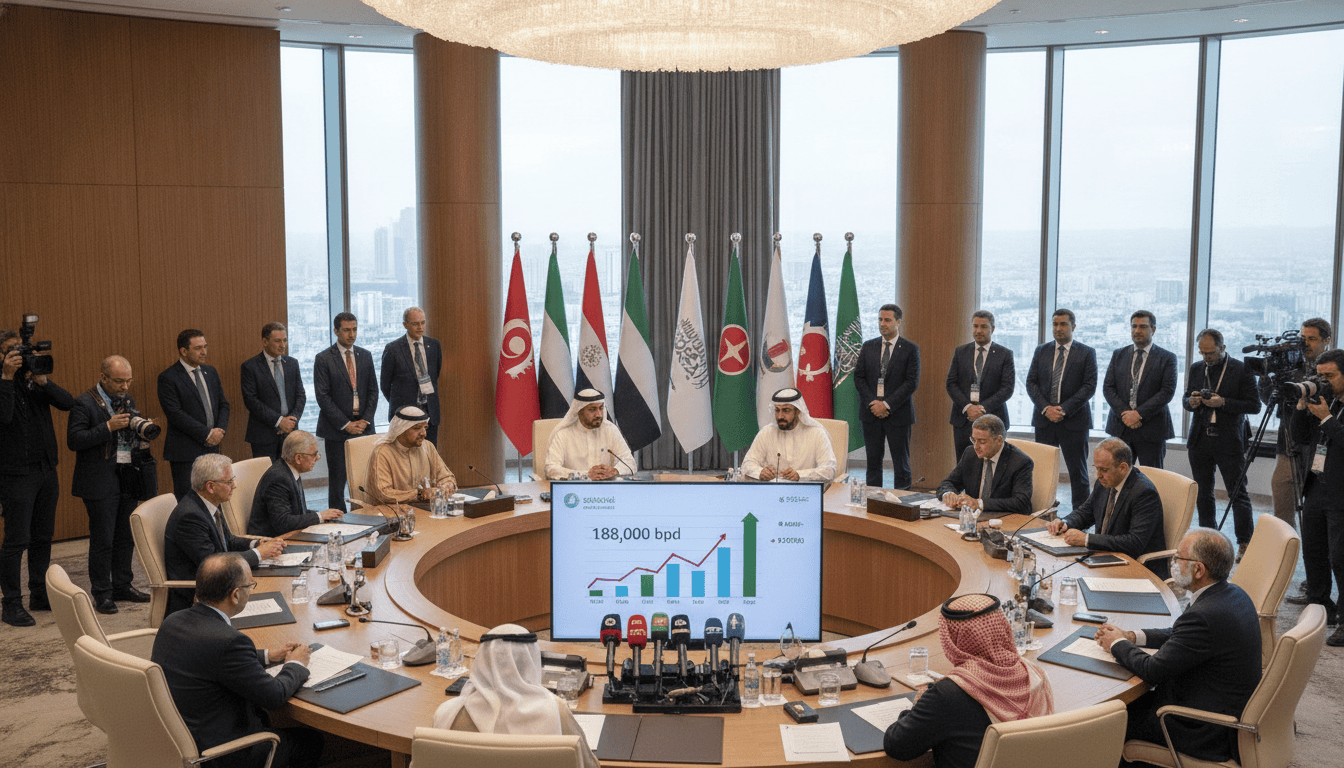
OPEC+ Confirms August Oil Production Increase of 188,000 Barrels a Day
OPEC+ will raise oil production in August by 188,000 barrels per day, the cartel said, signaling a cautious expansion of output as shipping through the Strait of Hormuz recovers and market conditions evolve.
OPEC+ oil production increase was announced by the cartel’s core group on the heels of recent, incremental boosts to supply, with the coalition saying the August uplift will be implemented gradually and remains conditional on market developments. The decision comes as member states retain the option to accelerate, pause or reverse the increase depending on price movements and shipping stability. The move underlines a calibrated approach aimed at balancing supply restoration with the risk of future oversupply.
Core Seven Outline the Increment
The announcement was made by the OPEC+ core group of seven producers—Saudi Arabia, Russia, Iraq, Kuwait, Kazakhstan, Algeria and Oman—who collectively set the near-term expansion plan. The group specified a daily increase of 188,000 barrels, equivalent to roughly 159 liters per barrel, to take effect in August 2026. Officials said a formal review of broader production policy will occur at a meeting scheduled for 2 August 2026, when members will assess market indicators and shipping trends.
Flexibility Emphasized as Central Policy
OPEC+ framed the increase as conditional, stressing flexibility in its implementation to respond to evolving conditions in oil markets and maritime routes. Ministers warned they could speed up the expansion if demand strengthened, or suspend and even roll back volumes should downside risks emerge. That stance reflects concern about volatile geopolitical factors and the cartel’s desire to avoid contributing to abrupt price swings.
Hormuz Shipping Recovery Lowers Risk Premiums
The decision followed renewed maritime traffic through the Strait of Hormuz after a period of disruption earlier in the year, when Iran blocked the waterway in late February 2026 following military strikes. A mid‑June 2026 memorandum between the United States and Iran opened the door to resumed transit, and shipping activity has strengthened since that accord. Market reporting from Bloomberg indicates that more than ten million barrels per day may again be transiting the strait, reducing the wartime risk premium on crude cargoes.
Market Response and Price Trajectory
Oil benchmarks have moved lower toward pre-conflict levels as the shipping route reopened and supply concerns eased, industry sources say. Traders and analysts note that the August increase is small relative to global flows, but it sends a signal that producers are prepared to put more crude into the market as logistical conditions normalize. Price sensitivity will be a key watchpoint ahead of the 2 August 2026 meeting, with OPEC+ ministers expected to weigh inventories, refinery demand and macroeconomic indicators.
Production vs. Targets and Forward Supply Risks
Analysts caution that actual output across the OPEC+ membership may still lag formal targets, owing to technical constraints, maintenance and logistical bottlenecks that limit near-term lifts. As shipping stabilizes, however, capacity utilisation is likely to climb and production could follow, observers say. Several market monitors now forecast a shift toward surplus next year if demand growth softens and planned capacity comes online, which is one reason the cartel’s central members are keeping tight discretion over the pace of increases.
The August increase marks another step in a series of measured supply adjustments that began in recent months, reflecting OPEC+’s effort to regain market share without triggering a sharp decline in prices. With the core group meeting set for 2 August 2026, ministers will have the opportunity to recalibrate their stance based on updated flows through the Strait of Hormuz, inventory data and shifting demand forecasts.
