
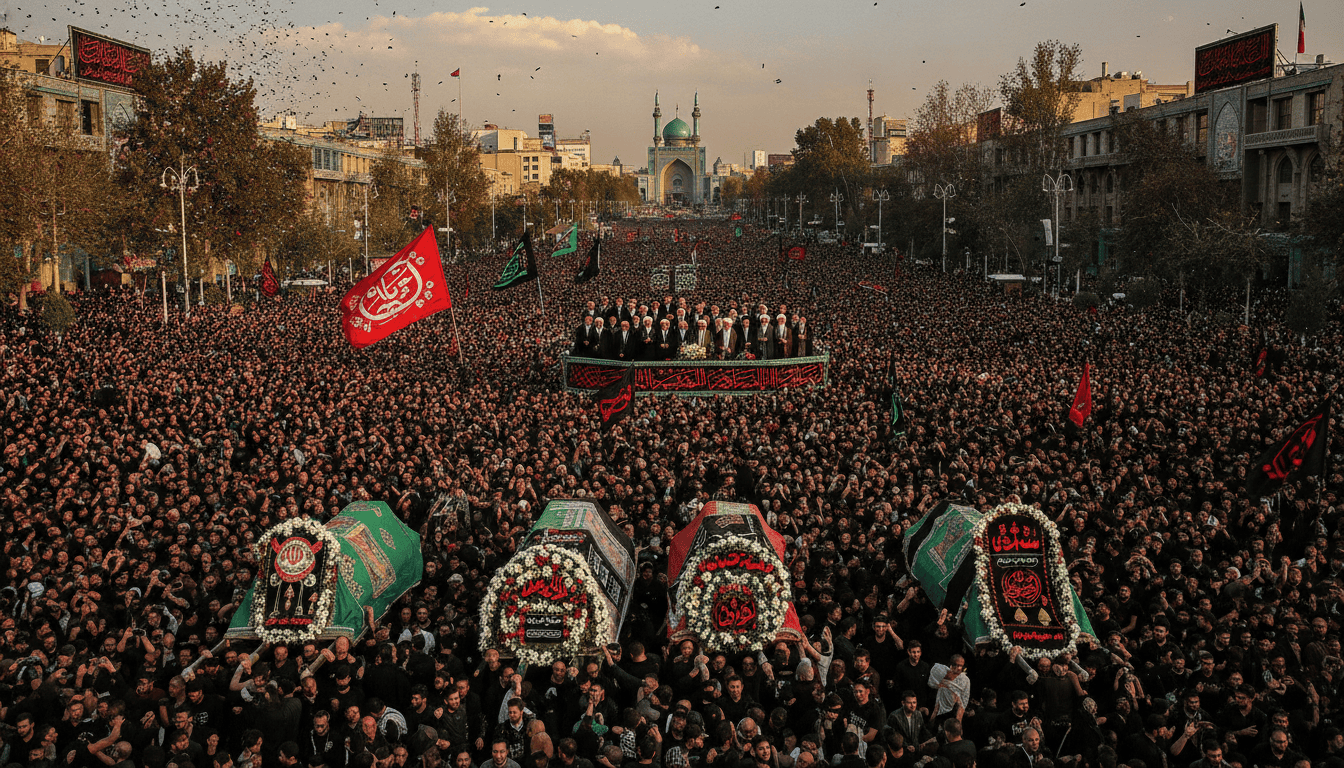
Khamenei funeral adopts heavy religious symbolism as Iran stages multi-city procession to project unity and call for retaliation
Khamenei funeral uses iconic imagery, route through Qom, Najaf and Karbala, and state rhetoric to frame his death as martyrdom and a national duty of mourning and resistance.
Opening summary of the ceremonies
The Khamenei funeral has unfolded as a tightly choreographed series of events that blend religious ritual with political messaging. State authorities framed the death of Supreme Leader Ayatollah Ali Khamenei as a martyrdom and urged nationwide grief as a collective obligation. Officials opened three days of mourning in Tehran before sending the procession on a planned route linking Iran and Iraq’s most important Shia sites.
State Rhetoric Frames Martyrdom and Duty
Official messaging has repeatedly described Khamenei’s death in terms of martyrdom, turning personal loss into a public duty. Banners and speeches have used variations of the slogan “We must rise,” presented in Persian and in Arabic as “Rise for God,” invoking a Quranic call to stand for a divine cause. The state has explicitly tied mourning to loyalty and resistance, urging citizens and allied movements to view public grief as a reaffirmation of the Islamic Republic’s principles.
Visual Iconography: the clenched fist and color palette
A stylized image of Khamenei’s clenched fist on a red-and-black background has become the dominant visual symbol of the funerary campaign. The motif references a posthumous text message attributed to Mojtaba Khamenei and recalls the leader’s wartime injuries while signalling defiance. State organisers have paired that iconography with the traditional colors of grief and martyrdom to link loss, sanctity and a call for retribution.
Route selection connects clerical legitimacy and transnational Shia sites
The procession’s route—from the Grand Mosalla in Tehran through Qom, Najaf and Karbala to burial in Mashhad—was chosen to echo the ideological map of Shia authority. Qom supplies clerical legitimacy through the seminaries that underpin Iran’s theocratic institutions, while Najaf and Karbala in Iraq are among the holiest sites in Shia Islam. Officials framed the tour as a pilgrimage that reasserts the revolution’s religious foundations and projects the regime’s transnational influence.
Foreign delegations and the “Axis of Resistance” on display
Delegations from regional allies including Hezbollah, Hamas, and Houthi representatives were received in Tehran during the official events, underscoring Tehran’s network of allied armed groups. Each visiting delegation participated in state rituals, where eulogists read selected Quranic verses before exchanges with Iranian leaders. The choreography of foreign guests was used to broadcast solidarity and to present Khamenei’s death as a moment of regional realignment in favour of Iran’s allied movements.
Religious language intensifies calls for retaliation, security questions persist
Large public displays have explicitly linked Khamenei’s killing to historical narratives of injustice, with a giant red flag over the Grand Mosalla invoking Karbala and the call “O avengers of Hussein.” State statements and banners have framed potential retaliation against the United States and Israel as not only strategic but religiously mandated. At the same time, authorities have offered few concrete details about how they plan to enact revenge, and analysts note that questions remain about timing, targets and the potential regional security implications.
Public mobilization and controlled spectacle in Tehran and beyond
Authorities expected millions to participate in processions and organized bearers, pilgrims and delegations to create an image of national unanimity. State media and security organs coordinated routes, slogans and visual motifs to ensure a consistent narrative across cities and borders. Observers say the spectacle serves multiple goals: consoling supporters, intimidating opponents, and consolidating Mojtaba Khamenei’s emergent leadership while minimising visible signs of dissent.
The funeral campaign has been notable for its blending of liturgical ritual and political theatre, with leaders invoking religious history to situate Khamenei’s death within a wider struggle. By linking ceremonies to the shrine cities of Qom, Najaf, Karbala and Mashhad, the state is simultaneously reasserting clerical authority and appealing to a regional constituency of Shia faithful. The visual language — the clenched fist, red banners, and Quranic references — operates as both a memorial and a mobilizing tool, aimed at rallying supporters and signalling resolve to rivals.
Critics and independent analysts have pointed out that the carefully managed displays may not reflect uniform public sentiment across Iran, where social and political divisions persist. Security precautions, controlled access to ceremonies, and the absence of some visible leaders from public platforms have fed speculation about the regime’s concerns over stability and assassination threats. Nonetheless, the sequence of funerary events has succeeded in projecting a coherent state narrative that emphasises martyrdom, resistance and a continuity of the Islamic Republic’s ideological project.
As the procession reaches its final stops and Khamenei is interred, the immediate political consequence will be gauged by how Tehran translates ritual anger into policy or action. Regional allies and armed groups have used the events to reaffirm solidarity, but the precise nature and timing of any retaliatory measures remain unclear. For now, the Khamenei funeral stands as a carefully scripted moment of national theatre designed to fortify the new leadership and to recast a violent death as both a sacred loss and a rallying cry.
