
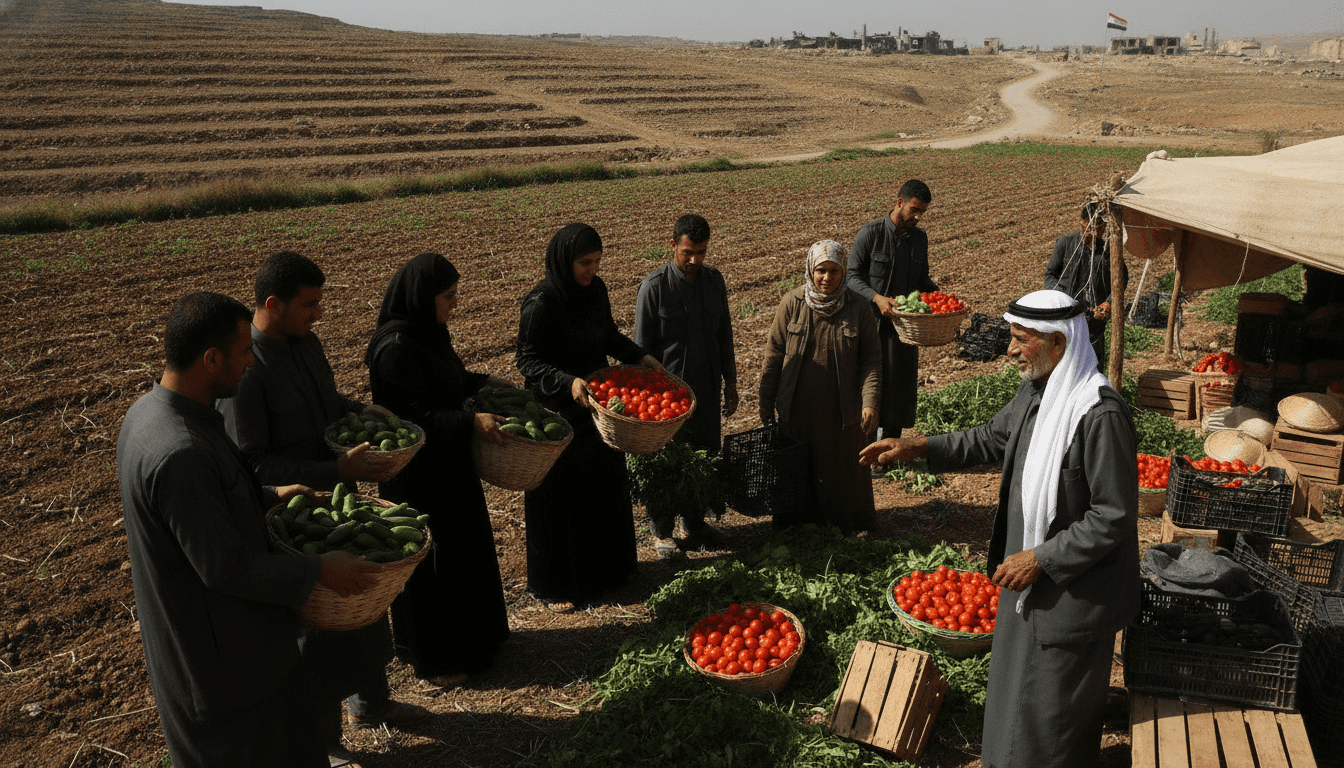
Israeli settler group Pioneers of Bashan urges farming of occupied Syrian land
The Pioneers of Bashan settler group urges cultivation and sale of crops from occupied Syrian land in Daraa and Quneitra amid rising tensions and recent incursions.
Israel’s newly formed settler group the Pioneers of Bashan has publicly called for the cultivation and commercial sale of agricultural produce from territories in Syria now under Israeli control, a move that residents and Damascus condemned as an escalation. The group, founded in April 2025 after the overthrow of Bashar al-Assad in December 2024, said working the land would boost yields and asserted a right to exploit farmland in the Daraa and Quneitra governorates. Its statements have added a civilian-economic dimension to a growing security confrontation along the Israel–Syria front.
Pioneers of Bashan call to farm occupied Syrian land
The Pioneers of Bashan said on social media that communities should farm and market crops harvested from areas captured during recent operations in southern Syria. The group highlighted agricultural potential in Quneitra and Daraa, presenting cultivation as both an economic opportunity and an assertion of territorial claim. Observers say the appeal seeks to normalize Israeli civilian activity on land that Damascus still regards as sovereign Syrian territory.
Group cites harvest figures and biblical rationale
In its post the group pointed to this year’s wheat output in parts of Quneitra, presenting harvest figures as evidence of the land’s fertility and commercial appeal. The group also invoked religious narratives often used by settler movements to justify expansion, framing agricultural settlement as a return of pioneered land to Jewish cultivation. Analysts caution that blending economic motives with ideological and religious claims risks further inflaming local tensions and undermining diplomatic options.
Israeli forces move into Abidin in Daraa
In parallel with the settlers’ statements, Israeli forces advanced into the village of Abidin in Daraa province, witnesses and state media reported, encountering residents who attempted to block access with road obstructions. The incursion prompted a rapid security response and was followed by exchanges that local sources described as heavy and displacing. Military movements into populated areas have raised alarms among humanitarian groups tracking displacement and access to basic services.
Artillery exchanges and civilian displacement
Following the entry into Abidin, Israeli forces used artillery fire, according to state-run Syrian media, which said residents fled to nearby villages overnight to escape the strikes. Local relief actors reported increased movement of civilians seeking shelter and safety amid intermittent shelling. Humanitarian agencies warn that even short-term displacements can strain resources in host communities and disrupt planting and harvest cycles at a critical agricultural moment.
Damascus condemns incursions as sovereignty breach
Syria’s foreign ministry issued a formal condemnation of the incursions, calling the actions “a blatant violation of Syrian sovereignty and territorial integrity” and accusing Israel of targeting civilian areas. Damascus framed the operations and the settler campaign as coordinated attempts to consolidate control over territory amid Syria’s recent political upheaval. Officials in Damascus have called on international actors to denounce the moves and press for the withdrawal of foreign forces.
Israeli officials frame a broader threat in public statements
At the same time, several Israeli ministers have publicly discussed the potential for a wider confrontation with Syria, arguing that the post‑Assad environment could shelter anti‑Israel armed groups. Minister of Diaspora Affairs Amichai Chikli, a member of the government’s right flank, has warned of a perceived new axis of hostile Sunni actors and listed countries he believes could align against Israeli interests. Those pronouncements have been interpreted by critics as providing political cover for both military operations and settler expansion, further polarizing domestic debate within Israel.
The contested nature of the land complicates any move to commercialize agricultural output, with ownership, legal status and international law all in dispute. Israel has maintained control of the Golan Heights since the 1967 war, but the recent advance into additional areas of Daraa and Quneitra comes after a dramatic change in Syria’s political landscape following the fall of Bashar al‑Assad in December 2024. The Pioneers of Bashan were established in April 2025, and their campaign to cultivate land now sits at the intersection of nationalist settlement aims and a volatile security environment.
International and regional actors are watching the developments for signs that localized incursions or civilian settlement drives could trigger broader confrontation. Diplomats and rights groups say any effort to institute civilian farming or markets on disputed land should be assessed against protections for civilians, property rights, and the obligations of occupying powers under international law. Meanwhile, residents in affected villages continue to face uncertainty as military activity and political rhetoric escalate.
The coming days will likely show whether the settler group’s call to cultivate occupied Syrian land leads to increased civilian presence and economic activity or whether it becomes another flashpoint in an expanding conflict that regional authorities and humanitarian organizations are struggling to contain.
