
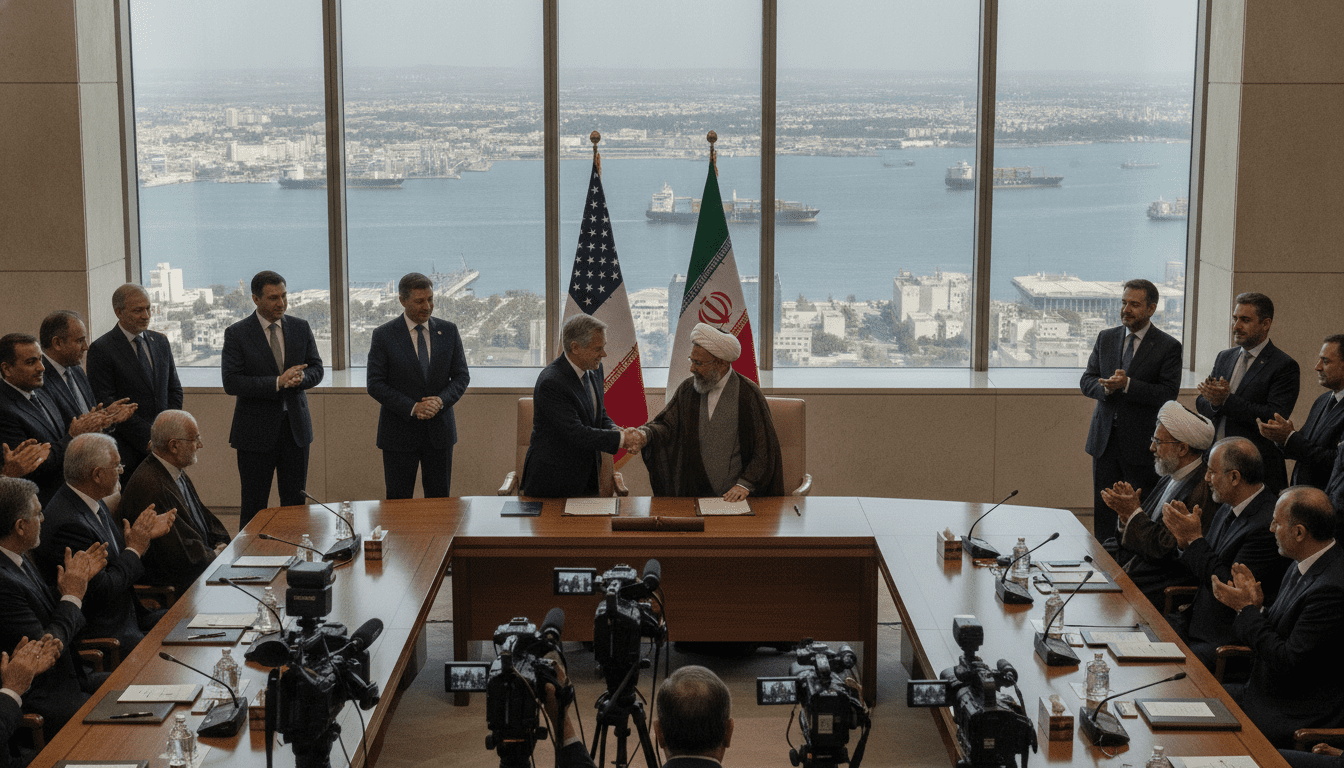
U.S. and Iran Reportedly Near Deal to Reopen Strait of Hormuz, Officials Say
U.S. and Iran officials say they are close to a tentative peace agreement that would reopen the Strait of Hormuz, but conflicting statements from both sides leave key details unresolved.
The United States and Iran have reportedly moved closer to a preliminary peace deal centered on reopening the Strait of Hormuz and ending the current hostilities. The phrase “Strait of Hormuz” is central to the negotiations, which several officials described as nearing completion while also being shadowed by internal disagreements. Despite public expressions of progress, divergent accounts from Washington and Tehran have created uncertainty about timing, scope and the terms that would govern maritime passage.
Senior U.S. official gives high odds of signature
A senior U.S. government official told reporters the chance of an agreement being signed was around 80 to 85 percent. The official cautioned that some Iranian hardliners still opposed a breakthrough and that those internal differences were being worked through. That assessment suggested a strong U.S. expectation that negotiators had resolved most major obstacles, even as elements remained unsettled.
Iran’s foreign minister calls Islamabad memorandum ‘close’
Iranian Foreign Minister Abbas Araghtschi posted on X that the Islamabad memorandum had never been closer to finalization and promised details would be disclosed in due course. His comment was amplified when U.S. President Donald Trump reshared the post on Truth Social, signaling bilateral awareness of the progress. Pakistan’s Prime Minister Shehbaz Sharif also said a final text existed and that Islamabad was coordinating next steps as mediator.
Contradictions over whether terms are settled
Despite conciliatory language, officials on both sides gave conflicting signals about whether the memorandum of intent is already effectively agreed. U.S. statements suggested the deal was largely in place, whereas Iranian officials emphasized that the document had not been signed and that changes remained possible. That mismatch raised immediate questions about how swiftly the Strait of Hormuz could be reopened to near pre-conflict traffic levels.
Ambiguity around freedom of navigation and control
According to a person familiar with the talks who spoke to Bloomberg, the memorandum reportedly leaves room for interpretation on several points, including what reopening the strait will mean in practice. President Trump reportedly described the outcome as providing ships free passage, while Iranian state media indicated Tehran would retain some degree of control. The differing descriptions point to a delicate balance negotiators are trying to strike between international navigation norms and Iran’s security and oversight claims.
Core provisions reportedly address ceasefire and sanctions, not nuclear file
Iranian statements indicate the memorandum would include an end to hostilities on multiple fronts, including actions linked to Lebanon, and a lifting of the U.S. blockade against Iran tied to reopening the Strait of Hormuz. Iranian officials said matters related to Tehran’s nuclear program would be deferred for later negotiation. Tehran’s policymakers framed the arrangement as a strengthening outcome for Iran, even as Western officials focused on immediate maritime and humanitarian impacts.
Shipping, markets and regional security remain cautious
Commercial shipping firms, insurers and regional navies are likely to watch closely for concrete language and implementation steps before adjusting routes and coverage. Even if an agreement is signed, operationalizing safe, routine passage through the Strait of Hormuz would require agreed verification, deconfliction measures and perhaps third-party monitoring. Until those practical mechanisms are clear, maritime operators and energy markets are expected to remain cautious about fully restoring pre-conflict levels of activity.
Diplomatic channels in Islamabad and other mediation backstops will now be tested as negotiators translate a memorandum of intent into a signed accord and implementable procedures. Observers say the next days should bring further clarification if the parties intend to remove the immediate risk to commercial transit.
If the Islamabad memorandum is finalized and implemented, reopening the Strait of Hormuz could ease a major chokepoint for global energy and trade flows, but the degree to which shipping, insurers and regional actors accept any new arrangements will hinge on precise, verifiable language and confidence-building measures.
