
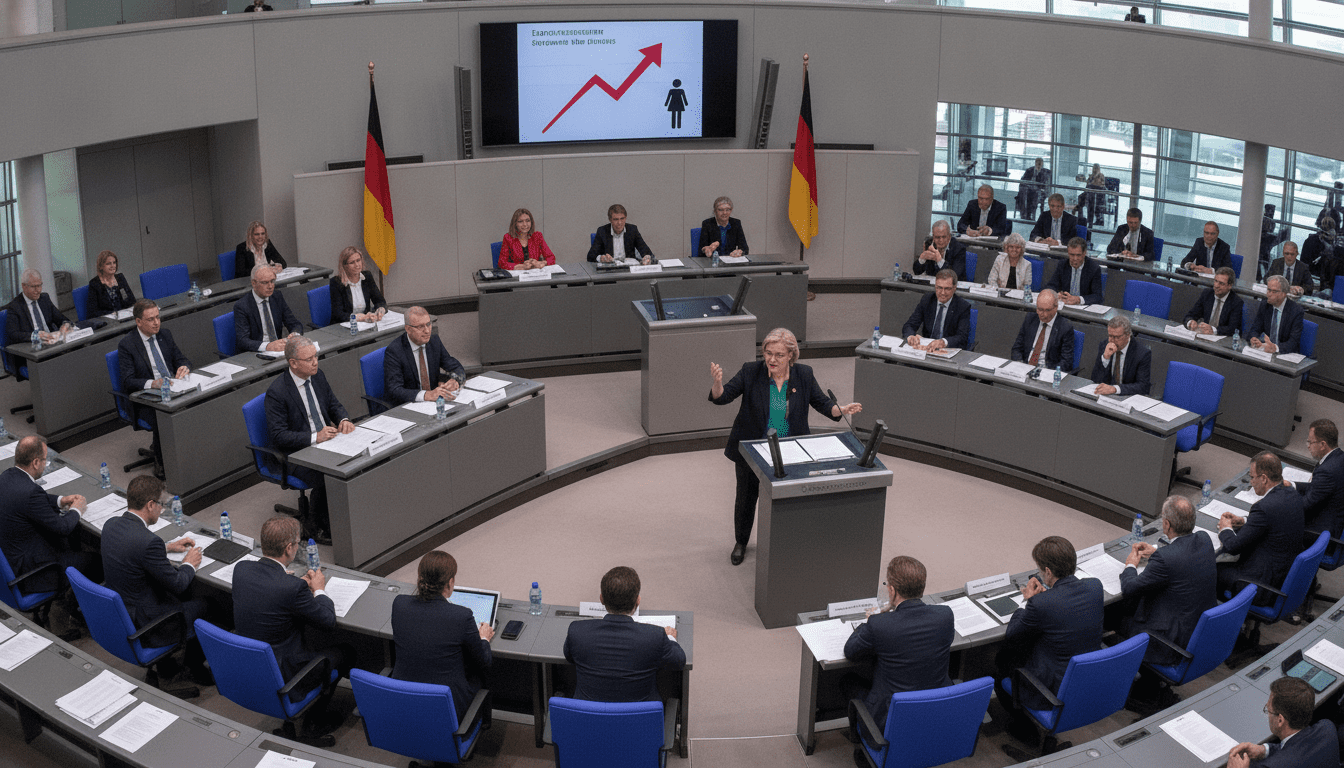
Ehegattensplitting reform gains momentum as economists urge limited realsplitting to boost female employment
Ehegattensplitting reform is at the centre of a renewed debate in Germany as economists propose capping spousal tax benefits to increase female labour participation, redirect support to families with children, and strengthen pay-transparency and childcare measures.
Germany’s debate over an Ehegattensplitting reform intensified this week after an open letter from a group of economists proposed a limited “realsplitting” model that would retain tax recognition of marriage while restricting unlimited advantages for couples with highly unequal incomes. The proposal, co-signed by more than a dozen academics, recommends redirecting fiscal support toward families with children and creating stronger incentives for women to increase paid work. Policymakers in Berlin now face pressure to pair tax changes with broader measures in childcare, social insurance and labour-market regulation.
Open letter proposes capped realsplitting and targeted family support
The signatories outlined a pragmatic package that would preserve respect for marriage but limit the disproportionate tax gains enjoyed by single-earner households. Under the suggested realsplitting approach, fiscal relief would be more closely tied to child-related needs rather than static spousal income differences. Supporters argue this recalibration would achieve three goals at once: acknowledge marriage, improve child subsidies, and boost incentives for women to participate more fully in the labour market.
The advocates emphasise that the reform is deliberately bounded and designed to be politically feasible, avoiding a wholesale dismantling of the current system. They say the savings from curbing unlimited spousal splitting could be redirected to expand childcare and strengthen social protections for working parents. Analysts note that the proposal aims to strike a balance between preserving family recognition and unlocking untapped economic potential.
DIW and Bertelsmann findings show financial disincentives for return to work
Recent studies by research institutes including DIW and work commissioned by the Bertelsmann Stiftung find that many married women face steep fiscal penalties when attempting to increase working hours after childrearing. High marginal tax rates and the loss of spousal benefits make additional paid work financially unattractive for a significant share of women. Researchers warn that this dynamic contributes to a persistent underuse of qualified labour at a time of demographic ageing and skills shortages.
Those studies also highlight the interaction between tax rules and labour-market structures: part‑time careers often block promotion paths, while marginal positions such as mini-jobs offer limited social protection. Economists argue that addressing only one element—tax treatment—will not suffice unless accompanying reforms improve the incentives for transitions into full social insurance and career-track roles.
Childcare, schools and care services framed as economic infrastructure
Policy experts say investments in childcare, full-day schooling and long‑term care must be treated as core economic infrastructure rather than optional social policy. Evidence indicates that reliable childcare and after-school offerings materially increase mothers’ employment rates and hours. Advocates call for not only broader access but measurable quality improvements and consistent opening hours to match full‑time employment patterns.
The letter’s authors stress that legal entitlements without sufficient capacity or quality will not translate into higher labour supply. They urge the government to prioritise funding and implementation timelines so that expanded entitlements yield immediate and dependable returns for working families. In the same vein, strengthening formal care services can reduce the informal burden that typically falls on women and thereby shrink the gendered care gap.
Tax, social insurance and mini‑job rules form a part‑time trap
Analysts identify a cluster of fiscal and regulatory rules that together create a “part‑time trap” for many women. The combination of spousal income splitting, contribution‑free co‑insurance, and the prevalence of low‑hours mini‑jobs frequently makes it economically rational to limit paid work. Reform advocates recommend synchronising changes: capping Ehegattensplitting benefits should be paired with converting mini‑jobs into gateways to regular employment and revising co‑insurance rules to prevent marginalisation of second earners.
Reforming pay and social protection systems, they argue, would make additional work more financially rewarding and socially secure. Policymakers are urged to design transitions that avoid sudden losses of support and instead create clear pathways toward full social insurance and career continuity for those increasing hours.
Workplace discrimination and pay transparency remain core challenges
Beyond fiscal and service changes, experts call for more robust measures to tackle unequal pay and career progression. Germany’s gender pay gap widens with age and is especially pronounced for highly qualified women, according to recent analyses. Campaigners point to slow implementation of the EU pay‑transparency directive and say stronger enforcement is required so equal pay becomes an accessible right rather than a burdensome court case.
Employment regulation and corporate practices must also adapt to enable career continuity in part‑time roles and to normalise longer parental leaves for fathers. Proposals include incentives for shared parental leave, facilitation of leadership pathways in reduced hours, and mandatory reporting that reveals structural pay disparities within firms.
Younger generations’ changing attitudes toward caregiving and work suggest political momentum for change, but entrenched power structures and workplace norms could slow progress.
Germany’s economic and democratic stakes are high: leaving the productive potential of half the population underused imposes long‑term costs on growth, public finances and social cohesion. The Ehegattensplitting reform debate has shifted from abstract equity arguments to a concrete policy discussion about labour supply, childcare as infrastructure, and the redesign of tax and social rules to enable genuine choice. The next steps by the federal government will test whether fiscal reform is matched by investments and regulatory change that together can expand opportunities for women and strengthen the broader economy.
