
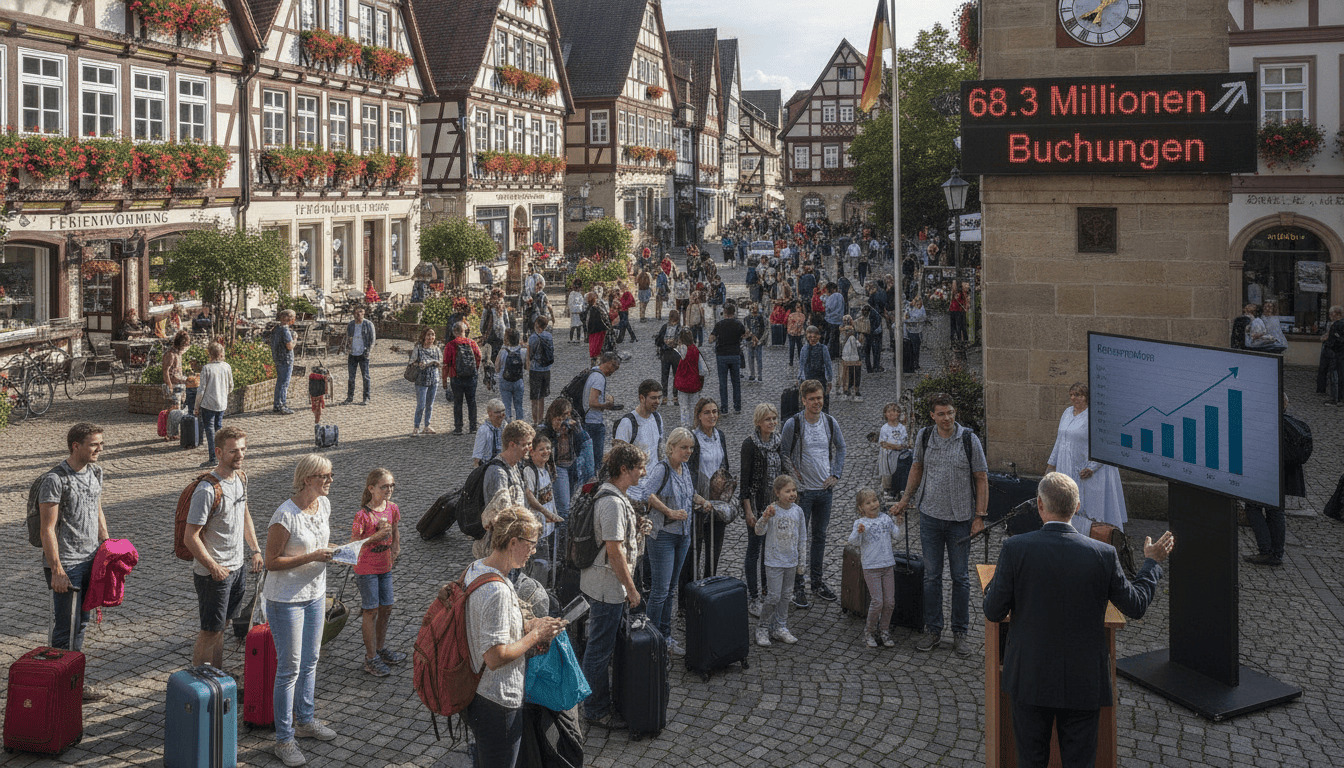
Vacation rental bookings in Germany reach record 68.3 million nights
Vacation rental bookings in Germany hit a record 68.3 million nights in 2025, driven by domestic travelers; Bavaria, Baden-Württemberg and NRW led the regions.
The number of vacation rental bookings made through major online platforms in Germany rose sharply last year, reaching 68.3 million nights according to the Federal Statistical Office. That total, recorded across Airbnb, Booking.com and Expedia, represents a 13 percent increase over 2024 and an 83.4 percent rise compared with 2019, the agency said, with TripAdvisor data excluded from the latest count. The surge was concentrated among domestic travelers, who accounted for roughly three of every four booked nights, underscoring a sustained post-pandemic shift toward online short-term rentals.
Domestic demand accounted for most bookings
The Federal Statistical Office’s data show 48.5 million of the booked nights originated with guests residing in Germany, a segment that grew 15.3 percent year on year. International demand also expanded, but at a slower pace of 7.8 percent, with the largest foreign contingents coming from the Netherlands, Poland, the United States, France and Switzerland. This pattern widened the gap between home-market activity and cross-border tourism on platform-mediated holiday stays, highlighting the importance of domestic travel to the sector’s recovery.
Bavaria, Baden-Württemberg and North Rhine-Westphalia led regions
Regionally, Bavaria emerged as the most-booked destination with about 10.6 million nights, followed by Baden-Württemberg and North Rhine-Westphalia, each registering roughly 8.1 million nights. These figures position inland and alpine destinations among the most popular choices for platform users, while larger urban and coastal states show different guest mixes. The distribution suggests both natural-amenity draws and strong domestic mobility are shaping demand more than ever.
Coastal states remained largely domestic affairs
Coastal and rural destinations displayed markedly different visitor compositions: Mecklenburg-Vorpommern and Schleswig-Holstein recorded approximately 90 percent of their platform bookings from domestic guests. The high domestic share in those states contrasts with city-states and some western regions, which attracted comparatively larger international shares. That geographic divergence points to distinct market dynamics between seaside or countryside “home games” and internationally oriented urban tourism.
Data scope and market coverage caveats
The Federal Statistical Office notes the statistics primarily reflect bookings of smaller, private holiday homes and apartments mediated through the named platforms and do not include TripAdvisor in the latest dataset. Because the series focuses on platform-mediated stays, the figures should be interpreted as a measure of the online short-term rental market rather than total overnight stays in the German accommodation sector. Analysts caution that platform coverage, reporting practices and the exclusion of certain services can influence year-to-year comparability.
The growth in platform bookings reinforces a longer-term trend toward digital intermediation of holiday accommodation, with implications for local housing markets, seasonal capacity and municipal regulation. Policymakers and local authorities have in recent years debated rules on short-term rentals to balance tourism income against housing availability for residents, and the latest numbers are likely to reawaken those discussions.
Platforms and industry stakeholders argue that online marketplaces expand choice for travelers and generate income for property owners and local economies, while critics point to pressure on rental markets and neighborhood disruption in popular destinations. The Federal Statistical Office’s dataset does not resolve those policy debates, but it provides a granular look at where demand is growing and which regions remain primarily served by domestic visitors.
The record figures for vacation rental bookings illustrate how strongly online platforms now shape short-stay tourism in Germany, with domestic travelers driving the recent upswing and a few large states attracting the lion’s share of nights.
