
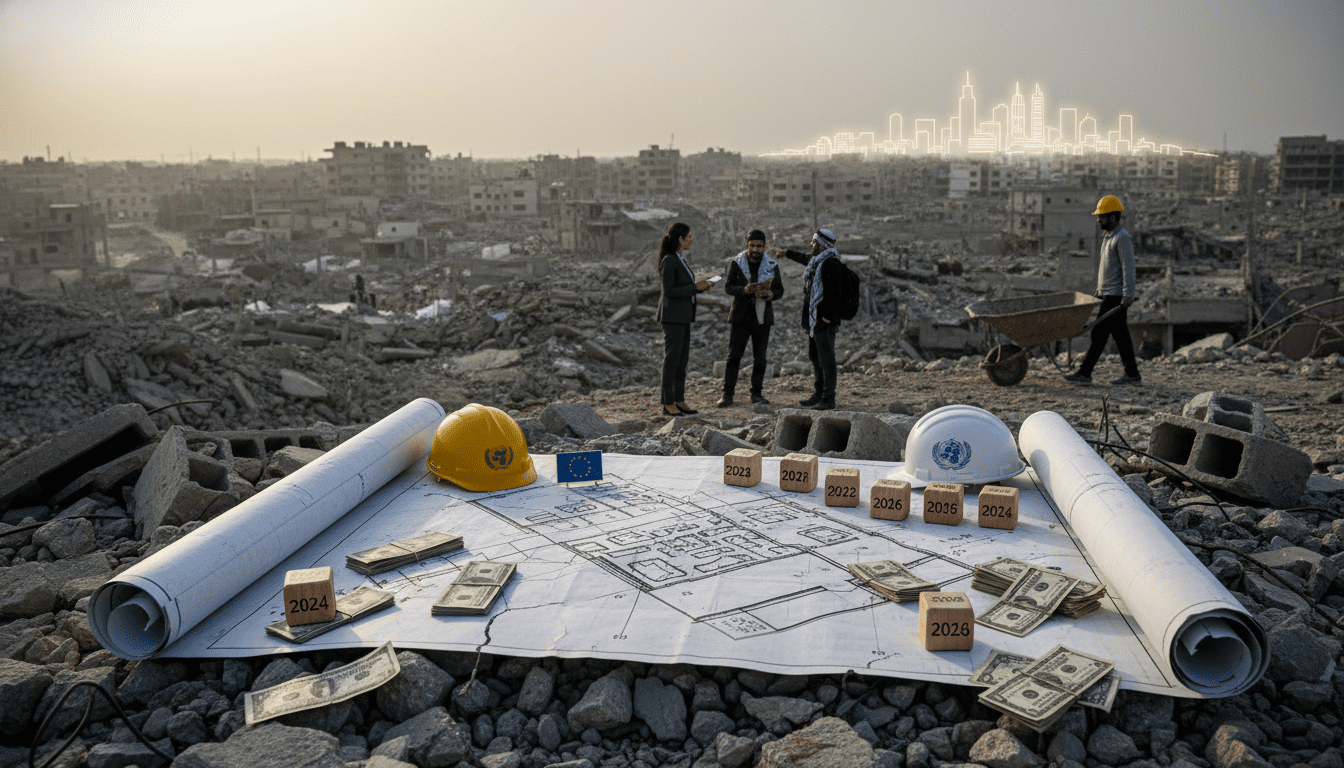
Rebuilding Gaza: UN-EU report says $71bn needed over 10 years
UN-EU report says $71bn will be needed to rebuild Gaza over 10 years; donors face political, financial and logistical barriers to restore essential services and homes.
The United Nations and the European Union published a joint assessment on 21 April 2026 estimating that roughly $71 billion will be required to rebuild Gaza over the next decade, with about one third of the total dedicated to restoring destroyed essential services. The report frames rebuilding Gaza as a long-term programme covering housing, health, water and power systems and urban infrastructure, and it raises urgent questions about who will provide and manage the funding. International agencies and local authorities face political and operational obstacles as they map out timelines and priorities for a battered enclave.
UN-EU estimate and proposed timeline
The joint UN-EU report sets a 10-year horizon for reconstruction, arguing that immediate relief must be matched with multi-year capital investment to stabilise Gaza’s economy and infrastructure. Officials behind the assessment stress that short-term humanitarian aid alone will not be sufficient to re-establish vital public services or to allow displaced families to return safely. The timeline anticipates phased reconstruction, beginning with utilities and essential health facilities, followed by housing, schools and wider economic recovery initiatives.
Cost breakdown and essential services priority
Approximately one third of the $71 billion—around $23.7 billion—has been earmarked for the urgent restoration of water, electricity, sanitation and healthcare systems destroyed during the recent conflict. The report highlights how damaged power plants, water networks and hospitals undermine both humanitarian relief and long-term recovery prospects. Rebuilding these systems is presented as a prerequisite for any wider reconstruction, since functioning services are necessary for shelter rehabilitation, education and private-sector revival.
Financing challenges and donor politics
Funding the $71 billion tab will require a complex mix of donor contributions, concessional finance, private investment and possibly multilateral lending, the report suggests, but it warns that political conditions and donor hesitancy could slow delivery. Contributors will need guarantees about project oversight, procurement transparency and security for workers and assets, while many potential donors are wary of political fallout. The report underscores the difficulty of securing pledges at the scale required without coordinated political commitments and credible governance arrangements on the ground.
Governance, coordination and accountability concerns
Experts in the panel discussion hosted by Adrian Finighan noted that reconstruction will hinge on robust governance structures able to coordinate hundreds of projects, manage funds and prevent corruption or diversion of resources. Sultan Barakat, a specialist in post-conflict reconstruction, emphasised the need for a clear institutional framework to channel aid and for capacity-building among municipal and national actors. The UN-EU assessment recommends a central coordination body and independent monitoring mechanisms to ensure that reconstruction meets international standards and serves civilian needs.
Perspectives from analysts and residents
Political analyst Xavier Abu Eid argued that political obstacles — including security arrangements and the status of borders and crossings — will shape which actors can participate in rebuilding Gaza. Economic analyst Raja Khalidi stressed the importance of aligning reconstruction with economic recovery plans so that investment promotes jobs and private-sector growth rather than dependence on aid. Ahmed Muin Abu Amsha, a Gaza-based music teacher who joined the discussion remotely, described the immediate human toll: families remain displaced, schools are damaged and everyday life depends on intermittent services, underscoring the urgency of starting practical repairs.
Operational hurdles: supply chains, labour and security
Beyond finance, the report and experts highlighted operational hurdles that could delay reconstruction, including restricted access for materials, shortages of skilled labour and the risk of renewed hostilities. Rebuilding large urban areas requires sustained imports of construction materials, safe transport corridors and protection for civilian workers and engineers. The assessment calls for donor support to include capacity-building, supply-chain planning and contingency measures to mitigate the risk of setbacks that would inflate costs and prolong displacement.
International actors have signalled varying levels of willingness to engage, but the report contends that no single government or institution can shoulder the cost alone. Successful rebuilding will likely require a coordinated donor conference, clear governance safeguards, and steps to create secure, predictable access for materials and personnel. The scale and complexity of the plan mean that timelines will be sensitive to both political decisions and conditions on the ground, and experts say early, targeted investments in services could unlock broader recovery efforts.
