
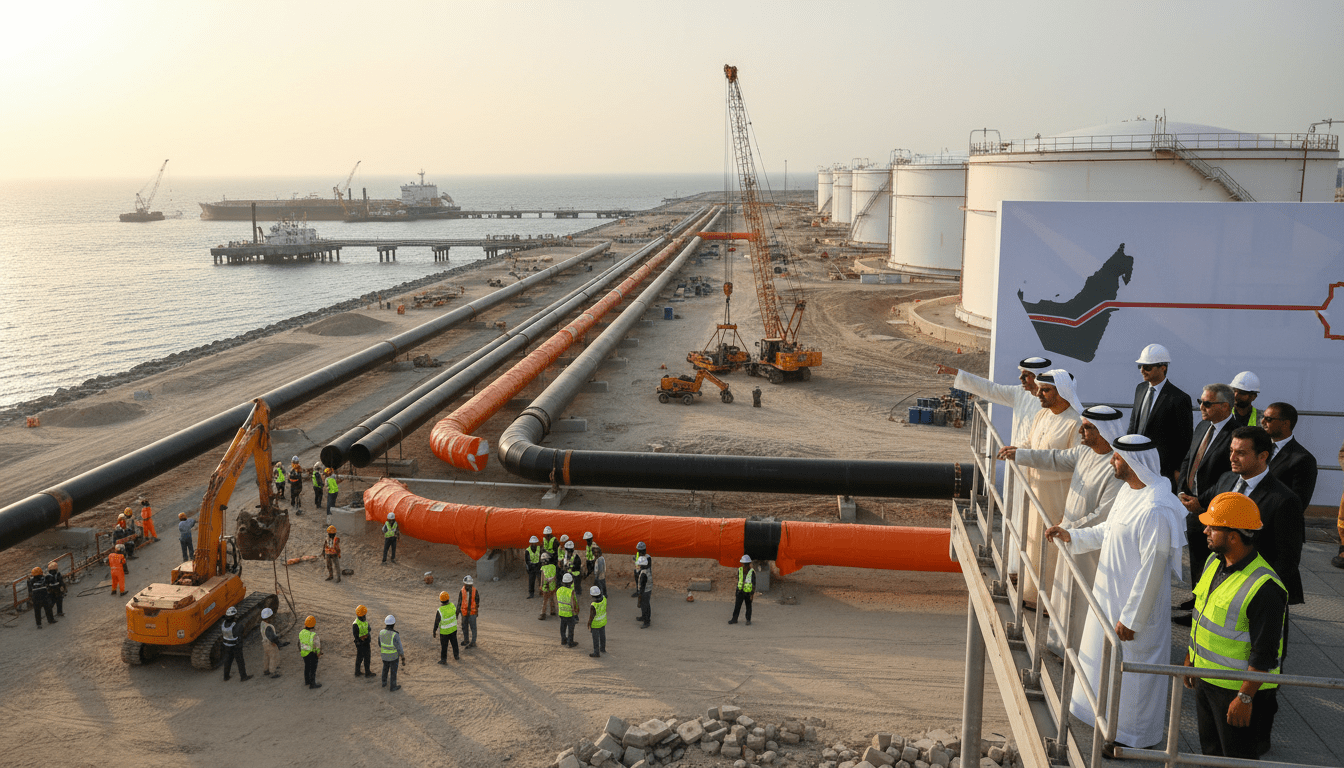
UAE Fast-Tracks West-East Pipeline to Double Fujairah Export Capacity by 2027
UAE accelerates the West-East Pipeline to double Fujairah export capacity by 2027, aiming to bypass the Strait of Hormuz amid heightened regional maritime tensions.
The United Arab Emirates announced on May 15, 2026, that it is fast-tracking the West-East Pipeline project to double export capacity through the eastern port of Fujairah, a move officials say will help meet global oil demand while reducing reliance on the Strait of Hormuz. The decision was unveiled by Crown Prince Sheikh Khaled bin Mohamed bin Zayed at an Abu Dhabi National Oil Company (ADNOC) executive meeting on Friday, May 15, 2026, with the government saying the pipeline should be operational by 2027. The acceleration underscores the UAE’s effort to protect export routes after a series of maritime incidents and new protocols in the Gulf shipping lanes.
Project announcement and timeline
Crown Prince Sheikh Khaled told the ADNOC meeting that the project’s acceleration is meant to “meet global demands,” signaling Abu Dhabi’s intent to bolster export flexibility. Abu Dhabi’s media office confirmed a 2027 operational target, and ADNOC officials said construction will be expedited across existing corridors to shorten delivery timelines. The company framed the work as part of a broader strategy to ensure continuity of supply for international markets while maintaining operational safety standards.
Construction plans will build on the existing Abu Dhabi Crude Oil Pipeline (ADCOP), which currently links Habshan to Fujairah. ADCOP, inaugurated in 2012, runs roughly 380 kilometres and has a throughput capacity of about 1.5 million barrels per day; the West-East Pipeline expansion aims to roughly double that export capability. ADNOC has indicated it will retain operational oversight to manage flows and integrate the new infrastructure into its global export planning.
Technical details and capacity impact
Officials have not released a full technical brief, but ADNOC’s announcement indicates the project will expand pipeline and port handling capacity at Fujairah to accommodate larger export volumes. Expanding throughput at Fujairah will require upgrades to storage, pumping stations and terminal berths to avoid bottlenecks as flows increase. ADNOC has historically balanced pipeline and tanker schedules to match refinery and shipping demand, and engineers say the new work will prioritize redundancy and resilience.
Doubling capacity through Fujairah would re-route a larger share of UAE crude away from the Strait of Hormuz, reducing transit risk for international buyers. That shift would also allow the UAE to quickly divert production in response to market signals or logistical disruptions elsewhere in the region. Energy market analysts say such diversification can ease price volatility by providing alternate physical trade routes for Middle Eastern crude.
Security drivers behind the shift
The drive to expand export routes follows repeated incidents and shifting protocols in the Strait of Hormuz that have disrupted shipping in recent months. Gulf states have cited a combination of attacks on infrastructure, new maritime rules introduced by Iran, and broader regional hostilities as factors motivating alternative corridors. The UAE and other producers have increasingly described route diversification as a strategic priority for energy security.
Fujairah itself has been targeted in recent attacks, underscoring the twin challenges of protecting onshore and offshore infrastructure. ADNOC and security agencies are coordinating risk assessments and protective measures around terminal facilities, while diplomatic channels continue to press for maritime safety assurances. The pipeline expansion is being positioned not just as an economic project but as part of a resilience package to safeguard exports.
Regional pipeline comparisons and precedent
The UAE’s move follows existing regional precedent: Saudi Arabia’s East-West pipeline, roughly 1,200 kilometres long from Abqaiq to the Red Sea port of Yanbu, was developed to bypass the Gulf and has been described by Saudi Aramco chief Amin Nasser as a “critical lifeline” for the kingdom. Oman’s long coastline outside the Strait of Hormuz also provides transit alternatives, while countries such as Kuwait, Iraq, Qatar and Bahrain remain more dependent on the waterway. The new UAE project will sit alongside these assets as part of a broader network of Red Sea and Gulf-facing export routes.
Analysts say the addition of more corridors increases regional export resilience but may also prompt strategic investments by buyers and insurers in alternative logistics. The net effect on global markets will depend on how quickly expanded capacity can be brought online and whether geopolitical tensions ease or intensify in the coming year.
Economic and diplomatic implications
Beyond immediate energy logistics, the pipeline acceleration carries economic and diplomatic signals. In April 2026 the UAE formally confirmed its departure from OPEC to pursue what officials described as a focus on national interests and an evolving energy profile. The pipeline initiative reinforces that strategic pivot, positioning Abu Dhabi to manage export flows independently while continuing to supply global markets. For customers, the promise of additional non-Hormuz capacity aims to reduce supply uncertainty and support long-term contracting.
Diplomatically, the move may ease pressure on partners relying on Gulf crude by offering alternative loading points, but it also highlights the persistent volatility in regional security that underpins energy planning. State and corporate players will likely use the project to underscore commitments to reliable supply, even as they engage in parallel talks on maritime safety and regional de-escalation.
The West-East Pipeline acceleration represents a calculated response by the UAE to a changed security and market environment, combining near-term construction urgency with a longer-term strategy to protect export capability and reassure international buyers.
