
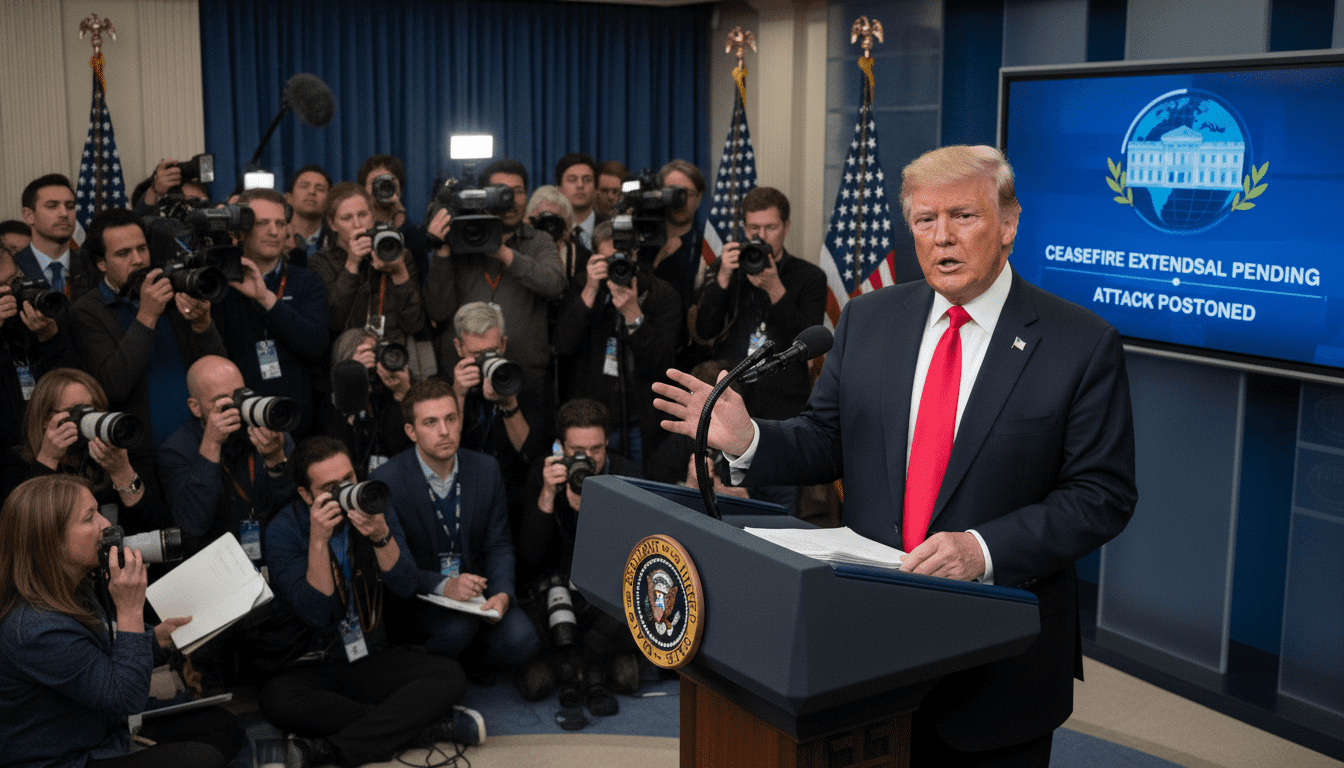
US extends ceasefire with Iran, delays planned strike to allow Tehran proposal
US extends ceasefire with Iran as Washington pauses a planned military strike at Pakistan’s request; talks hinge on Tehran’s proposal amid a naval blockade, raising risk.
The United States announced on Tuesday that it will extend a temporary ceasefire with Iran and delay a planned attack to give Tehran time to present a unified proposal to end the conflict. The move, called for by Pakistani mediators, keeps in place a naval blockade while Washington says its forces remain ready to act if talks fail. The announcement follows days of public disagreement in Washington and Tehran over the terms and scope of the truce. The extension preserves the fragile diplomatic window ahead of talks scheduled in Islamabad.
Presidential announcement and immediate impact
President Donald Trump said he had instructed the military to continue the blockade but to hold off on offensive operations until Iranian leaders submit a consolidated plan and discussions conclude. His statement, posted on social media, credited Pakistan’s Field Marshal Asim Munir and Prime Minister Shehbaz Sharif for requesting the pause. Earlier on Tuesday, Trump had warned that time was running out and had opposed an extension, making the reversal notable. The administration framed the delay as a conditional goodwill step aimed at salvaging negotiations.
Pakistan’s role and the Islamabad talks
Pakistani officials have positioned Islamabad as a mediator, arranging talks that were due to begin this week and now hang in the balance. Pakistan’s leaders reportedly urged the United States to withhold strikes to allow Iranian representatives to cohere behind a single negotiating position. Diplomats say Pakistan’s involvement reflects concerns about regional spillover and trade disruptions from the Strait of Hormuz being sealed. It remains unclear whether Tehran will commit to sending unified negotiators to the Pakistani-hosted sessions.
Tehran’s response and the blockade dispute
Iran did not immediately accept Trump’s characterization, with state-linked outlets saying an official position would be announced later. Tehran’s foreign minister, Abbas Araghchi, condemned the U.S. naval blockade as an “act of war” and a violation of the ceasefire, posting that Iran would defend its interests and resist coercion. Iranian reports also signaled reluctance to participate in talks so long as the maritime siege persists. International observers warn that the blockade complicates the diplomatic calculus and may hinder delegates from reaching agreement in Islamabad.
Contested claims about leadership unity in Tehran
The U.S. president argued that divisions within Iran’s leadership have slowed diplomatic progress and that a unified proposal could be forthcoming only after internal consolidation. Iranian and regional analysts disputed that portrayal, describing Tehran’s decision-making as more cohesive since the recent change in the supreme leadership. The country’s new leader, Mojtaba Khamenei, has not made a public appearance since his selection last month, and the Islamic Revolutionary Guard Corps remains a central actor in the conflict. Independent reporting from Tehran suggested the nucleus around the new leadership has longstanding ties to policy-making centres, casting doubt on the notion of a fractured hierarchy.
Key negotiating impasses: nuclear material and regional reach
At the heart of the talks are competing demands over Iran’s nuclear program, missile development and support for armed proxies in the region. Washington seeks a complete halt to Tehran’s nuclear activities and limits on missile production, along with curbs on backing for groups such as Hezbollah and Hamas. Iran has insisted on the right to enrich uranium for civilian purposes and rejected the removal of its existing stockpiles of highly enriched material. Tehran has also said it will not accept concessions that compromise its conventional military capabilities or its regional policies, leaving fundamental disagreements to be resolved in any negotiating text.
Military posture and the calculus of restraint
Despite the extension, U.S. forces will maintain a blockade and keep operations at a heightened level of readiness, the administration said. Officials framed the decision as calibrated pressure intended to compel Iran to negotiate, not as a withdrawal of military leverage. Analysts caution that the simultaneous maintenance of military pressure and diplomatic engagement can be unstable, especially when both sides dispute what constitutes a breach of the truce. The two-week ceasefire agreed on April 8 was already strained by disagreements over the inclusion of Lebanon in the truce and control of the Strait of Hormuz, and those unresolved points remain flashpoints.
The coming days are likely to determine whether a written Iranian proposal can be produced that satisfies mediators and allows talks in Islamabad to proceed. Tehran has publicly indicated it will announce its official stance in due course, while Washington has left the timing open-ended and linked any further action to the substance of Iran’s offer. For now, the extension keeps both diplomacy and deterrence on the table, even as regional tensions and the blockade sustain the risk of renewed hostilities.
