
London protests see tens of thousands as rival far-right and Nakba Day rallies converge
Rival London protests drew tens of thousands as Tommy Robinson’s march coincided with Nakba Day pro‑Palestinian rallies, prompting a major police deployment.
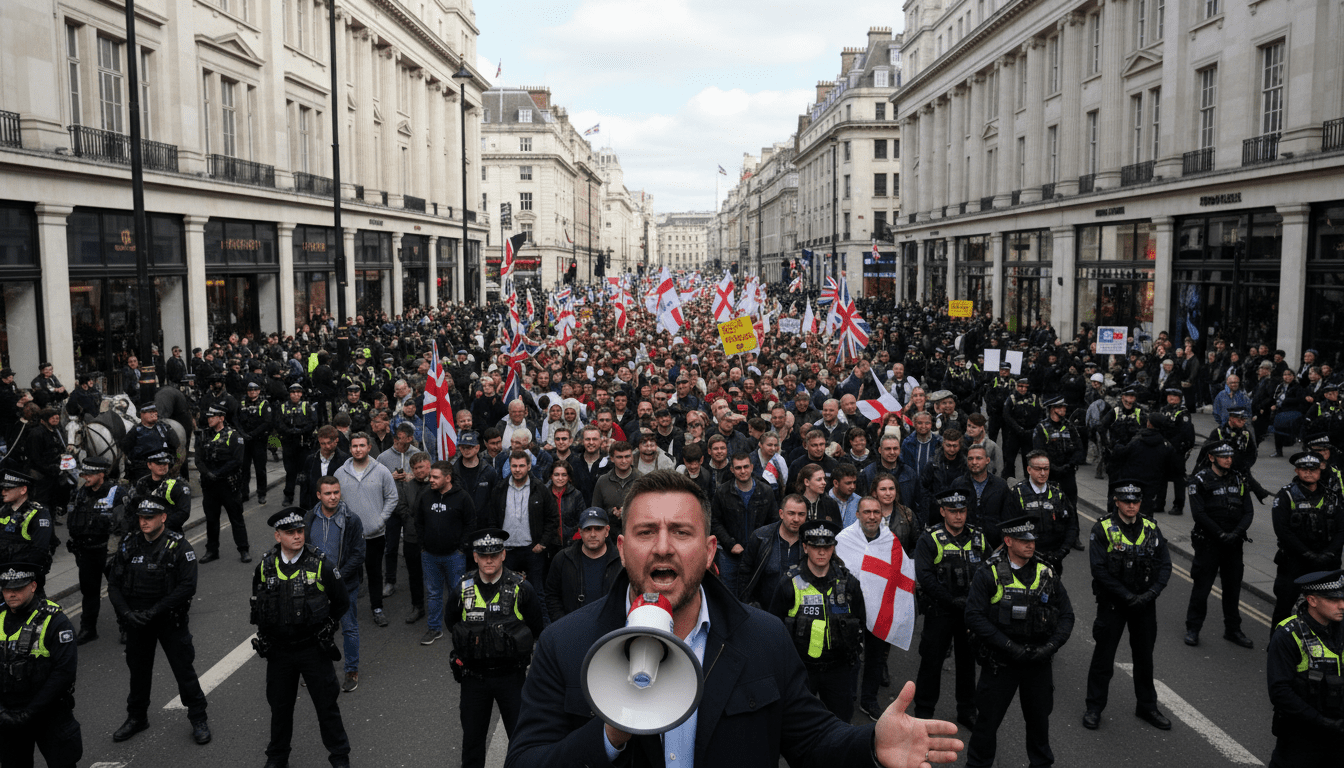
The capital was the scene of large-scale unrest on Saturday as competing demonstrations converged in central London, with the keyword “London protests” marking the public attention. Authorities reported more than 60,000 people joined a far-right “Unite the Kingdom” rally while roughly 20,000 attended a Nakba Day march, and both events moved through busy city districts. Police said the gatherings remained largely peaceful into the evening, but significant resources were committed to prevent clashes and disorder.
Mass turnout at far-right Unite the Kingdom march
The far-right demonstration, led by activist Tommy Robinson, attracted a diverse turnout that included older people, women and families, according to eyewitness accounts and police tallies. Organizers billed the event as a nationalist rally against migration and other policies, and marchers carried signs referencing a campaign to stop Channel crossings. The scale of the turnout recalled a previous Unite the Kingdom march last September that drew more than 100,000 people and saw violent confrontations with officers.
Concurrent Nakba Day demonstration draws thousands
A separate pro‑Palestinian march marking Nakba Day brought an estimated 20,000 participants who assembled in Kensington and marched toward central London. Demonstrators raised slogans critical of far-right groups and chanted messages rejecting racism, with many using the event to highlight the historical grievances commemorated on Nakba Day. The timing and route of the two rallies created a potential for friction, prompting advance planning from authorities and community leaders.
Metropolitan Police deploys unprecedented resources
Scotland Yard said it deployed about 4,000 officers to manage the events, describing the operation as “unprecedented” in scale for a single day of public order policing. Mounted units, dog teams, drones and a police helicopter were all on patrol to monitor crowds and to respond quickly to any flashpoints. The force also said it used camera systems equipped with facial recognition capability for the first time during such an operation, a move likely to raise questions about surveillance and civil liberties.
Arrests, security tech and policing costs
By early evening the Metropolitan Police reported 31 arrests across both demonstrations, with charges spanning public order offences and related incidents. The policing operation carried a high financial cost; officials estimated deployment expenses at up to £4.5 million, roughly €5.16 million. Senior officers emphasized that the scale and variety of tactics — from aerial observation to analytics — were intended to keep the rallies peaceful and protect bystanders and property.
Political leaders warn and courts prepare
Justice Secretary David Lammy publicly criticized the organizers of the Unite the Kingdom march on social media platform X, accusing them of stoking division and hate. He warned that should violence break out, government and judicial systems would act swiftly, and extra judicial capacity was being readied in anticipation of prosecutions. Political figures across the spectrum appealed for calm and urged protesters on both sides to avoid provocations that could escalate into clashes.
Participants’ messages and city response
Placards at the far-right rally often carried anti-immigration slogans such as “Stop the Boats,” referencing migrant crossings of the English Channel, while counter-demonstrators chanted “Smash the Far Right” and other anti-racism slogans. Local businesses and Transport for London adjusted services in parts of central London to cope with road closures and large crowds, and officials issued guidance encouraging commuters and residents to avoid affected routes where possible. Community groups and faith leaders called for peaceful expression and urged participants to respect one another’s right to protest.
Tensions in the capital on Saturday underscored the challenges of policing simultaneous, ideologically opposed demonstrations in a major city. While the day passed without the scale of violence seen at some past gatherings, the heavy security footprint, the use of advanced surveillance tools and the financial cost of policing are likely to prompt further debate about how such events are managed.
