
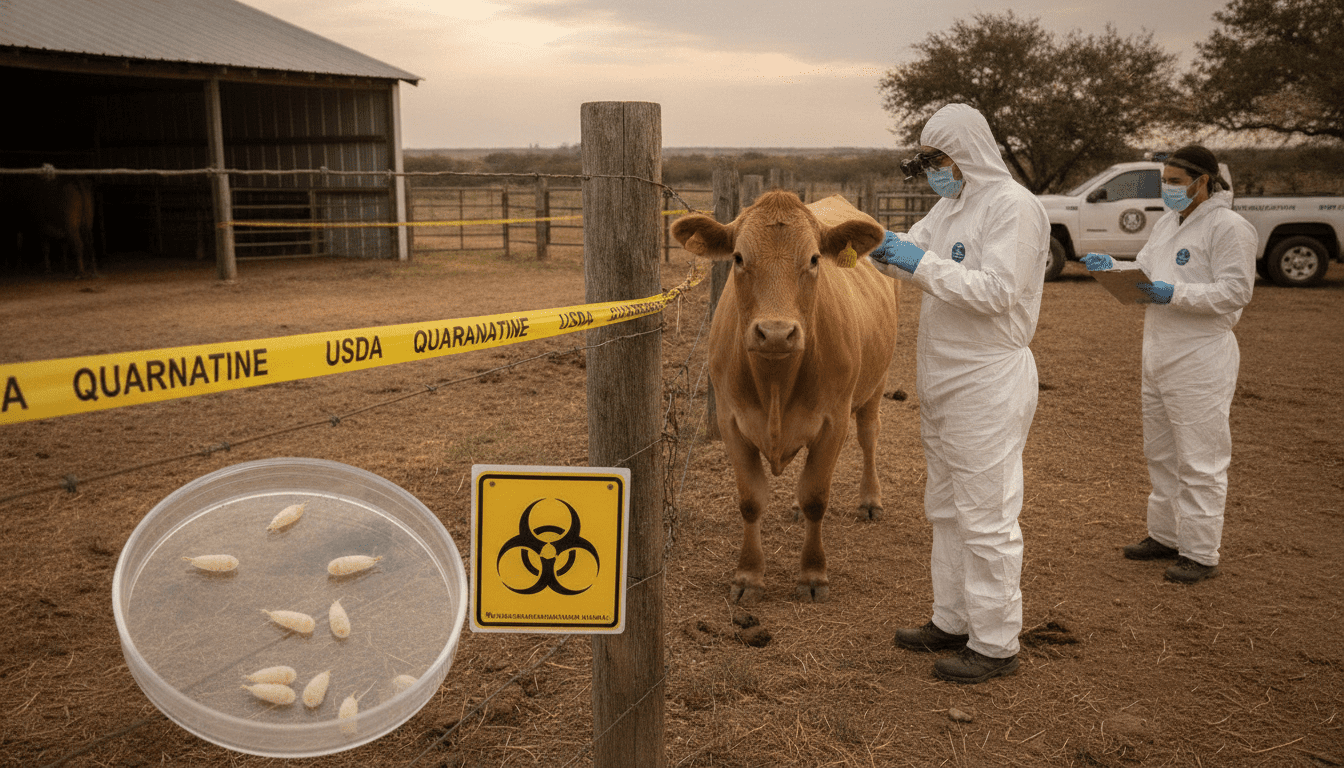
Screwworm fly found in Texas as USDA ramps up sterile-release and quarantines
Screwworm fly found in Texas; USDA confirms cases and expands sterile-release, quarantines and import bans as ranchers and markets brace for supply shocks.
The United States Department of Agriculture has confirmed the presence of the screwworm fly in Texas, detecting the parasitic larvae on two calves and setting off an urgent containment campaign. The screwworm fly, a species whose larvae burrow into the flesh of wounded mammals, was eradicated from North America in the 1960s but has reappeared after recent detections in Central America and Mexico. Authorities have established a 20-kilometre control zone, quarantined herds, and begun massive releases of sterilized male flies in an effort to prevent a wider outbreak.
USDA confirmation and initial cases
The USDA announced laboratory-confirmed screwworm fly infestations in two calves located in Texas, prompting immediate action by federal and state agencies. Officials said the findings followed surveillance following earlier regional reports of the parasite in Guatemala and Mexico. Agriculture Secretary Brooke Rollins told a House committee that officials are treating each detection as isolated while deploying containment resources to prevent further spread.
The screwworm fly’s detection in the United States comes after the species was observed moving northward over recent years, crossing difficult terrain such as the Darién Gap and establishing footholds in parts of Central America. Veterinary teams have increased inspections of cattle wounds and are working with ranchers to report suspicious lesions and maintain strict biosecurity on farms.
Biology of the pest and risk to livestock
The screwworm fly lays eggs in open wounds on mammals; the hatched larvae feed on living tissue, often causing severe injury or death from infection. Female flies can deposit hundreds of eggs on a single wound, and the feeding larvae—known as screwworms—tunnel into flesh in a spiral pattern that gives the species its common name. Cattle are particularly vulnerable, and untreated infestations can decimate individual animals and, in severe outbreaks, entire herds.
Veterinary specialists warn that modern intensive livestock operations can magnify transmission risk if wounds are not identified and treated promptly. In addition to direct animal suffering, secondary infections and the need for intensive veterinary care raise both animal welfare and economic concerns for producers.
Sterile-release strategy revived
Authorities have reverted to the sterilized-male release strategy that successfully eliminated screwworm fly populations from North America in the 1960s. The approach involves rearing large numbers of male flies, sterilizing them—typically by irradiation—and releasing them so they mate with wild females but produce no offspring. Historic campaigns reduced the parasite’s population to zero across the United States, Mexico and Central America.
Currently, production capacity is limited to a facility run jointly by the USDA and Panama’s agriculture ministry that supplies roughly 100 million sterile flies per week. Officials have been releasing millions of sterile males both from the ground and by aircraft since February as part of an accelerated response to the Texas detections.
Capacity shortfalls and new production efforts
Officials acknowledge a gap between existing sterile-fly output and the levels once achieved during the eradication era, when multiple rearing facilities operated across the Americas. The USDA is restarting a dormant production plant in Texas with a target capacity of 300 million sterile flies per week once construction and commissioning are complete. State officials, including Governor Greg Abbott, have urged faster completion to reduce the scale and duration of any outbreak.
While the Texas facility is under renovation, logistical and staffing challenges limit immediate expansion. In the short term, authorities are supplementing releases with the Panama facility’s output and prioritizing releases within the established control zone.
Trade measures and effects on cattle movement
In response to the detections, Canada has imposed an import ban on cattle from affected regions, and U.S. authorities have tightened restrictions on imports of calves from Mexico. Before the trade restrictions, Mexican producers exported roughly one million weaned calves annually to U.S. finishing operations along the border, a supply stream that has been disrupted. The interruption has strained smaller U.S. feedlots and regional slaughterhouses that relied on regular Mexican shipments.
Mexican producers have adjusted by expanding domestic finishing operations and increasing slaughter capacity for export, shifting some trade flows as North American markets adapt. Regulators have emphasized that trade measures are tailored to reduce cross-border disease spread while allowing unaffected commerce where biosecurity can be guaranteed.
Market impacts and outlook for beef prices
The reappearance of the screwworm fly arrives amid an already-tight U.S. cattle herd, the smallest in decades, which has left supply sensitive to additional losses. Retail beef prices have climbed substantially over recent years; current averages for a pound of steak are significantly higher than pre-pandemic levels. Analysts warn that localized losses, prolonged quarantine zones or extended trade restrictions could further tighten supplies and perpetuate price pressures in wholesale and retail markets.
Industry groups and economists note that rapid containment would limit the economic fallout, but prolonged control efforts or expanded geographic spread would raise production costs for ranchers and potentially accelerate price increases for consumers. Contingency measures, including targeted culling and emergency vaccination where applicable, are being evaluated alongside the sterile-release campaign.
The coming months will test the effectiveness of the multi-pronged response, with agency surveillance, farmer cooperation and the ramp-up of sterile-fly production central to preventing a larger crisis. Efforts now focus on isolating confirmed cases, protecting uninfected herds, and restoring production capacity so the screwworm fly can be suppressed before it re-establishes a breeding population in U.S. livestock.
