
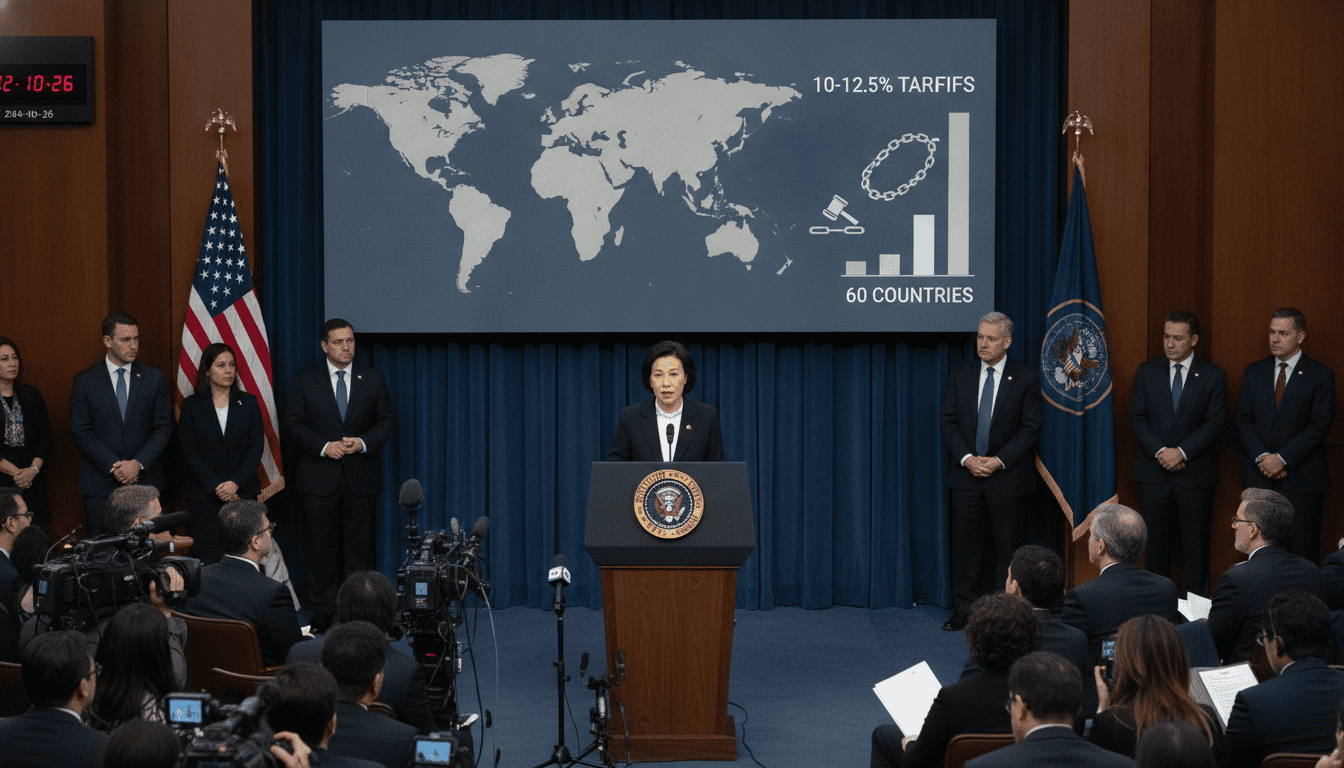
Trump announces new tariffs of 10% and 12.5% on imports from 60 trading partners
Trump unveils 10% and 12.5% tariffs on imports from 60 partners, citing forced-labor concerns under Section 301, prompting trade and diplomatic uncertainty.
The White House announced that President Trump will impose new tariffs of 10 percent and 12.5 percent on imports from 60 trading partners, a move the administration says targets goods linked to forced labor and affects more than 99 percent of U.S. imports. The announcement frames the measure as a response to inadequate enforcement by foreign governments of prohibitions on goods produced with forced labor and invokes Section 301 of a 1974 trade law as the statutory basis. The decision follows legal setbacks for prior tariff packages and comes as Washington seeks to maintain a tough trade posture.
White House outlines scope and rates
The administration said the 10 percent tariff will apply to countries that have committed to enforce import bans on goods produced with forced labor, while a 12.5 percent rate will apply to nations without such commitments. Officials described the list as encompassing roughly 60 trade partners responsible for over 99 percent of U.S. import volume. The move was presented as calibrated rather than blanket, with officials signaling that many existing targeted duties would remain in place.
Legal switch to Section 301 cited as stronger basis
The White House cited Section 301 of the Trade Act of 1974 as the legal authority for the new duties, arguing it is a more durable basis than emergency powers used earlier. Administration spokespeople and the U.S. trade representative had warned since June that the government would pursue alternative statutory routes after courts struck down earlier measures. The administration emphasized that Section 301 has precedent in prior trade actions and is less vulnerable to successful constitutional challenge.
Background of expiring and overturned tariffs
The new tariffs effectively replace 10 percent duties that were imposed in February under a different statutory rationale and set to expire at the end of the administration’s 150 day limit. Earlier this year the Supreme Court declared a separate set of emergency-based tariffs invalid, prompting the administration to reverse course and to refund affected importers. The government said it had returned more than 70 billion dollars to companies by the end of June as it unwound the prior measures.
Exemptions and covered goods explained
Announcing the plan, officials said certain categories will be exempt from the new levies, including goods already subject to other specific tariffs such as automobiles, steel and aluminum. Exemptions will also cover scarce raw materials and products not manufactured domestically, according to the guidance released by the administration. The limited carve outs are intended to reduce disruption to critical supply chains while preserving the broader pressure campaign.
U.S. trade officials defend forced labor rationale
U.S. Trade Representative Jamieson Greer and other administration officials framed the tariffs as a tool to eliminate modern slavery from global supply chains and to compel partners to take effective action. Greer told Congress this week that while the legal mechanisms have shifted, the overall trade strategy remains focused on reindustrialization, supporting American workers and narrowing the trade deficit. The administration argues that targeted duties tied to forced labor enforcement are a legitimate response to what it calls systemic enforcement failures abroad.
Economic and diplomatic implications
Economists and trade experts warn the tariffs could prompt retaliation and complicate negotiations with key allies, including members of the European Union that are explicitly within the affected group. Importers and manufacturers warn the duties may raise costs for U.S. businesses and consumers while prompting shifts in global supply chains. Policymakers in Europe and Asia will face pressure to respond, either through reciprocal measures or by accelerating enforcement and certification of supply chain practices.
The new tariff package underscores that tariffs remain a central pillar of the administration’s trade policy despite prior legal defeats, and signals a willingness to cycle through statutory authorities to maintain trade pressure. Market participants and diplomatic interlocutors will watch Washington’s next steps closely as implementation details and lists of covered products are finalized.
