
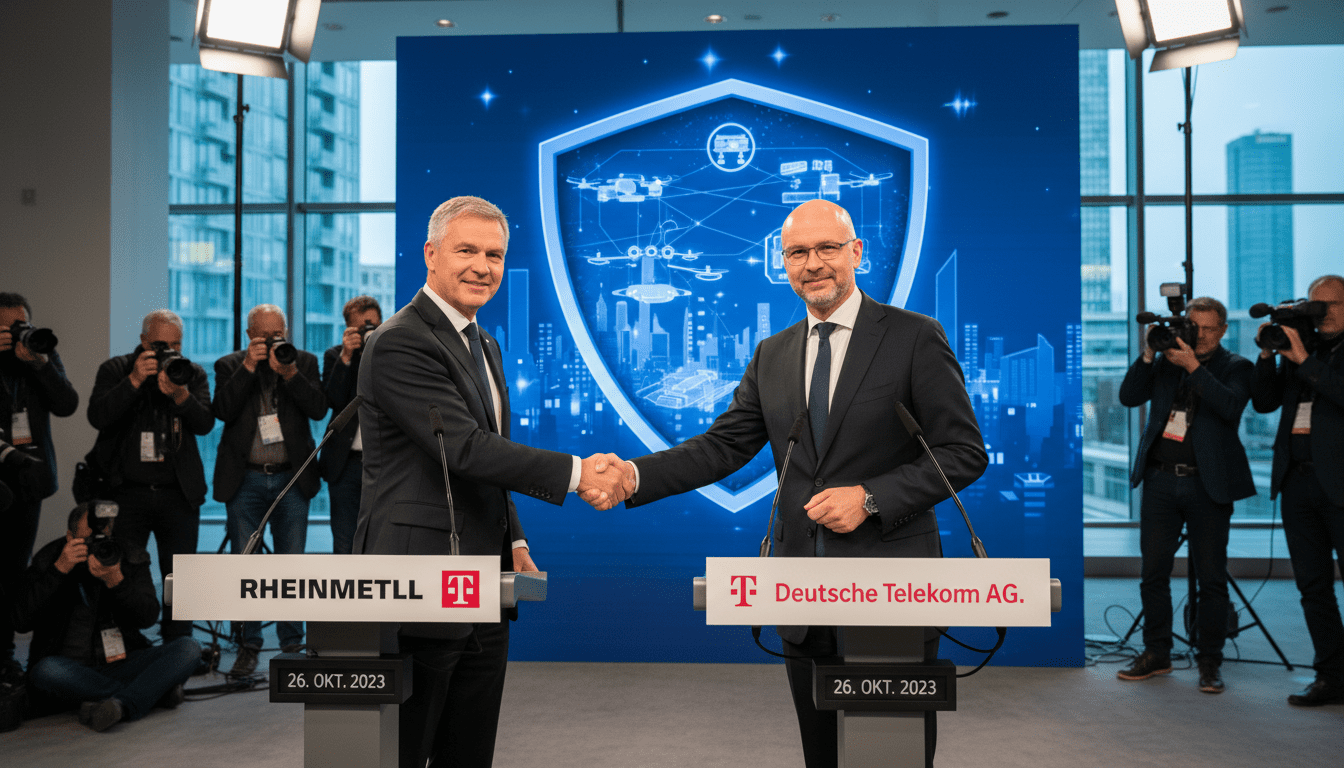
Rheinmetall and Deutsche Telekom to Build National Drone Defense Shield
Rheinmetall and Deutsche Telekom partner to develop a drone defense shield to protect airports and critical infrastructure amid rising unmanned aircraft incidents.
Rheinmetall and Deutsche Telekom announced a joint effort to develop an integrated drone defense system aimed at protecting airports and other sensitive sites from incursions by unmanned aerial vehicles. The partnership brings together a major defence manufacturer and the country’s largest network operator to address gaps in drone defense capability and to offer a scalable shield for critical infrastructure.
Rheinmetall and Deutsche Telekom Join Forces on a Drone Defense Shield
The collaboration pairs Rheinmetall’s experience in military hardware and security systems with Deutsche Telekom’s control over nationwide mobile networks and signal management. Officials said combining these competencies will speed development of countermeasures for drones that exploit civilian mobile links for navigation and control.
Industry observers note the alliance signals a broader shift as commercial telecoms move into security sectors once dominated by defence contractors. The project aims to provide layered protection that integrates detection, electronic disruption, and kinetic or non-kinetic interception tools.
Surge in Drone Sightings Around Airports and Plants
Recent years have seen repeated sightings of drones near runways, chemical plants, ports and power stations, prompting temporary shutdowns and public concern. Even small, low-cost unmanned aircraft can force costly interruptions and raise questions about espionage or deliberate disruption.
Those incidents have made clear that detection is often straightforward but timely and proportionate response is not. Governments and operators increasingly demand systems that not only spot intrusions but also neutralize threats without causing wider safety problems.
Detection Is Easier Than Interception
Detecting a drone with radar, acoustic sensors or radio-frequency systems can be relatively simple, but taking it down is far more complex. Effective drone defense requires a suite of tools such as jammers, interceptor drones, directed-energy systems and precision guidance to avoid collateral damage.
Networked attacks or drones using encrypted or satellite links complicate the picture further. Telekom’s network capabilities are expected to play a role in identifying control channels and enabling targeted electronic countermeasures against threats that rely on mobile infrastructure.
Regulatory and Authorization Challenges for Countermeasures
Legal authority to disable or capture airborne devices remains a major hurdle for operators and municipalities. Rules that govern the use of jamming equipment, the deployment of interceptor drones, and the employment of lasers are tightly constrained in many jurisdictions to protect aviation and communications.
That regulatory environment has contributed to frustration among businesses responsible for critical sites, who sometimes lack clear permissions or trained capacity to act quickly. The new partnership intends to engage regulators early to shape frameworks for controlled, lawful deployment of countermeasures.
Economic Opportunities and the Rise of Defence as Civilian Business
As states increase spending on resilience and sovereignty, defence-related contracts are becoming attractive to a wider range of industries. Telekom’s move into drone defense reflects the commercial potential of supplying protective services and technologies to both public agencies and private operators.
For Rheinmetall, teaming with a telecom partner offers access to sensor networks and data analytics that can improve detection fidelity. The strategic alliance therefore illustrates how national security concerns are reshaping market opportunities across sectors.
Competition and the Wider Market Response
A growing number of specialist firms already sell drone mitigation solutions, meaning scale and brand alone will not guarantee commercial success. Buyers of drone defense systems will prioritize proven integration, legal compliance and low-risk methods that preserve safety around populated or critical areas.
The Rheinmetall–Telekom venture will face scrutiny from rivals and customers who demand interoperability and clear rules of engagement. Success will depend on demonstrating that combined military-grade technology and civilian networks can deliver reliable, proportionate responses.
Authorities and Operators Seek Clear Protocols
Airports, utilities and industrial operators have been vocal about the need for standard operating procedures when drones are detected. Coordinated protocols that define who can act, which tools may be used, and how to minimise disruption are essential to effective drone defense.
The new partnership has the opportunity to develop operational playbooks and training programs alongside hardware and software, addressing practical questions that have frustrated defenders in recent incidents.
The collaboration between Rheinmetall and Deutsche Telekom underscores a growing recognition that defending critical infrastructure against unmanned threats will require cross-sector solutions, legal clarity and a mix of technological approaches. As work progresses, regulators and end users will be watching for systems that can reliably detect and neutralize hostile drones while preserving public safety and communications integrity.
